

Mir Altaf
Every generation receives the Republic not as a finished achievement but as an ongoing responsibility. Each must leave it stronger, fairer and more compassionate than it inherited.
Every year on the morning of August 15, India awakens to a familiar sight. The Tricolour goes up on government buildings, schools and homes. Patriotic songs fill the air, children march in neat rows, sweets are distributed and the Prime Minister addresses the nation from the Red Fort. For a few hours, a country of more than a billion people pauses to remember how its freedom was won.
But perhaps the more important question begins when the ceremony ends. What becomes of patriotism after the flags are folded? What does freedom ask of us on the morning of August 16, when the songs have stopped and life returns to its ordinary rhythm?
As India completes 79 years of Independence, these questions deserve to be asked as seriously as we celebrate the occasion. Political freedom was won in 1947 through extraordinary courage and sacrifice. Preserving, deepening and passing that freedom on to the next generation is the quieter responsibility that falls upon us. Independence was a historic achievement. Living up to its promise is a daily discipline.
The freedom movement sought more than the departure of a colonial power. Its larger aspiration was to build a country in which freedom had meaning for the ordinary citizen, in which law stood above arbitrary power, equality was not determined by birth, and India’s immense diversity could coexist within a common national identity. The Constitution gave institutional shape to many of those aspirations.
But no Constitution, however carefully written, can by itself guarantee the quality of a democracy. That ultimately depends upon the people who live under it.
A free society needs citizens who understand that rights and responsibilities are not competing ideas. They are two sides of the same bargain. We cannot demand freedom for ourselves while being indifferent to the freedom of others. We cannot celebrate democracy while refusing to tolerate disagreement. And we cannot speak of national interest while treating public property, public institutions and public resources as somebody else’s responsibility. This is where freedom becomes a discipline.
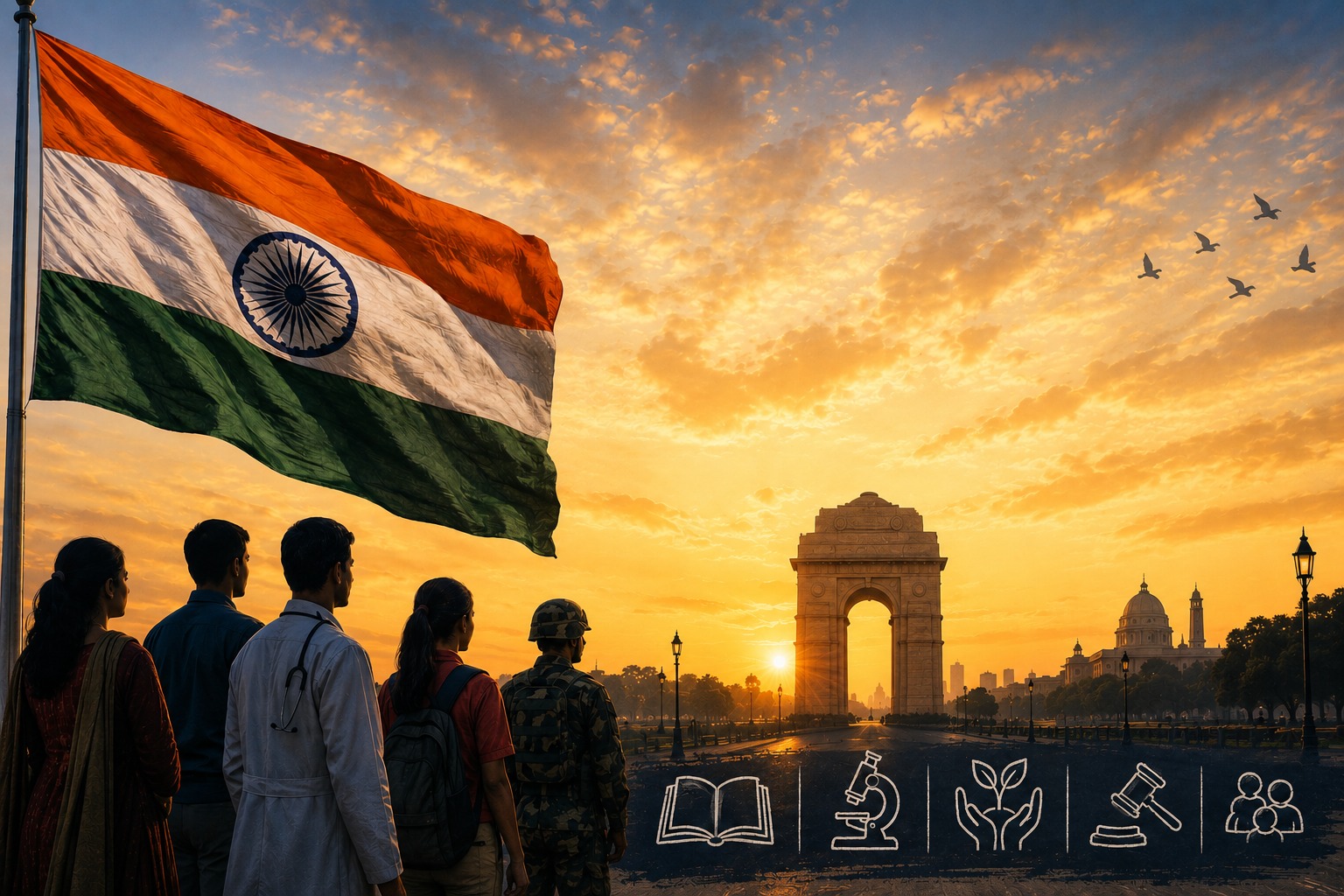
Much of nation-building, after all, is remarkably ordinary. It happens in a classroom where a teacher persuades a child not to give up on a difficult subject. It happens in a hospital where a doctor treats a poor patient with the same dignity as anyone else. It happens in a laboratory where a scientist spends years pursuing an idea whose value may not be visible today. It happens on a farm, in a factory, in a workshop and behind the wheel of a bus. It happens when a sanitation worker does a job most people notice only when it is not done.
It happens, too, at India’s distant frontiers, where soldiers stand watch while the rest of the country sleeps. None of these acts is usually described as patriotism. Perhaps we should begin to do so.
Patriotism is often at its easiest when it is expressed through symbols. The National Flag, the National Anthem and the rituals of Independence Day matter because they connect us to a shared history. But symbols derive their meaning from the values they represent. Respect for the flag means little if we have no respect for the citizen standing beside us. Singing the National Anthem has deeper meaning when we are equally committed to the dignity and freedom of our fellow citizens.
The real test of patriotism, therefore, may not be how loudly we proclaim our love for the country, but what we are prepared to contribute to it when nobody is watching.
India’s challenges today are, in many ways, very different from those of 1947. But neither is India the country it was in 1947. It is a young and ambitious nation with an expanding economy, a formidable scientific and technological base, a vibrant democratic culture and an increasingly confident place in the world. Its greatest asset, however, remains something less tangible: the ability of people with remarkably different histories, languages, faiths and ways of life to imagine themselves as part of the same national story.
India has never been held together by uniformity. Its unity has always been more complicated and more remarkable than that. From the Himalayas to Kanyakumari, from the deserts of Rajasthan to the valleys of Kashmir, from the great metropolitan centres to remote tribal settlements, the Indian experience has been one of learning to share a national space without becoming identical. That idea of India deserves careful protection.
For India’s young people, Independence Day should therefore be more than an annual reminder of something they did not personally experience. Most Indians under a certain age have known freedom only as an inherited fact. They did not see the Union Jack come down. They did not experience Partition. They did not witness the first sunrise of independent India.
That distance from history is natural. But it places a different responsibility on them.
The patriotism of the twenty-first century will increasingly be expressed through competence, character and contribution. A student who pursues knowledge seriously, an entrepreneur who creates employment, a scientist who solves a difficult problem, a citizen who refuses to spread a falsehood, a public servant who does not misuse authority and a volunteer who helps a stranger in distress are all participating in the unfinished work of nation-building.
The freedom fighters could win political independence. They could not build the India of 2026. That was never their task alone. Every generation receives the Republic for a while. It inherits its institutions, its freedoms, its contradictions and its unfinished work. Then it must decide what to do with them.
This is perhaps the most useful way to think about Independence as India moves towards 2047. The question is not simply what kind of economy we will have, how advanced our technology will be or how powerful India will become. Those things matter. But another question matters just as much: what kind of citizens will we be when that India arrives?
A prosperous country can be built with capital and technology. A strong country needs institutions. But a truly confident Republic requires something more difficult to manufacture: civic character. It requires the habit of telling the truth when a lie is convenient. It requires respecting the law even when breaking it seems easier. It requires protecting a public institution even when we believe nobody is watching. It requires allowing another person to disagree with us without turning that disagreement into hatred. It requires giving a child in a remote village a chance to dream as freely as a child in a metropolitan city. And it requires remembering that the country does not exist somewhere above us. It exists in the choices we make every day.
The most fitting tribute to those who secured India’s freedom, therefore, is neither nostalgia nor rhetoric. It is to make freedom meaningful in ordinary life: to strengthen institutions, educate children, respect differences, serve honestly and leave behind a country in which the next generation has at least as much reason to believe in India as we do.
The Tricolour will rise again on August 15. The speeches will end. The crowds will disperse. The flags will eventually come down. But the responsibility they symbolise will remain. Because freedom was won in a defining moment of history.
Comments are closed.