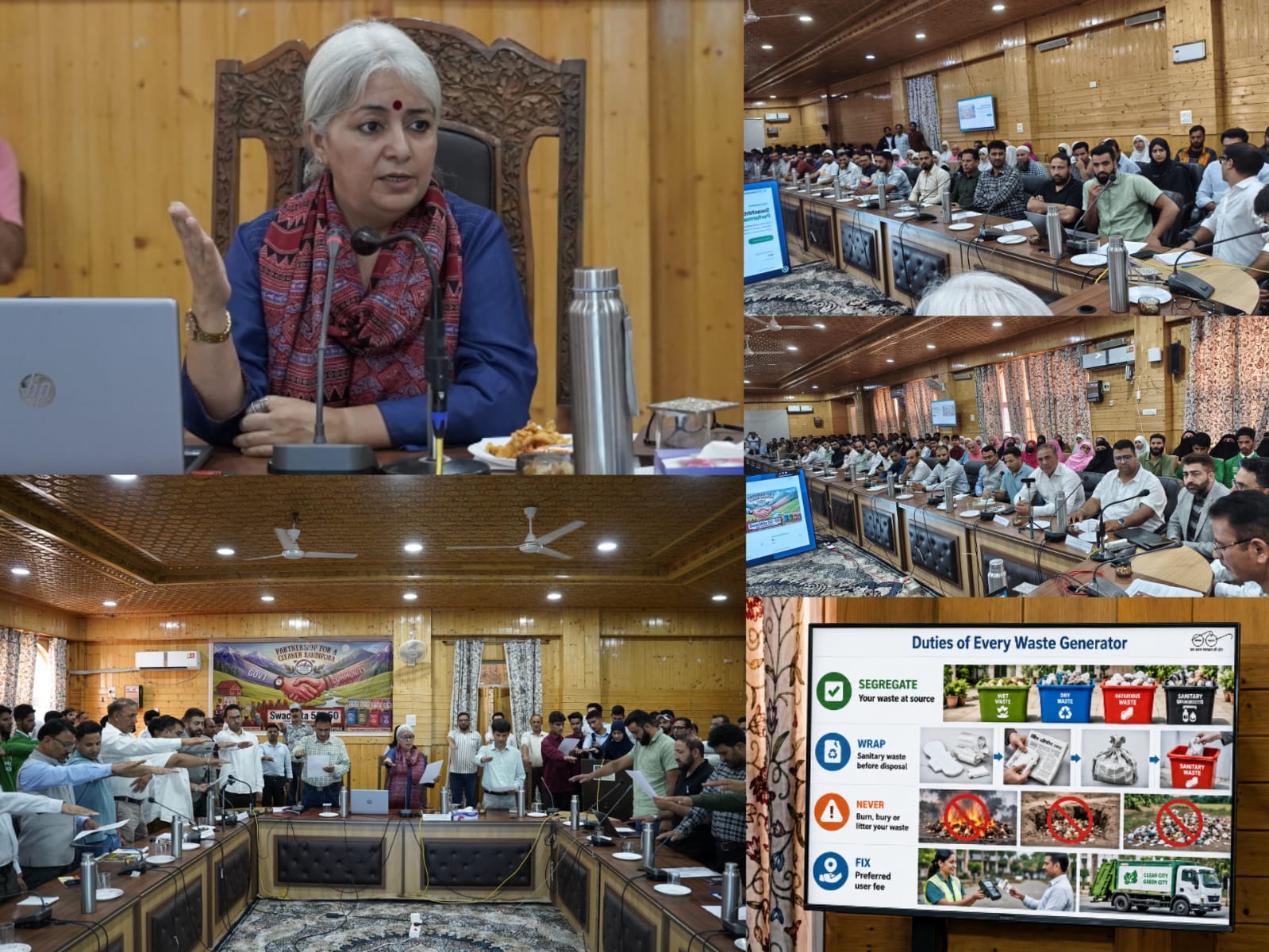
BANDIPORA, JULY 31: Deputy Commissioner Bandipora, Indu Kanwal Chib, today chaired the district-level convention marking the formal launch of the “Swachhta 50-50” initiative, a flagship campaign of the District Administration based on the principle of 50% Government and 50% Public participation for effective and sustainable solid waste management across the district, at the Conference Hall, Mini Secretariat Bandipora.
The convention witnessed participation of Additional District Development Commissioner Bandipora, Nazir Ahmad Mir; PO ICDS Bandipora, Yaar Ali Khan; ACP Bandipora, Aijaz Ahmad; Chief Education Officer Bandipora; District Information Officer; Block Development Officers, and other stakeholders.
The programme commenced with the National Anthem, followed by the Swachhta Pledge, which was administered by the students of Government Higher Secondary School Quilmuqam.
Addressing the gathering, the Deputy Commissioner said that Swachhta 50-50 is a people’s movement based on shared responsibility and called upon every stakeholder to work wholeheartedly to make the initiative a success. She said that the District Administration had already taken three major steps towards scientific waste management and that Swachhta 50-50 marked the fourth step in this direction.
Highlighting the implementation strategy, the Deputy Commissioner announced that after a one-month handholding period, Bulk Waste Generators (BWGs) would be required to scientifically manage their own waste in accordance with the Solid Waste Management Rules, while the District Administration would continue to provide all necessary technical support and guidance. She said that 89 identified BWGs in the district account for a major share of waste generation and would be brought under this mechanism.
She further informed that exhibitions would be organised to demonstrate scientific waste management practices and clarified that any issues relating to implementation in rural areas would be addressed through the Assistant Commissioner Panchayat, while concerns in urban areas would be handled by the concerned Municipal Committees.
The Deputy Commissioner also informed that the District Administration had successfully conducted an Extended Producer Responsibility (EPR) initiative in Gurez, where 11 companies participated. Of these, three companies accepted the proposals, while the remaining companies were closely monitoring the district’s waste management efforts and were expected to take a decision in the coming weeks. She reiterated that the responsibility for collection and disposal of single-use plastic (SUP) rests with the producers under the EPR framework.
She said that a dedicated coordination group had been constituted to ensure sustained implementation of the initiative and informed that the District Administration had also developed the dedicated portal Swachhta 50-50 in for monitoring and management of the programme.
Emphasising the role of institutions, the Deputy Commissioner said that every school and every Anganwadi Centre would adopt 50 households on a long-term basis. She said that students would sensitise their parents while teachers would certify installation of separate dustbins in their own households, setting an example for the community. She also stressed the need for greater participation of male members of society in household waste management.
The Deputy Commissioner identified four key household responsibilities under the initiative, including installation of separate dustbins for source segregation, home composting of wet waste, payment of user fee and adoption of cloth bags to eliminate the use of single-use plastic.
The Deputy Commissioner directed that work under the initiative should begin in schools from Monday and called upon stakeholders to actively sensitise shopkeepers regarding the use of cloth bags.
During the convention, Dr. Saptak Rarotra from SWAAHA Resources Management Pvt.Ltd. demonstrated the functioning of the Swachhta 50-50 digital platform, explaining features including the dashboard, organisation mapping, household allocation, household adoption, baseline survey, QR code generation and monitoring system designed to track implementation across the district.
The programme also featured technical sessions on scientific waste management. Tabrez Madni, Capacity Building Expert, Housing and Urban Development Department, appreciated the sustained efforts of Deputy Commissioner Bandipora in strengthening waste management systems and delivered a detailed presentation on scientific solid waste management. He elaborated on the provisions of the Solid Waste Management Rules, 2016, source segregation into four waste streams, door-to-door collection, transportation through compartmentalised vehicles, Material Recovery Facilities, wet waste processing through composting and Aerobin technology, sanitary waste disposal through incinerators and the importance of reducing, reusing and recycling waste. He also highlighted the duties of waste generators, responsibilities of Bulk Waste Generators, penalties for violations, the need to avoid burning or dumping waste and the importance of eliminating banned single-use plastic from all functions.
On the occasion, Assistant Commissioner Panchayat Bandipora appreciated the efforts of Deputy Commissioner Bandipora and the District Administration in advancing sustainable waste management across the district.
Earlier, Programme Officer ICDS Bandipora, Yaar Ali Khan, highlighted the “Kabaad se Jugaad” initiative being implemented in Anganwadi Centres as an innovative step towards resource utilisation and waste management.
An interactive session was also held during which students and participants actively shared their views. Students expressed concern over the impact of improperly managed waste on agricultural land and soil fertility and sought guidance on scientific waste disposal methods.
Concluding the programme, the Deputy Commissioner urged every citizen to begin the campaign from their own homes, stating that meaningful transformation can only be achieved through active public participation. She also announced that Phase-II of the initiative would bring more organisations under the ambit of Swachhta 50-50, further strengthening the district’s shared responsibility model for sustainable waste management.


Comments are closed.