New Delhi, July 27: Indian astronomers, in collaboration with international researchers, have made a rare astronomical discovery by observing a Blue Straggler Star (BSS) in the process of formation, providing some of the strongest direct evidence yet for how these unusual stars are created.
The study, led by researchers from the Indian Institute of Astrophysics (IIA), an autonomous institute under the Department of Science and Technology (DST), focused on a binary star system known as TIC 327546480 in the ancient open star cluster Collinder 261, located nearly 9,500 light-years from Earth.
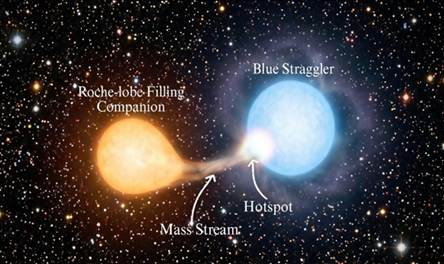
Blue Straggler Stars are an unusual class of stars that appear hotter, brighter and more massive than other stars of the same age within a star cluster, long puzzling astronomers seeking to explain their origin. The prevailing theory suggests that these stars rejuvenate themselves by gaining mass from a companion star or through stellar mergers, but direct observational evidence has remained scarce.
Using high-precision light data from NASA’s Transiting Exoplanet Survey Satellite (TESS) along with radial velocity observations from the European Southern Observatory’s Very Large Telescope in Chile, researchers confirmed that the binary system is actively undergoing mass transfer.
The team found that the system is semi-detached, meaning one of the stars has expanded beyond its gravitational boundary, known as the Roche lobe, causing it to transfer matter to its companion, the Blue Straggler Star. This ongoing transfer of material confirms that the rejuvenation process is still underway, making it one of the clearest examples of a Blue Straggler forming through mass transfer.
Researchers also detected strong X-ray emissions from the system, providing independent evidence that material from the companion star is actively being accreted by the Blue Straggler.
Detailed analysis showed that the Blue Straggler has a mass about 1.67 times that of the Sun, while its companion has a mass of around 0.32 solar masses. The binary system completes one orbit every 2.11 days, and the Blue Straggler rotates rapidly at approximately 69.55 kilometres per second, likely due to the continuous accretion of material.
Evolutionary modelling indicates that the mass transfer process began around 5.46 billion years ago and continues today, while the host star cluster is estimated to be about 7 billion years old.
The discovery offers one of the strongest pieces of observational evidence supporting the theory that Blue Straggler Stars are formed through mass transfer in binary systems, helping resolve a decades-old question in stellar astrophysics. Scientists said the system provides a unique natural laboratory for studying binary star evolution, stellar rejuvenation and the long-term evolution of star clusters across the Universe.
The findings have been published in the Astrophysical Journal Letters by a team of researchers from the Indian Institute of Astrophysics, Gauhati University, IUCAA Pune, INAF Italy, LUX Observatoire de Paris, and the University of North Florida, USA. (PIB)


Comments are closed.