

Muhammad Talha Amin Baruah
“The history of Muslims in Meghalaya did not begin during British rule. Their presence in the region goes back many centuries and is closely connected with trade, diplomacy, political relations and the spread of Sufism.”
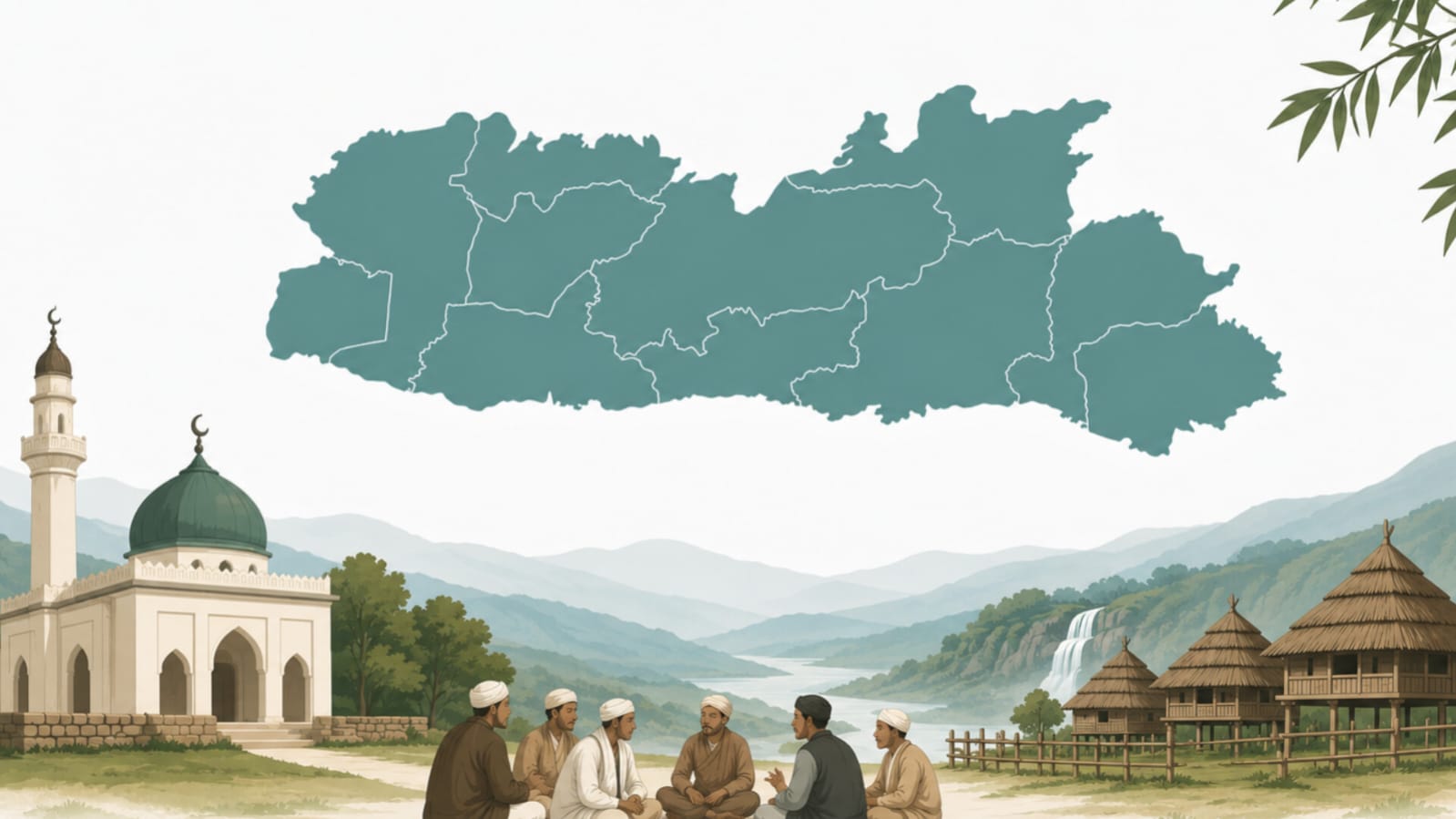
After I wrote an article on the Jaintia Kingdom’s Commander-in-Chief — Fateh Khan, who was the son of Nawab Alivardi Khan and nephew of Borgohain Syiem Sutnga II, many people requested me to write about the history of Muslims in Meghalaya in the pre-British era. The history of Muslims in Meghalaya during the pre-British period is closely linked to the region’s commercial networks, political interactions, and cultural exchanges with the neighboring Muslim Kingdoms. The history of Muslims in Meghalaya did not begin during British rule. Their presence in the region goes back many centuries and is closely connected with trade, diplomacy, political relations, and the spread of Sufism. Although Meghalaya remained outside the direct control of the major Muslim empires, the Khasi, Jaintia, and Garo Hills maintained regular contact with the neighbouring Muslim kingdoms of Bengal and Sylhet. These interactions gradually led to the settlement of Muslim communities and contributed to the cultural diversity of the region.
Historical evidence suggests that the rulers of Delhi and Bengal maintained friendly relations with the Khasi and Jaintia kingdoms. One important archaeological discovery supporting these relations is the unearthing of fourteen silver-plated coins in the Jaintia Hills. These coins indicate that the Jaintia rulers had political and commercial connections with Muslim rulers through the Viceroy of Murshidaabad.1
Like Assam, Manipur, Tripura and Nagaland, Sufism also entered in Meghalaya. The oldest known Sufi Saint to have come to the region of Meghalaya was Shah Nur Muhammad Shah. He was a disciple of the Sufi Saint — Shah Jalal Yemeni, who came to Northeast India from Yemen in the 14th century. The grave of Shah Nur Muhammad Shah is located in Laban, Shillong. Another important Sufi Saint who came to the region of Meghalaya, specifically to Garo hills, was Shah Kamal. He came to Mahendraganj of the Garo Hills, and settled there on the request of a Garo chief. Shah Kamal married a Garo woman, who was a Hindu Brahmin. He used to cure people who were in distress and used to preach the religion of Islam among locals. Many Garos had become Muslim in his hands. One day, Shah Kamal disappeared and few years later, two graves appeared at the place where he used to reside. People claimed that one was of Shah Kamal and the other was of his wife.²It is quite uncertain when Shah Kamal existed. Some believe he lived in the 14th century, while some believe he lived in the 17th century and came to Assam with Ram Singh in 1669. The 17th century theory emerged from the idea that Shah Kamal was one of the Panch Pir – Shah Kamal, whose grave is in Dhubri. I personally believe that both are different. Sufism also has a bit of history in Khasi Hills. Two Muslim saints had come to the East Khasi Hills from Sylhet. One of those Saints was Shah Safreen Shah. They were known as Phukirs among the locals.² Their presence reflects the peaceful spread of Islam through spiritual teaching rather than political conquest.
Islam has therefore had a long historical presence in the Garo, Khasi, and Jaintia Hills. Besides settlers from Bengal and Sylhet, several indigenous communities, including the Garo, Hajong, Khasi, Rabha, and Tharu, gradually developed a Muslim population through conversion to Islam and social interaction.³
Muslims had established contact with Garo Hills when they established control over Bengal. During the Mughal era, the more important estates bordering the Garo Hills were Karaibari, Kalimalupara, Mechpara and Habraghat in Rongpur district, Susang and Sherput in Mymensing district of Bengal, and Bijini in the Eastern Duars. Mughal rulers allowed Hindu Zamindars were allowed to hold multiple estates in Garo Hills. These Zamindars would pay tribute to the Mughal faujdar of Rangamati. Tributes were generally paid in the form of Agarwood and Elephants.⁴ Garo hills was controlled by Muslims when Goalpara was conquered by the Mughals in 1662.5
The Momin clan of the Garos are a Muhammadan Garo clan. This community is believed to have originated through marriages between Muslim men and Garo women. Some scholars also suggest that the Momin clan developed from the Awi clan, one of the traditional Garo divisions.6 The existance of Khasi Muslims is also evident. Khasi Muslims are a small Muslim community living mainly in the Khasi Hills of present-day Meghalaya. Their history goes back several centuries, when Muslim traders came to the Khasi region through trade and contact with neighboring areas such as Assam and Bengal. Some permanent settlers married Khasi women, leading to the growth of a distinct community.7 The founders of the Siyem clan, of a Khasi state were called Mawiongs because they were Bengali Muslims from Sylhet.6 While such traditions require further historical examination, they demonstrate the close connections between the Khasi Hills and neighbouring Muslim regions.
The Khasi kingdoms also maintained important relations with Muslims. Khasi Kings used to appoint Muslims at honourable positions in their chieftains. The Mughal–Khasi relation was limited, indirect, and largely shaped by the Mughals’ northeast frontier policy through Bengal and adjacent hill states. Therefore, the Khasi chiefs appointed Bengali agents known as ‘Duardars’ to keep an account of the contacts made with the Mughal authorities and traders.5
Khasi states did clash with Muslims, mainly from Sylhet. There are inscriptions that indicate more than one attack. A possible ruler of Laur, whose name is documented as Dewan Muhammad, attacked Khasi hills during the rule of Khasi ruler — Rangnoh. However, the Syiem of Nongstoin defeated Dewan Muhammad near the Jadukata river. The story of Dewan Muhammad is debated, though his existence and invasion are not. Since Khasi states were reluctant on attacking Laur, Dewan Muhammad might have launched a campaign against them.8
The Jaintia are a predominantly hill-dwelling, matrilineal community of Khasi-related origin in the Jaintia Hills and adjacent parts of Sylhet. In the medieval and early modern period, the Jaintia kingdom (centered around Jayantia/Jaintiapur) existed alongside expanding Muslim powers. In the late 16th century and early 17th century, a Muslim chief named Jamal Khan was in conflict with the Kachari Kingdom. This event is briefly detailed in the Kachari Buranji. During this conflict, Jamal Khan, who crossed Barak Valley to invade Kachari Kingdom, had reached Khaspur of Jaintia Kingdom in order to erect a fort there.9
The Jaintia Kingdom had particularly close interactions with the Mughal Empire. The records of the Mughal empire notes great amount of details regarding the Jaintia Kings.10 Abul Fazl’s Ain-e-Akbari mention Jaintia as one of the eight Mahals of the sarkar of Sylhet. This highlights the importance of the Jaintias in Mughal administration. Ahom King — Jayadhwaj Singha had sent a letter to the Jaintia King — Man Singh in 1662, requesting his aid in fighting Mir Jumla II. The letter also describes that the Mughals had killed two Jaintia messengers at Garhgaon.10 The response of the Jaintia King remains unknown, but it is certain that he did not retaliate against Mir Jumla.
Mir Jumla’s campaign (1662–1663) was the Mughal general — Mir Jumla II’s decisive campaign of the Ahom kingdom. Upon Victory, the Treaty of Ghilajharighat was signed on 23 January 1663 between Mir Jumla and Jayadhwaj Singha. Mir Jumla then withdrew from Assam, but his men suffered terribly from the inclement weather, and Mir Jumla himself fell ill and died near Mankachar. Before Mir Jumla died, he rested at a hilltop in the Jaintia hills. At that time, he had constructed a Mosque there. This mosque built in 1663, still exists in Meghalaya and is perhaps the oldest mosque in the State.2
The Jaintia state was never part of the Mughal empire, but it repeatedly came under Mughal political intervention due to its proximity to Bengal. The ‘Akhbarats’ report that Shaista Khan, the Mughal Nazim (governor) of Bengal, learned that the Jaintia king had attacked the area of Sylhet with about 1,500 foot soldiers. The Jaintia king’s forces had destroyed police outposts (thanas), looted nearby villages, and laid siege to the fort at Sylhet. Shaista Khan responded by sending troops together with Iradat Khan and Tahawwur Asad, the zamindar of Kharakpur. Their combined force defeated the Jaintia ruler, ended the attacks, and brought the Sylhet region back under imperial (Mughal) control.11
The influence of neighbouring Muslim administrations also affected the governance of the Jaintia Kingdom. Jaintia Kingdom had adopted Muhammadan rulers’ administrative concepts in their administration. Parganah system was adopted by Jaintia rulers in adjoining areas of sarkar of Sylhet. Jaintia ruler — Ram Singh Syiem Sutnga I who ruled from 1694 to 1708, appointed Sikdars in each village and Choudharys over sixteen sikdars. The choudharys used to collect revenue for the Jaintia kingdom. Both the Sikdar and Choudhary were allowed to resolve minor legal cases in the Kingdom.6
Muslim population had increased in the Jaintia Kingdom during the Mughal era. Recognising the religious needs of his Muslim subjects, Jaintia king – Jainarayan, who reigned the Jaintia Kingdom from 1708 to 1731, had brought a Muslim scholar from Haridwar. Jainarayan brought the scholar for religious education of the Muslim population of the Jaintia Kingdom. Jaintia Kingdom had other Muslims in their administration, like Qazis (islamic judges) were appointed by the Jaintia Kings to serve justice to the Muslim subjects according to Islamic law.5
Examining the pre-British presence of Muslims in Meghalaya provides valuable insights into the region’s interconnected history and the evolution of its diverse social landscape.
In conclusion, the history of Muslims in pre-British Meghalaya is one of peaceful interaction between Garos, Khasis & Jaintias with the Muslims. The interaction includes trade, diplomacy, religious exchange, and cultural integration. Muslims contributed to the region of Meghalaya not only through commerce and administration but also through the spread of Sufi traditions. The historical relationship between the Muslim communities and the Khasi, Jaintia, and Garo Chieftains/Kingdoms demonstrates that Meghalaya has long been a land of cultural & religious diversity with mutual coexistence. Studying this shared past provides a deeper understanding of the rich and interconnected history of Northeast India in itself.
References:
-
Md. Hasibor Rahman (2004) Muslims in Meghalaya. Kitab Bhavan. Pg. 44
-
Ibid; Pg. 99-101
-
Ibid; Pg. 13
-
Ibid; Pg. 5
-
Ibid; Pg. 15-16
-
Ibid; Pg. 80-81
-
Banrida Theresa Langstieh. “Demographic Structure of the Khasi-Muslims of Shillong, Meghalaya.” Journal of Human Ecology, Volume 12 No. 2 (2001). Pg. 121
-
Tngensi Rynjah (1991) Ka History ka ri khasi – Jaintia (1562-1826). Ri Khasi Press. Part II Volume III Pg 31-32
-
Col. Ved Prakash (2007) Encyclopedia of North-East India. Atlantic Publishers and Distributors (P) Ltd. Volume 4 Pg 1615
-
Shobhan N. Lamare (2005) The Jaintias: Studies in Society and Change. Regency Publication. Pg 49-50
-
Tahir Hussain Ansari (2019) Mughal Administration and the Zamindars of Bihar. Taylor & Francis. Pg 36
Comments are closed.