

S Ahmad
”From ancient trade routes to modern textile supply chains, India’s cotton story is entering a decisive phase where productivity, technology, sustainability and farmer welfare must move together.”
Few crops have shaped India’s economic history as profoundly as cotton. Long before industrialisation transformed global manufacturing, Indian cotton fabrics travelled across continents, admired for their quality, craftsmanship and durability. The cotton fields of the subcontinent fed thriving textile centres that connected India with markets stretching from Central Asia and the Middle East to Europe and Africa. Cotton was more than an agricultural commodity; it was an engine of commerce, employment and cultural identity.
Centuries later, cotton continues to occupy a similarly strategic position in India’s economy, though the context has dramatically changed. Today, the crop supports millions of farming families, fuels one of the world’s largest textile industries, contributes significantly to export earnings and provides livelihoods across an extensive value chain encompassing ginning, spinning, weaving, garment manufacturing and trade. Few sectors illustrate the interconnectedness of agriculture and industry as effectively as cotton.
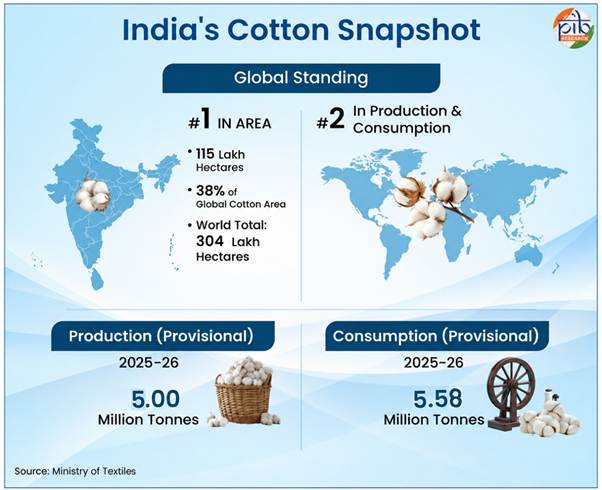
Official figures underline this significance. India remains the world’s largest cultivator of cotton by area and the second-largest producer and consumer. Cotton cultivation extends over more than 114 lakh hectares, accounting for nearly two-fifths of the world’s total cotton acreage. Approximately six million farmers cultivate the crop, while another 40 to 50 million people depend on cotton-related activities ranging from processing and transportation to textile manufacturing and exports. This vast ecosystem explains why cotton continues to be celebrated as India’s “White Gold”—a crop whose value extends far beyond the farm.
Yet the story of Indian cotton is neither one of uninterrupted success nor one of simple statistics. It is a story of remarkable resilience, persistent structural challenges and renewed policy ambition. While India leads the world in cultivated area, productivity continues to lag behind several competing cotton-producing nations. The paradox is striking: the country devotes more land to cotton than any other nation, yet production growth has often remained constrained by low yields, climatic uncertainties, pest attacks and fragmented farm holdings.
This paradox illustrates an important lesson for Indian agriculture. Expanding cultivated area alone is no longer sufficient to sustain growth. Future gains must increasingly come from better productivity, improved fibre quality, technological innovation and stronger integration between farmers and markets. In other words, India’s cotton economy must now move beyond quantity towards quality and competitiveness.
The evolution of India’s cotton sector reflects the broader transformation of Indian agriculture itself. Traditional farming practices have gradually given way to improved seed varieties, scientific crop management and greater market integration. The commercial introduction of Bt cotton in 2002 represented one of the most significant technological turning points in the sector. By offering resistance against bollworm infestation, Bt cotton substantially reduced pest-related losses while improving yields in many regions. For thousands of farmers, this translated into lower expenditure on pesticides and improved incomes during the initial years of adoption.
However, technological breakthroughs rarely provide permanent solutions. Over time, changing pest dynamics, climate variability and rising cultivation costs have once again highlighted the need for continuous innovation. Cotton cultivation today faces a far more complex set of challenges than it did two decades ago.
Climate change has emerged as perhaps the most significant of these. Nearly two-thirds of India’s cotton area remains rain-fed, making production highly vulnerable to erratic monsoons, prolonged dry spells and extreme weather events. Farmers increasingly confront unpredictable rainfall patterns that disrupt sowing schedules, reduce yields and increase production risks. Rising temperatures also influence pest behaviour, creating additional pressures on already fragile farming systems.
At the same time, global textile markets have become far more competitive. International buyers increasingly demand consistency in fibre quality, traceability, sustainability and compliance with environmental standards. Cotton is no longer evaluated solely on the basis of quantity produced. Fibre length, contamination levels, certification systems and transparent supply chains have become equally important determinants of market access.
This changing landscape requires India to rethink its cotton strategy comprehensively. Agricultural productivity, industrial competitiveness and export performance are now deeply interconnected. Weaknesses at the farm level eventually affect textile manufacturers, exporters and the country’s global market position. Conversely, improvements in farming practices create ripple effects throughout the value chain.
Recognising these realities, recent policy initiatives seek to move beyond conventional support mechanisms towards a more integrated cotton development strategy. Minimum Support Price operations continue to provide an important safety net for farmers during periods of market distress. By ensuring procurement when prices fall below announced support levels, the MSP system offers a degree of income stability that encourages continued cultivation.
The Cotton Corporation of India has played a particularly significant role in implementing these interventions. The expansion of procurement centres across cotton-growing states reflects efforts to improve market access while reducing the dependence of farmers on distress sales. In years characterised by volatile prices, such institutional support becomes especially important for protecting farm incomes.
Yet price support alone cannot transform the sector. Sustainable competitiveness ultimately depends upon raising productivity while reducing production costs. This recognition forms the foundation of the Mission for Cotton Productivity, one of the most ambitious recent initiatives aimed at revitalising India’s cotton economy.
The mission acknowledges that scientific research, improved seed varieties, biotechnology and field-level extension services must work together if India is to achieve significant productivity gains. Its emphasis on climate-resilient and pest-resistant varieties recognises the growing pressures imposed by changing weather patterns and evolving pest challenges. Equally important is its focus on Extra Long Staple cotton, a segment where India continues to face supply constraints despite strong demand from the domestic textile industry.
The broader vision aligns closely with India’s aspiration to strengthen the entire textile value chain under the “Farm to Fibre to Factory to Fashion to Foreign” framework. This approach recognises that cotton should no longer be viewed merely as a raw agricultural commodity. Instead, it represents the starting point of a sophisticated industrial ecosystem capable of generating employment, exports and value addition at multiple stages.
Technology has become another defining feature of this evolving strategy. Digital platforms such as the Kapas Kisan App illustrate how governance itself is undergoing transformation. Traditionally, procurement often involved lengthy queues, paperwork and uncertainty regarding payment schedules. Digital registration, advance slot booking, Aadhaar-linked payments and real-time communication have significantly streamlined these processes, making procurement more transparent and farmer-friendly.
Such digital innovations may appear administrative, but their broader implications are considerable. Reducing transaction costs, improving transparency and enhancing farmer confidence contribute directly to more efficient agricultural markets. In an increasingly digital rural economy, technology can become as important as irrigation or improved seeds in determining agricultural competitiveness.
Quality assurance represents another critical frontier. Global textile markets increasingly reward consistency rather than sheer volume. Initiatives such as Kasturi Cotton Bharat seek to establish Indian cotton as a globally recognised premium brand through certification, traceability and quality assurance. QR-based certification systems and blockchain-enabled traceability represent important innovations that connect Indian cotton with evolving international market expectations.
Branding agricultural commodities has often remained an underutilised opportunity for India. While the country enjoys enormous production capacity across several commodities, value addition through branding, certification and quality differentiation has frequently lagged behind. Cotton offers an opportunity to reverse this trend by positioning Indian fibre as a trusted premium product in international markets.
Equally significant is the recognition that cotton’s contribution extends well beyond textiles. Cottonseed oil, livestock feed, biomass fuel, medical absorbent cotton and several industrial by-products demonstrate the crop’s remarkable versatility. A modern cotton economy therefore encompasses multiple industries rather than a single agricultural commodity.
This broader perspective is essential because future agricultural prosperity will increasingly depend upon diversified value chains rather than primary production alone. Farmers benefit not merely from higher yields but from stronger processing industries, efficient logistics, better branding and expanded market opportunities. Cotton provides perhaps one of the clearest examples of how agriculture and manufacturing can reinforce each other’s growth.
As India pursues the goal of becoming a global manufacturing hub while simultaneously strengthening rural incomes, cotton occupies a uniquely strategic position. It links villages with industrial clusters, agriculture with exports and traditional livelihoods with advanced technologies. Few sectors possess such remarkable potential to generate inclusive economic growth across both rural and urban India.
The challenge now lies in translating this potential into sustained outcomes. Productivity gaps must narrow, climate resilience must improve and farmers must gain greater access to technology, markets and value addition. The foundation has been laid through policy initiatives and institutional reforms. The next stage will require equally strong implementation, scientific innovation and close collaboration between governments, research institutions, industry and farmers themselves.
The future of India’s cotton economy will ultimately depend on one decisive factor: whether the country can successfully bridge the gap between agricultural potential and industrial excellence. Producing more cotton is undoubtedly important, but producing better cotton—cleaner, stronger, traceable and sustainable—will define India’s competitiveness in the decades ahead. As the global textile industry undergoes rapid transformation, driven by changing consumer preferences and environmental regulations, cotton-producing nations can no longer rely solely on abundant acreage or low production costs. Quality, sustainability and innovation have become the new currencies of agricultural trade.
This shift is particularly relevant because the global textile market itself is undergoing profound changes. Consumers are increasingly demanding ethically sourced products, environmentally sustainable production methods and complete transparency across supply chains. International brands now seek suppliers capable of demonstrating traceability from the farm to the finished garment. Environmental, Social and Governance (ESG) standards have become integral to procurement decisions, making sustainability a commercial necessity rather than a voluntary commitment.
For India, this changing landscape presents both a challenge and an unprecedented opportunity. As one of the world’s largest cotton producers and textile manufacturers, the country possesses a complete value chain that few competitors can match. From cultivation and ginning to spinning, weaving, garment manufacturing and exports, India has developed an integrated ecosystem capable of serving both domestic and global markets. Strengthening each link of this chain can significantly enhance India’s position in international trade.
One of the most promising initiatives in this direction is Kasturi Cotton Bharat, which seeks to reposition Indian cotton as a globally recognised premium fibre. Rather than competing solely on volume, the programme focuses on quality assurance, certification, branding and traceability. QR-based certification and blockchain-enabled tracking systems are designed to assure buyers that the cotton they purchase can be traced throughout the supply chain, thereby enhancing credibility and market confidence.
This approach reflects an important shift in agricultural policy. Traditionally, Indian agriculture has concentrated on increasing production, often paying relatively less attention to branding and value addition. Yet global experience demonstrates that premium branding can substantially enhance farmer incomes without necessarily expanding cultivated area. Products associated with quality, authenticity and sustainability often command significantly higher prices than undifferentiated commodities.
Technology is also reshaping cotton cultivation at the field level. Demonstrations under the Special Project on Cotton have shown encouraging improvements in productivity through High-Density Planting Systems (HDPS), closer spacing techniques and improved crop management practices. These interventions are particularly important because they address one of the sector’s most persistent weaknesses—low average yields.
Field demonstrations indicating productivity gains of over 30 percent illustrate the importance of transferring scientific knowledge from research institutions to farmers. Agricultural innovation achieves little unless it reaches the field in forms that farmers can adopt practically and economically. Extension services therefore remain just as important as laboratory research in determining the success of technological interventions.
Equally encouraging is the growing emphasis on climate-resilient agriculture. Cotton cultivation increasingly faces the twin challenges of water scarcity and erratic weather patterns. Developing drought-tolerant, pest-resistant and high-yielding varieties has therefore become an economic imperative rather than merely an agricultural objective. The Mission for Cotton Productivity rightly recognises that climate resilience must become central to future agricultural planning.
Water management deserves particular attention in this context. Although much of India’s cotton is grown under rain-fed conditions, improving water-use efficiency through micro-irrigation, better soil management and precision agriculture can substantially reduce production risks. Climate adaptation will increasingly determine agricultural competitiveness, especially in crops like cotton that remain highly sensitive to weather variability.
Another important dimension often overlooked in discussions on cotton is the role of farmers themselves as entrepreneurs rather than merely producers. Modern agriculture requires continuous decision-making regarding seeds, fertilisers, pest management, mechanisation, marketing and risk management. Empowering farmers through timely information, digital advisory services, access to institutional credit and stronger producer organisations can significantly improve both productivity and profitability.
Digital governance has already begun transforming interactions between farmers and procurement agencies. The Kapas Kisan App represents an important step towards reducing transaction costs while improving transparency in procurement operations. Such innovations not only simplify administrative procedures but also strengthen farmers’ confidence in institutional mechanisms. In the long run, digital platforms could evolve further to integrate advisory services, market intelligence, weather forecasts and crop insurance within a single ecosystem.
However, technology alone cannot solve every structural challenge. Fragmented landholdings, fluctuating global prices, rising cultivation costs and periodic pest outbreaks continue to affect cotton farmers across many regions. Addressing these issues requires coordinated policy support that combines scientific research, market reforms, institutional finance and rural infrastructure development.
The textile industry, which consumes a substantial portion of India’s cotton output, also has an important role to play. Stronger linkages between farmers, ginners, spinning mills and textile manufacturers can improve quality consistency while ensuring fairer returns throughout the value chain. Contract farming models, farmer-producer organisations and collaborative supply chains may offer opportunities for reducing inefficiencies and enhancing competitiveness.
International trade dynamics add another layer of complexity. Cotton markets remain influenced by global demand, exchange rate fluctuations, trade policies and competition from synthetic fibres. India’s cotton strategy must therefore remain flexible enough to respond to changing international conditions while protecting the interests of domestic farmers. Diversifying export destinations, expanding value-added textile exports and investing in research and branding can help reduce vulnerability to market volatility.
Importantly, cotton should no longer be viewed solely through the lens of agriculture or textiles. It represents an integrated rural-industrial ecosystem capable of generating employment at multiple levels. From seed production and farm mechanisation to garment exports and technical textiles, the cotton economy touches millions of lives across rural and urban India. Every improvement in productivity has implications not only for farmers but also for industrial growth, exports and employment generation.
The government’s current initiatives—including enhanced MSP operations, the Mission for Cotton Productivity, digital procurement platforms, technology demonstrations and quality certification programmes—reflect an encouraging shift towards holistic sectoral development. Yet implementation will remain the true test of success. Scientific breakthroughs must reach farmers, digital platforms must remain accessible, institutional support must be responsive and quality standards must be consistently maintained.
Ultimately, India’s cotton story is about far more than a commercial crop. It is a story of civilisation, enterprise and resilience that stretches from the looms of ancient India to the sophisticated textile factories of the twenty-first century. Cotton has survived colonial disruption, global competition, technological revolutions and changing consumer preferences because it continues to adapt to new realities.
Today, another chapter is being written. It is a chapter defined not simply by higher production targets but by smarter farming, stronger institutions, cleaner technologies and globally competitive value chains. If these efforts succeed, India will not only consolidate its position as one of the world’s leading cotton producers but also emerge as a benchmark for sustainable and inclusive cotton development.
The future of India’s “White Gold” therefore lies not merely in producing more fibre but in creating greater value at every stage—from the seed sown by the farmer to the finished fabric reaching consumers across the world. A cotton economy that combines productivity with sustainability, technology with tradition and farmer welfare with industrial growth can become a powerful driver of India’s broader aspiration for inclusive economic development. In that vision, every cotton boll harvested is more than an agricultural output; it is a thread weaving together rural prosperity, industrial progress and the promise of an Atmanirbhar India.
Comments are closed.