
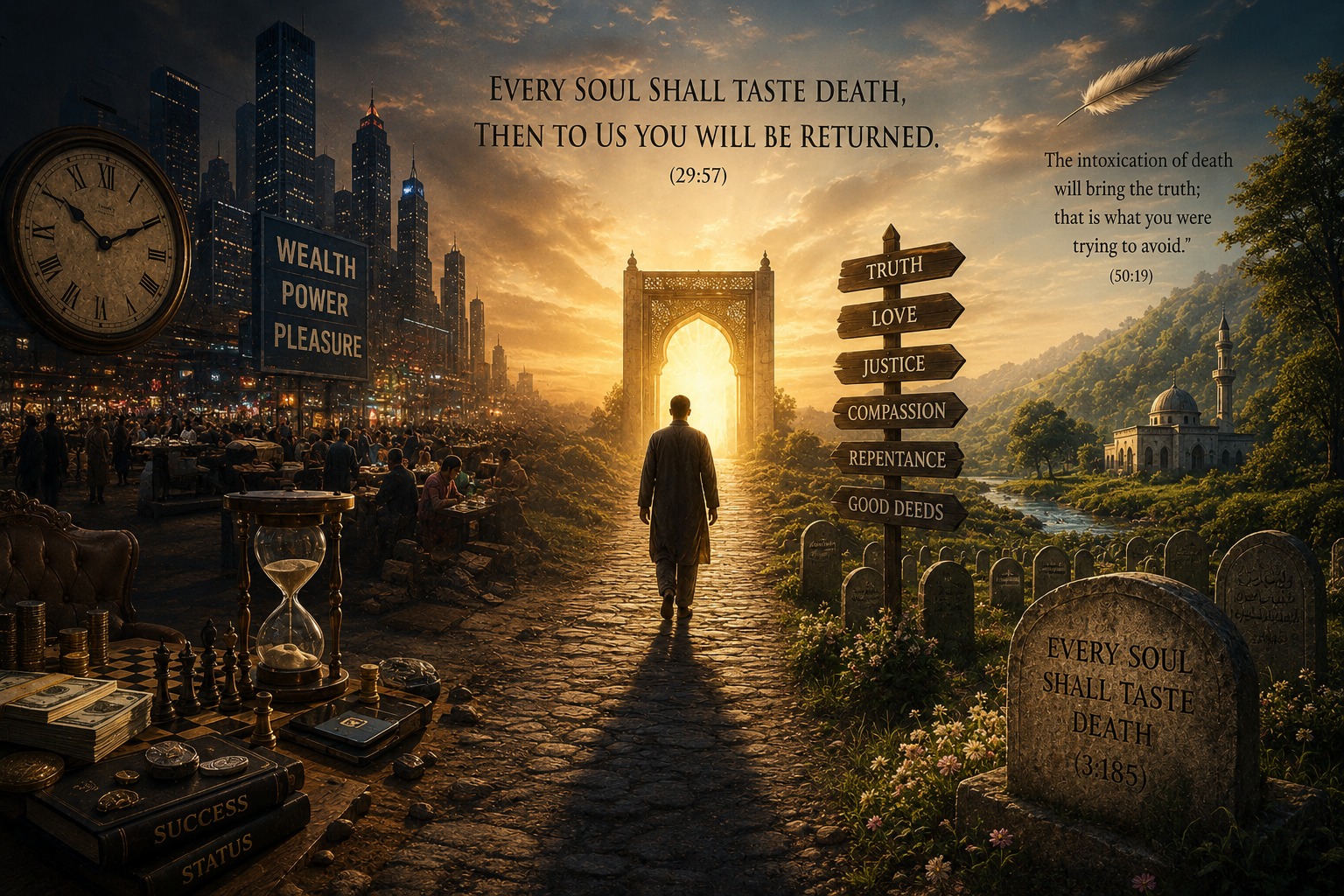
Death as Humanity’s Greatest Certainty

Meaning, Moral Awakening, Responsibility and the Passage from Finitude to Eternity

Shabeer Ahmad Lone


“To understand death is not to escape it, but to allow it to illuminate life so completely that one no longer lives superficially but truthfully, responsibly, and with a depth that is revealed—not extinguished—by the ending of time.”

“The Qur’an presents death as a moment of unveiling, moral awakening, and transition to eternity through clear and authentic verses: “And the intoxication of death will bring the truth; that is what you were trying to avoid” (50:19), revealing death as disclosure of ultimate reality; “He is the One who created death and life so that He may test you as to which of you is best in deeds” (67:2); “And He is the One who has made you successors upon the earth… so that He may test you in what He has given you” (6:165); “And We test you through both hardship and ease as a trial” (21:35); “Every soul shall taste death” (3:185),“Every soul shall taste death, then to Us you will be returned” (29:57) and “Every soul will taste death, and you will only be given your full reward on the Day of Resurrection” (3:185), affirming it as a passage from finitude to eternal accountability; “Indeed, the death from which you flee will surely meet you, then you will be returned to the Knower of the unseen and the seen” (62:8), emphasizing inevitable return and divine encounter; “Until, when death comes to one of them, he says, ‘My Lord, send me back so that I may do righteousness…’ No! It is but a word he speaks” (23:99–100), portraying death as moral awakening too late for action; and “Then why, when the soul reaches the throat… and you are looking on… why do you not bring it back, if you are truthful?” (56:83–87), exposing human helplessness and the boundary of worldly power-together establishing death as the decisive disclosure of truth, the awakening of conscience, and the irreversible passage into the eternal presence of God.”

When Sayyidina Abbas (May Allah be pleased with him), the paternal uncle of the Messenger of Allah (Peace be upon him), passed away, a Bedouin offered condolences to his great son, Hazrat Abdullah ibn Abbas (May Allah be pleased with him), with these words:”O Abdullah! Remember that Abbas has found a companion better than you (meaning Allah), and you have been granted something greater than him (meaning patience).”Abdullah ibn Abbas remarked that no one had ever offered him a more deeply moving and comforting condolence upon his father’s passing than this.

Fi’l-haqeeqat koi nahin marta,

Maut hikmat ka ek parda hai. – Sheikh Zahooruddin Hatim

Maut ki ek alamat hai agar dekha jaye,

Rooh ka chaar anasir pe sawari karna. – Khurshid Rizvi

Maut ke saath hui hai meri shaadi so Zafar,

Umr ke aakhri lamhaat mein dulha hua main. -Zafar Iqbal

Death remains the most universal certainty and the most singularly personal event, a reality that gathers within it the limits of knowledge and the depth of meaning. It stands at the boundary where the measurable dissolves into the immeasurable, where the language of science yields to the language of existence. One may chart the decline of the body, map neural cessation, and define legal thresholds, yet none of these reach the inner crossing by which presence becomes absence and time yields to what lies beyond it. This boundary is not merely epistemic but existential; it reveals that human life is not exhausted by what can be observed. The enigma of death persists because the human being is not only a biological organism but a bearer of meaning, intention, moral responsibility, and transcendence.

Death is not merely the end of life but its greatest disclosure. It strips away illusion, exposes what truly matters, and awakens us to meaning, responsibility, and moral purpose. In the light of mortality, every moment becomes precious, every choice consequential, and every act of truth, love, justice, and compassion an echo of eternity. Finitude thus becomes not a cause for despair but the very horizon from which authentic life, moral awakening, and the journey toward eternity derive their deepest significance.

The modern scientific imagination, for all its precision, encounters a quiet insufficiency when approaching death. It can describe processes with remarkable clarity, yet it cannot answer why finitude matters or why the awareness of it transforms the quality of living. The human response to death is not reducible to instinctual fear; it includes awe, reflection, resistance, surrender, and an often unarticulated longing for ultimacy. Contemporary research increasingly confirms that mortality awareness reorganizes cognition, deepens ethical sensitivity, and reshapes priorities. Yet even this remains partial, for it identifies the effects of death-awareness without fully grasping its ontological depth. Death is not only something that happens; it is something by which life is understood.

The philosophical tradition has long recognized this structuring power. When Martin Heidegger speaks of being-toward-death, he reveals that mortality is not merely an endpoint but the condition that renders life uniquely one’s own. Death gathers existence into urgency, stripping away the illusion of infinite postponement. Yet finitude alone cannot bear the full weight of meaning. If death is interpreted as sheer negation, life risks dissolving into contingency; if it is reduced to abstraction, its urgency fades. The human search, therefore, is not merely to acknowledge death, but to interpret it in a way that sustains both seriousness and hope.

This search is ancient. In the voice of Socrates, preserved in Phaedo, philosophy becomes a preparation for death-a gradual liberation from illusion and a reorientation toward truth. Death, in this sense, is not the negation of thought but its consummation. It reveals whether one has lived in accordance with what endures or merely with what appears.

The mystical traditions radicalize this insight by transforming death from an event into a method. Jalal ad-Din Rumi’s call to “die before you die” is an invitation to interior revolution: the death of ego, vanity, and false permanence. Ibn Arabi deepens this by interpreting death as unveiling-the lifting of veils that conceal reality. What is feared as annihilation becomes, at a deeper level, disclosure. Death does not create truth; it reveals it. The decisive question, therefore, is not whether one will die, but in what state of being one will encounter that unveiling.

Revelation intensifies this by introducing the dimension of accountability. Death is not only a transition but a reckoning, not only an finitude but a eternity. It gathers the dispersed fragments of life-actions, intentions, omissions-into a single, inescapable clarity. In the thought of Al-Ghazali, remembrance of death is the beginning of wisdom because it reorders desire, disciplines the self, and aligns life with its ultimate purpose. Death thus ceases to be merely future; it becomes a present ethical force, silently evaluating every choice.

The psychological dimension reflects this convergence with striking clarity. As Ernest Becker argued, much of human culture is structured as a defense against mortality. Yet when this defense gives way to conscious awareness, transformation becomes possible. Individuals often shift from accumulation to meaning, from appearance to authenticity, from self-preoccupation to responsibility. The work of Elisabeth Kübler-Ross, though often simplified, gestures toward the inner struggle to integrate death into consciousness-not as an intrusion, but as a truth that must be faced.

Across the sacred literatures of humanity, death is rarely portrayed as annihilation; it is rendered as unveiling, return, and moral awakening. The Qur’ānic voice reminds that “every soul shall taste death,” not as a negation but as a passage into truth where the hidden becomes manifest and the weight of every act is known. In the Bhagavad Gita, the self is described as casting off the worn garment of the body, suggesting that identity exceeds its material form and that death is a transition within a larger continuity. The Buddhist Bardo teachings speak of the interval after death as a luminous yet perilous unveiling of one’s own consciousness, where clarity or भ्रम reflects the quality of awareness cultivated in life. Biblical wisdom frames death as a return-“for dust you are, and to dust you shall return”-yet also as an opening toward judgment, mercy, and eternal significance. In the Taoist imagination, death is a transformation within the ceaseless flow of the Tao, where form dissolves but harmony persists. And in the ecstatic utterances of Jalal ad-Din Rumi, death becomes a wedding night, a union with the Beloved, where what seemed like loss is revealed as arrival. Despite their differences, these traditions converge upon a single, profound intuition: death is not the erasure of meaning but its disclosure-the moment when life is gathered, weighed, and returned to the deeper reality from which it came.

Echoing this sacred vision in the wider literary and philosophical imagination,

across world literature, from Jalal al-Din Rumi and Ibn Arabi to Martin Heidegger and Albert Camus, death is not an end but a disclosure: in Sufi and Punjabi vision (Rumi, Bulleh Shah) it is union; in Urdu poetics (Mirza Ghalib, Muhammad Iqbal, Faiz Ahmed Faiz) a paradox of longing, irony, and transcendence; in English thought (William Shakespeare, Emily Dickinson, John Donne) a mystery both intimate and defied; in Arabic reflection (Al-Mutanabbi, Al-Ma’arri) a ground of dignity and awakening; in German-French philosophy (Johann Wolfgang von Goethe, Jean-Paul Sartre) the horizon of authenticity or absurdity; and in Bengali-Sanskrit wisdom (Rabindranath Tagore, Bhagavad Gita, Katha Upanishad) a transition, not extinction-thus, across traditions, death becomes the threshold where the finite meets the infinite, illuminating life itself.

Swami Ram Teerath ki rehlat par Shaair-e-Mashriq Allama Iqbal ne kaha tha:

Hum baghal-e-darya se hai ae qatra-e-betab tu

Pehle gauhar tha bana, ab gauhar-e-nayaab tu

Aur Swami Ram Teerath ne mulk-e-adam ke safar par rawana hone se qabl likha tha:

Oomat! be-shak uda de is jism ko

Mere doosre jism hi mere liye kam nahin hain

Sirf chaand ki kirnein, chaandi ki taaren

Pehen kar chain se kaat sakta hoon

Pahaadon, nadi naalon ke mel mein gaata phiroon ga

Main hi baad-e-khush-khiraam hoon

Meri yeh soorat sailaani har waqt rawaani mein rehti hai

Is roop mein main pahaari par se utra

Murjhate paudon ko taaza kiya, gulon ko hansaya

Bulbul ko rulaya, darwaazon ko khatkhataya, soton ko jagaya

Kisi ka aansoo poncha, kisi ka ghunghat udaaya

Is ko chher, us ko chher, yeh gaya, woh gaya

Na kuch saath rakha, na kisi ke haath aaya

In the lived reality of dying, abstraction collapses into immediacy. Those who approach death often seek not extension but completion: reconciliation, forgiveness, presence, and meaning. What was once peripheral becomes central; what was once central often appears trivial. This reversal reveals a truth that life frequently obscures: that relationships, integrity, and truthfulness constitute the real substance of existence. To accompany the dying, therefore, is to enter a domain where ethics is no longer theoretical but embodied, where compassion becomes the highest form of knowledge.

There is also a subtler dimension, increasingly recognized in both contemplative traditions and emerging research: that the approach of death can disclose an intensified awareness in which memory, identity, and perception are gathered into a final coherence. Whether interpreted neurologically or metaphysically, this phenomenon suggests that death is not merely a dispersal but, in certain respects, a concentration-a moment in which the scattered elements of a life are drawn into a single point of clarity. In this light, death resembles not only an ending but a summation.

Death also exposes the moral architecture of society. While mortality is universal, its conditions are profoundly unequal. Poverty, violence, and systemic injustice produce deaths that are not merely natural but structured by human neglect and inequity. In this sense, death becomes a moral mirror, reflecting the distribution of care and the failures of collective responsibility. To think deeply about death is thus to confront not only one’s own finitude but the conditions under which others are allowed-or forced-to meet theirs. The ethical demand of mortality extends outward, calling for a reconfiguration of social life in which dignity is not contingent but fundamental.

Even beyond physical cessation, death does not entirely sever presence. The dead persist through their imprints on memory, character, and history. Relationships are transformed, not erased. This continuity suggests that death alters the mode of existence rather than abolishing it, inviting a deeper understanding of human connection that exceeds material boundaries. In this persistence lies both consolation and responsibility: the recognition that one’s life will continue to shape others long after one’s own departure.

Language, at this threshold, falters and turns to metaphor-sleep, return, journey, unveiling. These metaphors do not resolve the mystery, but they reveal a persistent intuition: that death is not sheer nothingness. Human consciousness, across cultures, resists absolute negation, seeking instead to articulate death as passage or disclosure. This resistance is not merely psychological; it reflects the depth-structure of human orientation toward meaning, an orientation that refuses to accept that what is most significant in life can simply vanish without remainder.

At its deepest level, death functions as the ultimate criterion of authenticity. It strips away illusion and exposes what endures. Wealth, status, and recognition lose their significance, while truthfulness, compassion, and responsibility emerge as the only lasting measures. As Leo Tolstoy shows with devastating clarity, the tragedy of life lies not in dying, but in realizing-too late-that one has not truly lived. Death, in this sense, is not merely a biological event but an existential verdict, revealing whether life has been aligned with truth or dissipated in distraction.

The integration of death into life is therefore the beginning of wisdom. It is not a morbid fixation but a clarifying awareness. To live with death in view is to live deliberately, to act responsibly, to love sincerely, and to seek truth beyond appearance. It transforms time from something to be spent into something to be honored, from a sequence of moments into a moral and spiritual trust.

Hope, within this horizon, is neither denial nor sentimentality. It is the recognition that life, when aligned with truth and responsibility, participates in a reality that exceeds its visible limits. Whether expressed as the encounter ,an all-encompassing grace , or existential coherence, this hope affirms that death does not nullify meaning but consummates it. It holds open the possibility that justice, incomplete in this world, is not ultimately denied, and that the apparent finality of death conceals a deeper continuity.

What distinguishes the truly visionary across cultures and ages is not the denial of death but its profound integration. Those who have shaped thought, spirituality, and moral imagination have often lived with an acute awareness of finitude, allowing it to refine perception, intensify purpose, and deepen compassion. Their lives demonstrate that awareness of death, when rightly understood, does not diminish life-it dignifies it, concentrating it into significance and directing it toward what endures.

Thus, death is not merely an end, nor simply a passage. It is the horizon that gives life its depth, the measure that gives it weight, and the unveiling that gives it truth. It is the silent architecture within which existence takes shape, the hidden teacher that accompanies every moment, and the final disclosure that reveals what life has truly been. To understand death is not to escape it, but to allow it to illuminate life so completely that one no longer lives superficially but truthfully, responsibly, and with a depth that is not extinguished by the ending of time, but rather revealed through it.

Jism ki maut koi maut nahi hoti hai

Jism mar jaane se insaan nahi mar jaate

Dharkanain rukne se armaan nahi mar jaate

Saans tham jaane se elaan nahi mar jaate

Hont jam jaane se farmaan nahi mar jaate

-Sahir Ludhianvi

Jis ne dunya ki haqeeqat jaan li

Woh bhala maya se ghabraye ga kya

Saaf jis ka dil, irada jis ka naik

Is ko shaitanon se khauf aaye ga kya

Jis pe roshan ho gaye sirr-e-nihan

Maut se woh shakhs ghabraye ga kya

Main ke shah bhi hoon, ra’aya bhi hoon main

Mere jaisa shakhs mar jaye ga kya

-Subramanium Bharti


Author can be mailed at  shabirahmed.lone003@gmail.com

Comments are closed.