

S Ahmad
For a country as geographically vast and socially diverse as India, connectivity has never been merely about transportation. It has always been about opportunity. Roads, railways, ports and airports are not simply physical infrastructure; they are instruments of economic inclusion that determine how easily people can access education, healthcare, employment, markets and public services. In recent years, India’s infrastructure story has increasingly focused on creating seamless multimodal connectivity, recognising that balanced development requires every region—not just metropolitan centres—to participate in the nation’s economic growth.
Among the various sectors driving this transformation, civil aviation has emerged as one of the most dynamic. Once regarded as a luxury reserved for business executives and affluent travellers, air travel has gradually become accessible to wider sections of society. Competitive fares, expanding airline networks, modern airports and supportive government policies have collectively transformed India’s aviation landscape. Today, India is the world’s third-largest domestic aviation market, reflecting not only rising incomes but also a growing demand for faster and more efficient mobility.
Yet this impressive growth has historically remained concentrated around major cities. Delhi, Mumbai, Bengaluru, Hyderabad, Chennai and Kolkata became major aviation hubs, while hundreds of smaller towns continued to remain disconnected from the country’s expanding air network. For residents of remote districts, reaching the nearest operational airport often required hours of travel by road before beginning an onward flight. Such disparities limited economic opportunities, discouraged investment and restricted access to essential services.
Recognising these challenges, the Government introduced the Regional Connectivity Scheme (RCS), popularly known as UDAN—Ude Desh ka Aam Nagrik—in 2016. The idea was both ambitious and transformative: make air travel affordable for ordinary citizens while connecting underserved and unserved regions to the national aviation network. Rather than viewing aviation solely through the lens of commercial profitability, UDAN recognised regional connectivity as an instrument of inclusive development.
Nearly a decade later, the results are difficult to ignore. Hundreds of regional routes have become operational, connecting airports, heliports and water aerodromes that previously witnessed little or no scheduled commercial activity. Millions of passengers have travelled under the scheme, while several towns once considered isolated have entered India’s aviation map. More importantly, UDAN has demonstrated that regional aviation is not merely about moving people quickly; it is about integrating communities into the broader national economy.
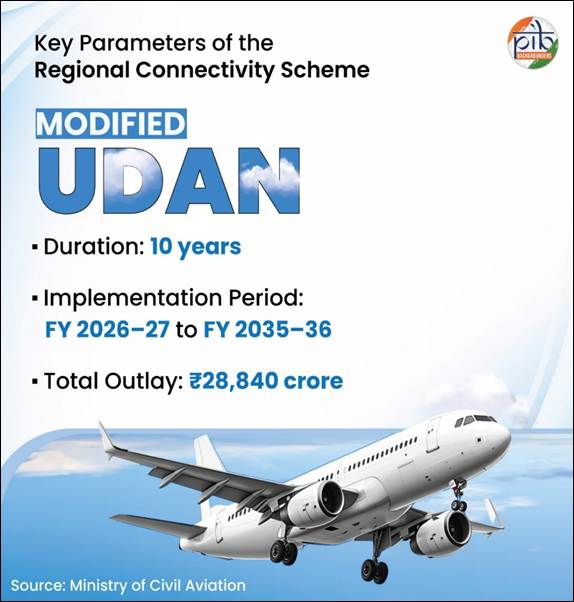
The launch of the Modified UDAN Scheme marks the next stage of this journey. With an ambitious financial outlay extending over the next decade, the programme seeks not only to expand routes but also to strengthen the underlying ecosystem that supports regional aviation. The emphasis has shifted from merely launching flights to creating infrastructure capable of sustaining long-term connectivity.
This transition reflects an important policy lesson. Connectivity cannot depend solely on airline operations. Airports require modern infrastructure. Airlines require financial viability. Remote regions require specialised aircraft suited to difficult terrain. Passengers require reliable services rather than occasional flights. Sustainable aviation therefore demands an integrated approach in which infrastructure, operations, regulation and market development evolve together.
One of the most significant features of the Modified UDAN Scheme is its commitment to developing new aerodromes from existing airstrips. Across India, numerous abandoned or underutilised airfields represent untapped infrastructure assets. Reviving these facilities offers a cost-effective method of expanding aviation capacity without beginning entirely from scratch.
For many smaller towns, an operational airport represents far more than a transportation facility. It becomes a catalyst for economic transformation. Investors often consider connectivity before establishing manufacturing units, logistics hubs or service industries. Tourism destinations become more attractive when travel times decline significantly. Educational institutions gain access to students from wider regions, while hospitals become accessible to patients requiring specialised treatment.
The economic multiplier effect of airports has been documented across the world. Every improvement in connectivity generates additional demand for hospitality, transport, warehousing, retail and professional services. Employment opportunities extend beyond aviation itself, creating livelihoods across multiple sectors. Regional airports therefore function as growth centres capable of stimulating wider economic activity.
The Modified UDAN Scheme also acknowledges another important reality: connectivity in India cannot follow a uniform model. The country’s extraordinary geographical diversity requires equally diverse transport solutions.
Large commercial airports may be suitable for densely populated urban centres, but they are not always practical in mountainous terrain, island territories or sparsely populated regions. In such locations, helicopters often become indispensable rather than optional.
The proposal to develop 200 modern helipads recognises precisely this challenge. Helicopter services can dramatically improve connectivity in Himalayan states, the North-East, island territories and other geographically difficult regions where conventional airports remain impractical.
Beyond passenger transport, helicopters play a critical role in emergency healthcare, disaster management, defence logistics, administrative outreach and tourism. During natural disasters, they frequently become the only means of reaching isolated communities. In mountainous regions, they facilitate evacuation of critically ill patients who would otherwise require several hours or even days to access advanced medical care.
The COVID-19 pandemic demonstrated how transportation infrastructure forms an essential component of public health preparedness. Faster connectivity enables rapid deployment of medical personnel, medicines, vaccines and emergency equipment during crises. Investments in regional aviation therefore strengthen not only economic resilience but also disaster response capacity.
Equally significant is the scheme’s provision for Operation and Maintenance support. Infrastructure projects often receive considerable attention during construction but comparatively less focus after completion. Airports in smaller markets frequently struggle with recurring operational expenses before passenger volumes become commercially sustainable.
Providing temporary operational support acknowledges this financial reality. Rather than allowing newly developed airports to become underutilised assets, the scheme seeks to ensure that essential services continue while regional demand gradually matures. Such support can bridge the gap between initial investment and long-term commercial viability.
Another cornerstone of Modified UDAN is the continuation of Viability Gap Funding (VGF) for airline operators. Regional aviation differs fundamentally from metropolitan aviation. Passenger volumes remain lower, operating costs per seat are often higher and commercial returns may take longer to materialise. Without policy support, airlines would naturally prioritise profitable metropolitan routes over smaller regional markets.
Viability Gap Funding addresses this imbalance by sharing part of the financial risk during the initial years of operation. Importantly, the scheme incorporates a phased reduction in financial support, encouraging operators to progressively build commercially sustainable services rather than depending indefinitely on public assistance.
This balanced approach reflects sound economic policy. Government intervention should catalyse markets rather than permanently replace them. Temporary support allows demand to develop organically while encouraging operational efficiency and market discipline.
Perhaps one of the most forward-looking elements of the Modified UDAN framework is its emphasis on strengthening indigenous aviation capabilities under the broader vision of Atmanirbhar Bharat. India’s dependence on imported aircraft has long presented strategic and economic challenges. Encouraging the deployment of domestically manufactured helicopters and aircraft represents an important step towards building indigenous aviation capacity.
Such initiatives generate benefits extending beyond aviation. Domestic manufacturing creates employment, strengthens technological capabilities, reduces import dependence and contributes to industrial self-reliance. As India’s aviation market continues expanding, indigenous manufacturing could eventually position the country as a significant player within the global aerospace ecosystem.
However, infrastructure alone cannot transform regional aviation. The success of Modified UDAN will ultimately depend upon coordinated implementation involving central and state governments, airport operators, airlines, regulatory authorities and local communities. Land acquisition, environmental clearances, operational efficiency and passenger awareness will all influence the pace of progress.
The experience of the original UDAN scheme demonstrates that regional connectivity can produce tangible improvements in everyday life. For many citizens, journeys that previously required eight or ten hours by road now take less than an hour by air. Such reductions in travel time are not merely matters of convenience. They improve productivity, facilitate business travel, expand educational opportunities and strengthen family connections across regions.
The challenge now lies in ensuring that these benefits become broader, deeper and more sustainable. Modified UDAN represents an opportunity not simply to expand aviation infrastructure but to redefine how India connects its people, its markets and its aspirations.
If the first phase of UDAN demonstrated that regional aviation can be made affordable, the Modified UDAN Scheme seeks to prove that it can also be sustainable. That distinction is important because infrastructure projects achieve their true value not when they are inaugurated, but when they continue to deliver reliable services over decades. The challenge before policymakers is therefore not merely to build more airports, but to create an aviation ecosystem that remains economically viable while serving public interest.
The economic significance of regional aviation extends far beyond passenger movement. Every operational airport acts as a growth engine for its surrounding region. Improved air connectivity encourages private investment, stimulates tourism, enhances trade and creates employment across multiple sectors. Hotels, restaurants, transport operators, logistics companies, retail businesses and service providers all benefit when connectivity improves. Airports often become anchors around which new commercial activity develops, particularly in districts that have traditionally remained outside mainstream investment corridors.
Tourism offers one of the clearest examples of this multiplier effect. India possesses extraordinary natural, cultural and historical diversity, yet many destinations have remained underexplored because reaching them is time-consuming and expensive. Improved regional air connectivity can fundamentally alter this equation. Destinations in the Himalayas, the North-East, island territories and heritage towns become far more attractive when visitors can reach them within hours instead of undertaking long and exhausting road journeys.
The economic implications are substantial. Tourism generates employment not only in hotels and travel agencies but also for taxi operators, artisans, guides, local food producers, handicraft sellers and countless small businesses. Regional aviation therefore contributes directly to local livelihoods while encouraging balanced economic development beyond metropolitan centres.
Healthcare represents another area where improved air connectivity can have life-changing consequences. For patients living in remote districts, specialised medical treatment often requires travelling hundreds of kilometres to tertiary hospitals located in major cities. In medical emergencies, every hour matters. Helicopter services and regional flights can dramatically reduce travel time, enabling critically ill patients to receive timely treatment that might otherwise remain inaccessible.
Similarly, doctors, medical specialists and emergency supplies can reach underserved regions more efficiently through improved aviation networks. During natural disasters, floods or landslides, air connectivity frequently becomes the only reliable means of delivering relief materials and rescue personnel. Investments in regional aviation therefore strengthen not only transport infrastructure but also national disaster preparedness and public health resilience.
Education and governance also stand to benefit significantly. Universities, research institutions and training centres become more accessible to students from remote regions. Administrative officials can travel more efficiently between district headquarters and state capitals, improving governance in geographically challenging areas. Judicial, electoral and developmental activities likewise benefit from faster mobility.
For businesses, time saved translates directly into productivity. Entrepreneurs in Tier-II and Tier-III cities can meet clients, suppliers and investors without losing several days to travel. Agricultural exporters gain quicker access to high-value domestic and international markets, especially for perishable products such as fruits, flowers, seafood and dairy products. Improved logistics reduce spoilage, increase competitiveness and enhance farmers’ incomes.
These benefits collectively illustrate why aviation should be viewed as productive infrastructure rather than merely a transportation service. Every new route has the potential to generate economic activity far exceeding the direct revenue earned from ticket sales.
However, enthusiasm should not obscure the challenges that continue to confront regional aviation. Several routes introduced under earlier phases of UDAN experienced low passenger demand, operational disruptions or airline withdrawals. Some airports struggled to maintain regular services despite initial enthusiasm. These experiences underline an important lesson: infrastructure alone cannot guarantee commercial success.
Passenger demand depends upon broader economic activity. Regions with limited tourism, weak industrial bases or low disposable incomes may require longer periods before aviation services become financially self-sustaining. Policymakers must therefore adopt realistic expectations regarding the pace at which regional markets mature.
Airlines also face operational constraints. Rising aviation turbine fuel prices, maintenance costs, shortage of trained personnel and fleet availability all influence the viability of regional operations. Smaller aircraft suitable for short regional routes often have higher operating costs per passenger compared to larger aircraft serving metropolitan routes. Sustained policy support will therefore remain necessary during the transition period.
Environmental sustainability presents another emerging consideration. Aviation contributes to greenhouse gas emissions, and expanding air connectivity inevitably raises questions regarding climate responsibility. Rather than viewing economic development and environmental protection as competing objectives, future aviation policy should seek convergence between the two.
Investments in fuel-efficient aircraft, sustainable aviation fuels, renewable energy-powered airport infrastructure and improved air traffic management can significantly reduce environmental impact. India’s long-term aviation strategy should therefore incorporate sustainability as a central design principle rather than an afterthought.
Global experience offers valuable lessons. Countries such as Canada, Australia, Brazil and the United States have long recognised that market forces alone cannot sustain regional connectivity across vast territories. Public support mechanisms remain common because governments acknowledge that regional aviation generates broader social and economic benefits not fully captured by commercial revenue.
India’s approach through the Regional Connectivity Scheme has been distinctive in creating a funding mechanism supported largely from within the aviation sector itself. This model reflects an innovative attempt to balance fiscal responsibility with developmental objectives. Continued refinement of this framework, informed by operational experience, will be essential as Modified UDAN enters its implementation phase.
Equally important is coordination with other infrastructure initiatives. Airports cannot function in isolation. Efficient road connectivity, reliable public transport, digital infrastructure, tourism facilities and logistics networks must develop simultaneously. A passenger landing at a regional airport should be able to continue the onward journey conveniently and efficiently. Similarly, agricultural exporters require integrated cold-chain infrastructure if improved air connectivity is to translate into higher rural incomes.
The success of Modified UDAN will therefore depend upon adopting a genuinely multimodal approach to infrastructure planning. Airports should complement highways, railways, inland waterways and digital connectivity rather than operate as standalone assets.
Another encouraging feature of India’s evolving aviation strategy is its increasing focus on last-mile connectivity. In a country where geography often determines opportunity, connecting remote villages, hilly districts, border regions and island territories carries significance extending well beyond economics. Better connectivity strengthens national integration by ensuring that citizens, regardless of location, enjoy greater access to public services, markets and opportunities.
The proposed expansion of heliports is particularly relevant for strategically important border regions where rapid mobility supports both civilian welfare and national security. Improved aviation infrastructure in such areas contributes to administrative efficiency, emergency response capability and overall regional development.
Ultimately, the true success of Modified UDAN should not be measured solely by the number of airports inaugurated or routes announced. Those are important indicators, but they are means rather than ends. The larger objective is to create an aviation network that genuinely transforms everyday life.
Success will be reflected when a student from a remote district can reach a university interview within hours instead of days; when a critically ill patient receives specialised treatment in time because helicopter connectivity made rapid evacuation possible; when local entrepreneurs attract investment because their town is now connected to major commercial centres; when tourists discover destinations that had remained hidden due to poor accessibility; and when young people choose to build futures in their hometowns because improved connectivity has expanded economic opportunities.
Infrastructure has always played a defining role in nation-building. Roads connected villages. Railways united markets. Digital networks transformed communication. Regional aviation now has the potential to become the next great integrator of India’s economic landscape.
The Modified UDAN Scheme reflects an understanding that development cannot remain concentrated in a handful of metropolitan centres. A truly developed India will emerge only when growth reaches smaller towns, remote districts and previously underserved regions. Affordable and reliable air connectivity can become an important bridge between aspiration and opportunity.
The journey from UDAN to Modified UDAN is therefore not merely an expansion of an aviation programme. It symbolises a broader development philosophy—one that seeks to ensure that geography no longer limits opportunity, that infrastructure serves inclusion rather than exclusivity, and that economic growth is shared across regions rather than confined to urban corridors.
As India moves towards becoming a developed economy over the coming decades, regional aviation will occupy an increasingly important place within the national infrastructure framework. The foundations have been laid. The policy direction is clear. What remains is effective implementation, sustained investment and continued collaboration between governments, industry and communities.
If these objectives are achieved, Modified UDAN will be remembered not simply as an aviation scheme but as a transformative initiative that narrowed distances, connected aspirations and brought millions of Indians closer to opportunity. In doing so, it will reaffirm a timeless principle of development: when connectivity expands, possibilities expand with it.
Comments are closed.