
Has the Bread Arrived?

(This story reflects a changing rural society where, in the name of progress, people are slowly drifting away from self-reliance, tradition, and their roots. Through the lives of a father and son, it raises a quiet question: Is modern convenience truly development, or has it taken away the essence of life itself?)


Usuf Mir


“A home with a cow, a few chickens and a kitchen garden possessed a wealth that money alone could never buy.”

Dawn had not yet fully broken. Sahil had woken up early. His thoughts were on his son Haider’s university examination.

As he was leaving for the mosque to offer the Fajr prayer, Haider called out from behind.

“Abu, if you don’t mind, could you bring some bread on your way back? It will save me some time.”

Sahil smiled and stepped out of the house.

Back home, the family prayed for Haider’s success and wished him well.

After the prayer, Sahil went straight to the village shop to buy bread. But what he saw there surprised him.

Quite a number of men and women were waiting anxiously outside the shop.

Everywhere, the same question echoed:

“Has the bread arrived?”

The shopkeeper gave the same reply again and again.

“The baker hasn’t baked any bread today. There is no bread available in any shop in the village.”

Sahil stood silently, watching the scene unfold before him.

He remembered a time when fresh bread was baked in every home each morning. Now an entire village stood helplessly waiting for a loaf of bread.

After waiting for some time, he returned home empty-handed.

“No bread, son,” he said.

Haider picked up his bag and smiled.

“It’s alright, Abu. I’ll eat when I return.”

A few moments later, he left for his examination.

When the door closed behind him, a strange emptiness settled inside Sahil.

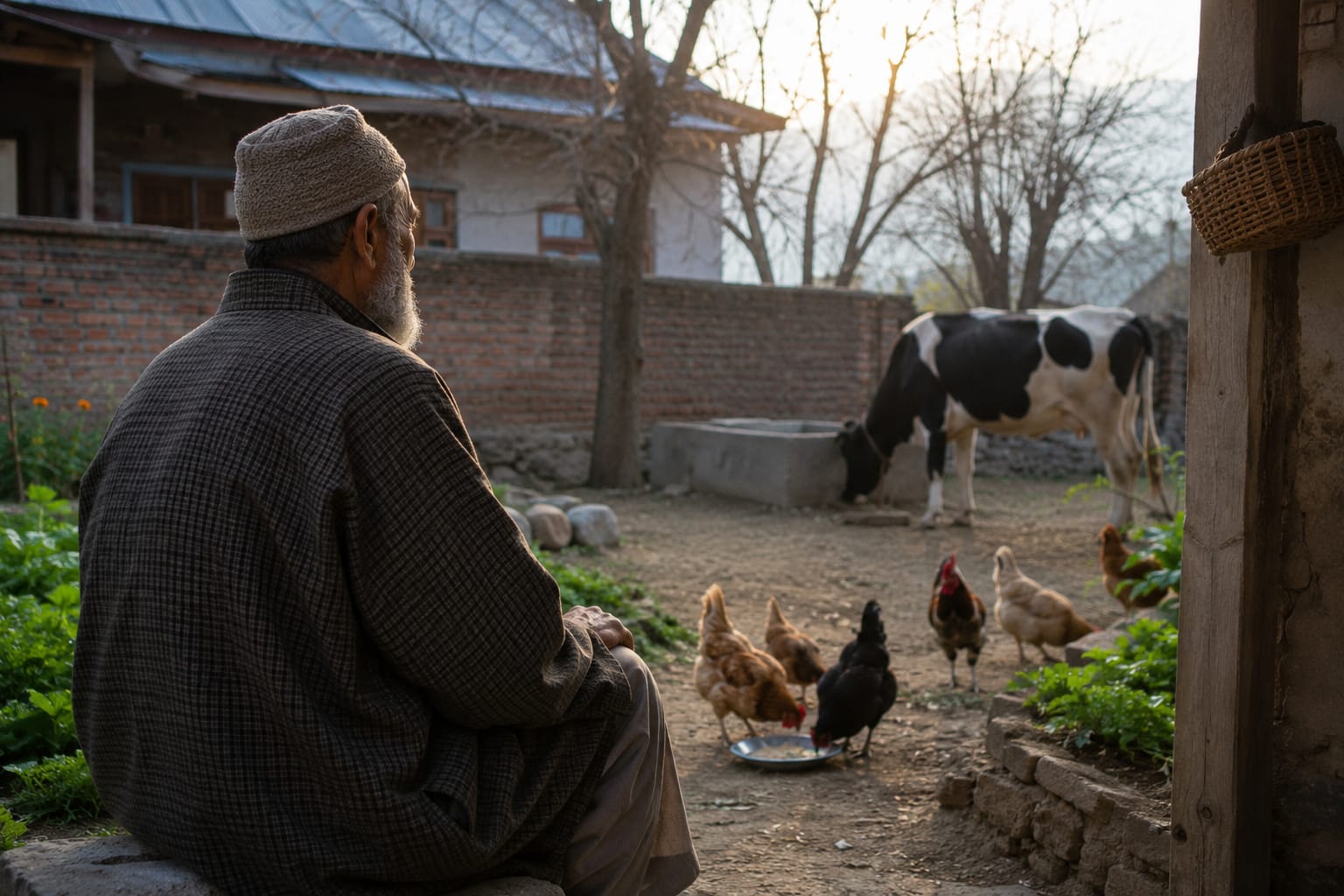
He walked into the courtyard and sat down.

It was the same courtyard that had once been the heart of a self-sufficient household. A cow used to stand tethered in one corner, chickens pecked grain in another, and daily life moved with a quiet rhythm of its own.

As he sat there, an old memory returned.

There had been a time when their cow had stopped giving milk. Some family members had suggested selling it since it was becoming a burden.

His father firmly refused.

“As long as I am alive, this cow will not leave this house. It is part of this family. I will never allow my daughters or daughters-in-law to depend on others for milk.”

At the time, Sahil had thought his father was simply being stubborn.

Today, he understood that his father had been protecting something far more valuable than a cow. He had been protecting self-reliance.

Another memory surfaced.

One late evening, long after darkness had fallen, Sahil’s old friend Ghulam Rasool arrived unexpectedly at their home.

Without hesitation, the family began preparing a meal. One of the chickens raised in the courtyard was brought out, and food was prepared immediately. The guest was welcomed with warmth and dignity.

No one had to rush to the market.

No one had to wait for supplies.

Everything they needed was already at home.

The memory faded, and Sahil found himself thinking of his late wife.

She had been more than a homemaker. She had been the soul of the household. She cared for the cow, fed the chickens, looked after the kitchen garden, and managed countless responsibilities that kept the family independent.

Life had been simple, yet complete.

Now times had changed.

Convenience had increased, but self-reliance had diminished.

Everything now depended on the market, and when the market stopped, life itself seemed to stop with it.

Sahil remained seated in the courtyard for a long time.

The memories of the past continued to flow through his mind.

Gradually, a truth became clear to him.

Once, people fulfilled many of their needs with their own hands.

Now they had become dependent on others for even the simplest necessities.

He looked up at the sky.

The voices of birds drifted gently through the air.

A quiet resolve took shape within him.

If life gave him another opportunity, he would rebuild a small foundation of self-sufficiency in his home: a cow, a few chickens, and a modest kitchen garden.

He wanted the coming generations to understand that progress does not mean abandoning one’s roots. True progress lies in moving forward while keeping those roots strong.

There was no longer any question in Sahil’s heart.

Only a quiet certainty remained!


Author is a retired District Information Officer. He can be mailed at  yousufmir555@gmail.com


Comments are closed.