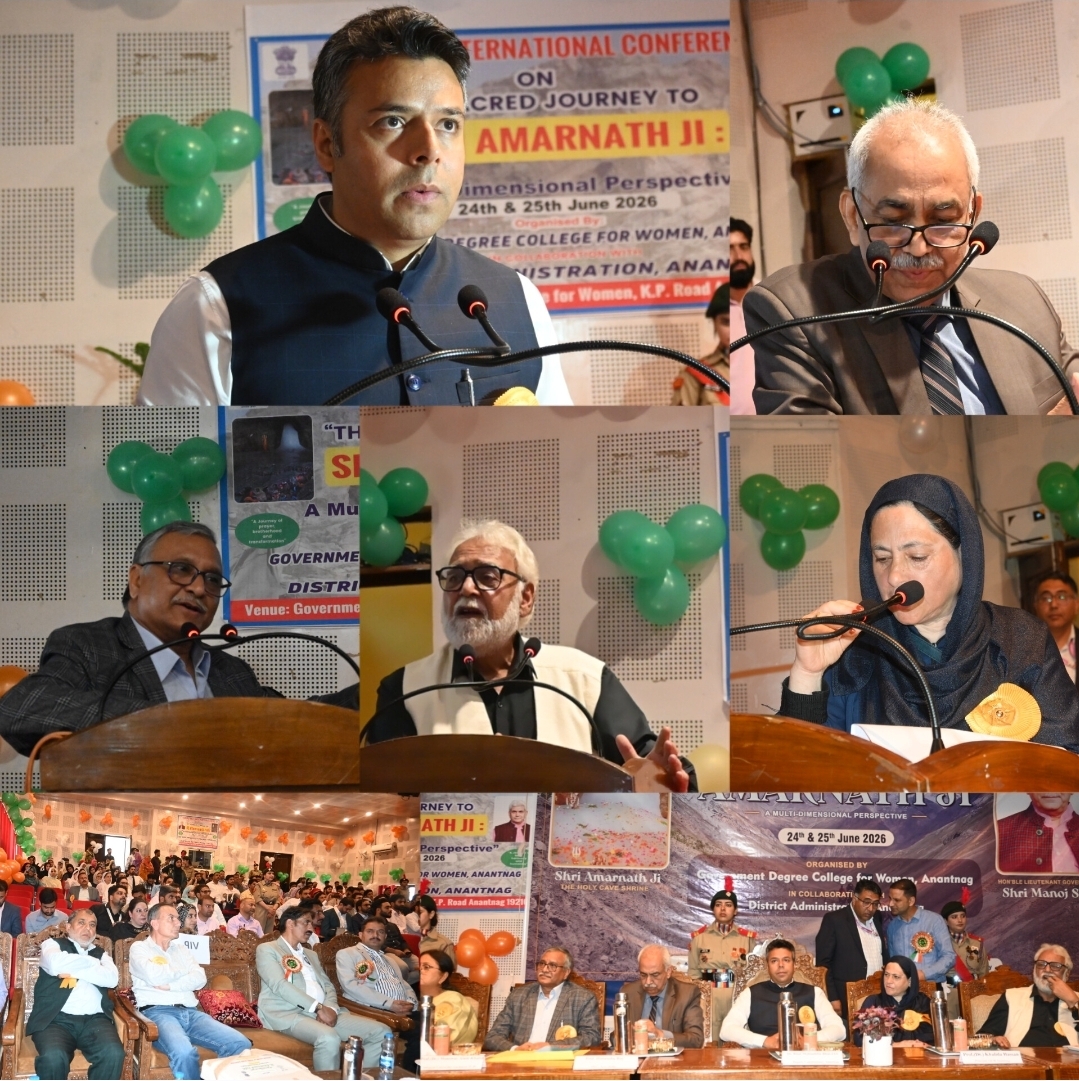
ANANTNAG, JUNE 24: First of its kind, a two-day International Conference on the theme “The Sacred Journey to Shri Amarnath Ji: A Multi-Dimensional Perspective” commenced today at Government College for Women (GCW), Anantnag.
The conference, being organised by District Administration in collaboration with the host college, has brought together administrators, faculty from reputed institutions and organisations, eminent academicians, researchers, scholars, students, officials and civil society members.
The inaugural session was attended by Deputy Commissioner(DC), Dr. Bilal Mohiuddin Bhat (Patron of the Conference), Principal GCW, Prof Khalida Hassan (Co-patron of the Conference), Prof Monowar Alam Khalid (Professor Environmental Science and Dean Students Welfare, Integral University Lucknow), Prof Himanshu Roy (Professor Centre for Political Studies, JNU), Prof Kapil Kumar (Former Chair Professor, Centre for Freedom Struggle and Diaspora Studies), Prof Farooq Ahmad Malik, GDCW (Organising Secretary), faculty of various Govt Degree Colleges, academicians, researchers, scholars, students and civil society members.
Three sessions were held on first day during which the speakers deliberated upon various aspects of the revered Shri Amarnath Ji Yatra (SANJY). They highlighted the historical, cultural and spiritual significance of the Annual Himalayan Pilgrimage besides elaborating it’s administrative, socioeconomic and ecological dimensions.
In her welcome address, Principal of the College highlighted the importance of academic discussions on heritage, traditions and the overall significance of the annual SANJY. She said the platform will serve as a great opportunity to engage on multicultural aspects of the sacred Shri Amarnath Ji Yatra.
Addressing the gathering, the Deputy Commissioner underlined the importance of preserving the cultural and spiritual legacy associated with Shri Amarnath Ji Yatra. He said that syncretic uniqueness of this annual pilgrimage is reflected from the fact that the service providers historically associated with the Yatra are often from different faith than that of visiting devotees.”The local community has always been at forefront and extended warm hospitality to the pilgrims making their sacred journey to the Holy Cave easy, comfortable and enriching’, he remarked.
Dr. Bilal talked about the immense contribution the annual pilgrimage has in keeping alive the multifaith and pluralistic traditions of Kashmir adding the same perfectly reflect the plural and inclusive ethos of our great nation. “The place, aptly called ” Peer Waer”, has long stood as a “melting pot” of different faiths and a cradle of cultural evolution where Shaivism, Sufism and other beliefs have evolved and thrived”, he noted. He informed the audience that this year several key measures have been taken for sustainable and greener Yatra and the district administration is committed to ensure it is conducted in a safe, seamless and pilgrim friendly manner.
Professor Kapil Verma while speaking on the occasion said that people of Kashmir have old age ethical and social connection with the Shri Amarnath Ji Yatra, emphasising the cultural pluralism and syncretic values of the place. He said that hospitality of Kashmir is well known to the world. He termed the local people as “part and parcel” of the sacred pilgrimage who always provide the necessary service and cooperation during the entire Yatra. He further highlighted the economic impact of the pilgrimage tourism besides the diversity of the nation.
During the inaugural session, Prof Monowar Alam Khalid delivered a special address on “Shri Amarnath Ji Yatra: Ecological Challenges and Suggested Solutions.” He called for complimenting the ecological wisdom with suitable technological interventions so the goal of a sustainable Yatra on the fragile Himalayan region is realised.
Prof Khalid further said that management decisions should be guided by ecological thresholds and scientific assessment of maximum carrying capacity keeping in view pilgrim numbers, camp strength, waste handling capacity, resource availability and emergency response mechanisms. He advocated for zero waste techniques, green energy transition, protection of resources and biodiversity, nature based solutions, involvement of local community, linking of Yatra with Sustainable Development Goals so that the sacred pilgrimage becomes a global model of sustainable religious tourism.
In his keynote address on “Multiculturalism in India: A Historical Trajectory”, Prof. Himanshu Roy said that multiple cultures have existed in India for centuries. He shared his valuable insights on the historical context of SANJY, enlightening the participants about the evolution of the spiritual journey.
Organising Secretary, Prof. Farooq Ahmad Malik gave an overview of the conference and emphasised the role of research and scholarly dialogue in understanding the pilgrimage from diverse perspectives.
The technical sessions witnessed paper presentations and detailed discussions by scholars and experts on themes including social, cultural and spiritual aspects of the Yatra, fostering peace and cultural resilience, philosophy of pilgrimage and ecological concerns.
The event aims to provide a platform for meaningful academic exchange and a comprehensive understanding of the sacred pilgrimage through multidisciplinary perspectives.


Comments are closed.