


Shoiab Mohmmad Bhat
“Scientists warn that continued deforestation could push rainforest ecosystems beyond a critical tipping point, triggering irreversible collapse with consequences for climate, agriculture, biodiversity, and human survival worldwide.”
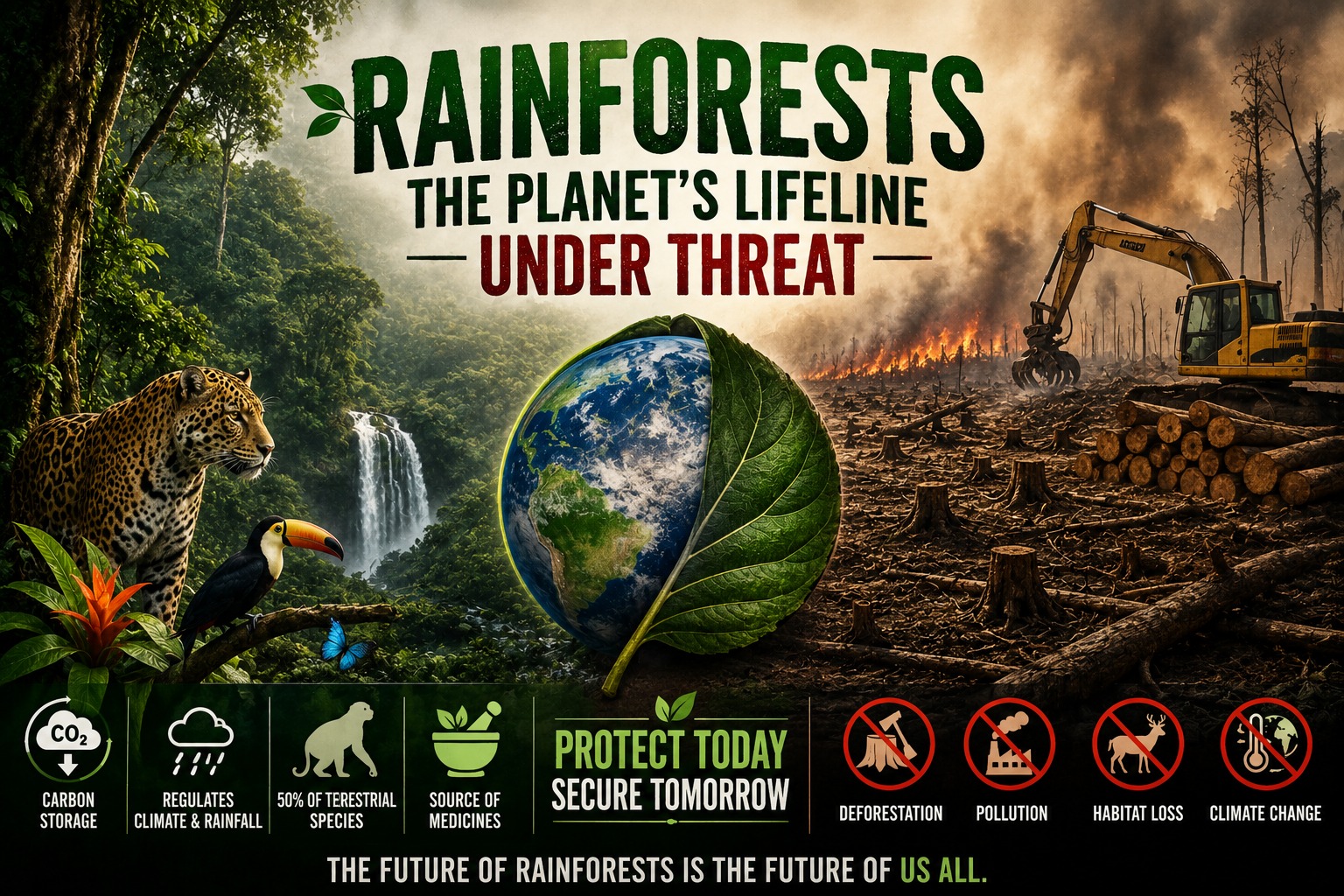
So, think about this for a second. What ecosystem holds over half the world’s terrestrial species, but covers less than 7% of the Earth’s surface? It is a staggering contrast, right? When we actually picture that level of density, literally half of all land-based life crammed into such a tiny concentrated fraction of the globe, it really hits us. This is not just a bunch of trees; it is the biological epicentre of our entire planet.
Section One: The Engines of Earth
Let’s look at their immense scale. Now, what’s really interesting about this is how it totally shatters a concept most of us were probably taught in grade school. You know the myth, right? The rainforests are the lungs of the Earth, constantly pumping out an endless supply of oxygen for us. Well, actually, scratch that. The reality is they are more like a massive global carbon vault. Mature rainforests are actually pretty close to carbon neutral. Instead of being these infinite oxygen factories, they are locking away just unfathomable amounts of carbon dioxide in their heavy biomass and complex soils, keeping it safely out of our atmosphere. And honestly, their engineering power goes way beyond just storing carbon. Get this, the Amazon rainforest literally generates its own rainfall. Through this wildly cool biological process called evapotranspiration, billions of trees act like giant water pumps, releasing so much water vapour into the air that they actively drive cloud formation. So they are not just reacting to the climate around them; they are actively engineering it, cooling our global and regional climates in the process.
Section Two: A Treasure Trove of Life
The hyper-dense biodiversity is hidden deep within these environments. Fifty per cent, just let that number sink in. Half of all known terrestrial species live right here in these forests. It is a giant puzzle of incredibly complex food webs and high species specialization. We are talking about everything from jaguars stalking the Amazon floor to orangutans swinging through Southeast Asia to gorillas navigating the Congo Basin. And that is not even counting the millions, literally millions, of plant and insect species scientists have not even documented yet. And this brilliantly illustrates how this global ecology grounds itself directly in our everyday human lives. A whopping 25%, that is one quarter of all our modern pharmaceuticals, are derived directly from rainforest plants. We are talking about life-saving medical compounds pulled straight out of the jungle canopy. And with so many species still completely undiscovered, the potential for new medicines is just off the charts. So, when we talk about preserving this ecosystem, we are really talking about protecting the foundation of modern healthcare.
Section Three: The First Guardians
Focusing on the human element, we see that indigenous people have lived in and sustainably managed these forests for thousands of years. They are the primary stewards. They maintain this incredibly deep generational knowledge about forest dynamics, and they actively protect these exact medicinal plant sources we were just talking about. And here is an absolutely crucial takeaway. The data backs this up. Research consistently proves that deforestation rates are significantly lower in indigenous-managed territories compared to completely unprotected areas. They are, without a doubt, the most effective frontline defenders of these ecosystems.
Section Four: A System Under Siege
Now, we need to take a serious look at the current reality, which brings us to a stark, unavoidable question. What happens when the engine stops? We have just seen how these forests regulate climate, lock away carbon, and house half of all land life. So, knowing that immense value, we really have to look at the powerful forces that are threatening to bring this whole planetary system to a grinding halt.
Okay, let’s dive into this and look at the exact human activities driving this destruction. First up is massive agricultural expansion, specifically clearing out huge tracts of land for cattle ranching and soy production. Then we have extensive logging operations, both legal and illegal, just stripping away the canopy. Add to that the infrastructure that cuts roads deep into untouched areas, plus the highly destructive mining and resource extraction that are poisoning the soil and water. These are the factual realities rapidly eating away at the edges and the heart of the forests.
This builds into a terrifying domino effect. Scientists call it the climate feedback loop.
Step one: As we lose those trees to the drivers mentioned, we see a massive reduction in carbon absorption.
Step two: This directly leads to a spike in atmospheric CO₂ and higher global temperatures.
Step three: The tipping point. The extreme heat and increased droughts can trigger an irreversible transformation, turning lush rainforest into dry savannah-like landscapes. It is a total ecosystem collapse from which there is simply no return.
Now, we might be wondering, how does a savannah thousands of miles away actually affect us? Well, consider this: disrupted water cycles mean a huge increase in drought risk globally. The moisture cycling, the evapotranspiration mentioned above, is critical. When the rainforests stop pumping all that water vapour into the atmosphere, regional and global rainfall patterns shift dramatically. That directly threatens agriculture all over the world. So, the loss of the rainforest is not just some distant tragedy. It is a literal threat to the stability of the food sitting on our dinner plates.
Section Five: How We Save Them
Let’s pivot to some urgent but optimistic solutions. So, the crucial point is understanding how massive international frameworks connect directly with our daily lives. On the global scale, we have international treaties like the Paris Agreement, REDD+ programs aiming to slash emissions from deforestation, and heavy lifting from NGOs like the World Wildlife Fund. But think about the other side: we have tangible individual power too. We can reduce our paper and wood consumption, actively avoid products linked to deforestation like unsustainable palm oil and beef, and deliberately choose to support FSC-certified products. Our daily economic choices literally fund or fight the destruction we saw earlier.
I will leave with a powerful thought to wrap up our explainer today. The future of the rainforest is inseparable from the future of humanity itself. These vibrant ecosystems are our planetary climate regulators, our global biodiversity reservoirs, and our massive water pumps. The actions we take right now, both at the global policy level and in our everyday individual choices, will absolutely dictate the future of this planet.
Comments are closed.