


World Food Safety Day: Safe Food, Healthy Lives

Syed Yunis Bukhari


“Safe food is not a privilege reserved for a few; it is a basic necessity for every human being. In a world where food travels across continents and reaches millions of consumers daily, even a single lapse in hygiene or quality control can have serious consequences. Protecting food safety is therefore not the responsibility of governments alone—it is a shared duty that begins on the farm and continues all the way to the family dining table.”

Food is the foundation of life. It nourishes the body, supports growth and development, and sustains communities and economies. Yet, food can only fulfill this role when it is safe for consumption. Every year on June 7, the world observes World Food Safety Day, a global initiative led by the World Health Organization (WHO) and the Food and Agriculture Organization (FAO) to raise awareness about the importance of preventing, detecting, and managing foodborne risks. The observance reminds us that access to safe food is not a privilege but a fundamental requirement for good health and well-being.

In an era marked by rapid urbanization, changing dietary patterns, globalization of food supply chains, and increasing environmental challenges, food safety has emerged as one of the most significant public health concerns worldwide. While food production has increased dramatically over the past few decades, ensuring that food remains safe from farm to fork continues to be a complex challenge. Food contamination can occur at any stage of the food chain during cultivation, harvesting, processing, transportation, storage, preparation, or consumption. A single lapse in hygiene or quality control can have serious consequences for public health.

According to the World Health Organization, an estimated 600 million people almost one in ten globally fall ill each year after consuming contaminated food, resulting in approximately 420,000 deaths. Children under the age of five bear a disproportionate burden of foodborne diseases, accounting for nearly one-third of all related deaths. These alarming statistics highlight that food safety is not merely a technical issue confined to laboratories and regulatory agencies; it is a critical public health priority that affects every household.

Foodborne diseases are caused by a variety of biological, chemical, and physical contaminants. Harmful microorganisms such as SalmonellaEscherichia coli (E. coli), Listeria monocytogenesCampylobacter, and various viruses can contaminate food and water, leading to illnesses ranging from mild gastrointestinal discomfort to severe infections and long-term health complications. Chemical contaminants, including pesticide residues, heavy metals, food additives used beyond permissible limits, and environmental pollutants, pose additional risks. Physical contaminants such as glass fragments, metal particles, or plastic pieces can also compromise food safety.

India, with its vast and diverse food ecosystem, faces unique food safety challenges. The country’s growing population, increasing demand for processed foods, and expansion of food service industries have amplified concerns related to food hygiene and quality assurance. Incidents of food adulteration, improper storage, unhygienic preparation practices, and contamination of water sources continue to pose risks to public health. Although regulatory mechanisms under the Food Safety and Standards Authority of India (FSSAI) have strengthened food safety governance, sustained awareness and compliance remain essential.

For Jammu and Kashmir, food safety holds particular significance. The region is renowned for its agricultural and horticultural produce, including apples, walnuts, saffron, cherries, almonds, and various traditional food products. These commodities contribute significantly to local livelihoods and the regional economy. Maintaining high standards of food safety is therefore crucial not only for protecting consumers but also for enhancing market confidence and expanding trade opportunities. As local food products increasingly reach national and international markets, adherence to food safety standards becomes a key determinant of competitiveness and sustainability.

The rise of street food culture and the growing popularity of ready-to-eat foods further underscore the importance of food safety awareness. Street food vendors provide affordable and accessible meals to millions of people, but inadequate sanitation, unsafe water, improper food handling, and poor waste management can increase the risk of contamination. Consumers must exercise caution and make informed choices regarding where and what they eat. Likewise, food business operators must recognize their responsibility in ensuring safe food handling practices.

Food safety is particularly important in healthcare settings, schools, hostels, and community institutions where vulnerable populations are served. Outbreaks of foodborne illnesses in such settings can affect large numbers of individuals within a short period. Strict adherence to hygiene protocols, regular inspections, staff training, and quality monitoring are essential preventive measures.

Medical laboratories play a crucial role in safeguarding food safety. Through microbiological analysis, chemical testing, and quality assurance procedures, laboratory professionals help identify contaminants, monitor compliance with safety standards, and support outbreak investigations. Advances in diagnostic technologies have improved the ability to detect foodborne pathogens rapidly, enabling timely interventions and reducing public health risks. The contributions of laboratory scientists, microbiologists, and public health professionals are therefore indispensable in building safer food systems.

Climate change has introduced new dimensions to food safety challenges. Rising temperatures, changing rainfall patterns, floods, and droughts can influence the prevalence and distribution of foodborne pathogens. Environmental changes may increase contamination risks and affect food production systems. Consequently, food safety strategies must increasingly incorporate climate resilience and sustainable agricultural practices.

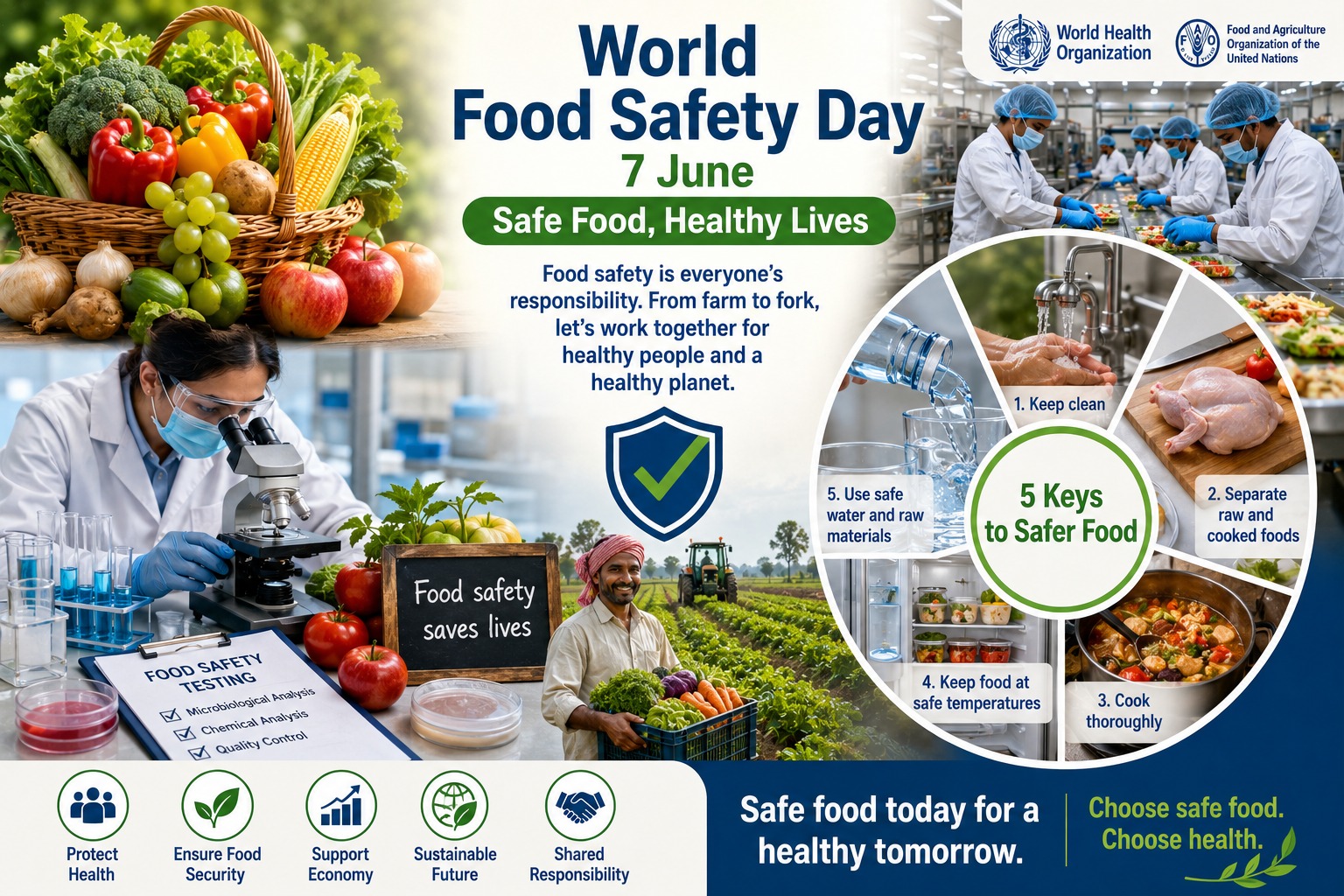
At the household level, simple preventive measures can significantly reduce foodborne illnesses. Washing hands before preparing food, using safe drinking water, separating raw and cooked foods, cooking food thoroughly, refrigerating perishables promptly, and maintaining kitchen hygiene are among the most effective interventions. The WHO’s “Five Keys to Safer Food” keep clean, separate raw and cooked foods, cook thoroughly, keep food at safe temperatures, and use safe water and raw materials remain universally relevant guidelines for consumers.

Educational institutions have an important role in promoting food safety awareness. Schools, colleges, and universities can organize seminars, workshops, poster competitions, awareness campaigns, and community outreach programs to educate students about safe food practices. Such initiatives help cultivate responsible behavior and encourage future generations to prioritize food safety in their personal and professional lives.

World Food Safety Day also serves as a reminder that food safety is a shared responsibility. Governments must strengthen regulatory frameworks and surveillance systems; food industries must maintain quality standards and ethical practices; healthcare professionals and researchers must continue generating evidence-based solutions; and consumers must adopt safe food handling habits. Effective collaboration among all stakeholders is essential to building resilient food systems capable of protecting public health.

As we observe World Food Safety Day, it is important to recognize that safe food is integral to achieving broader goals of health, nutrition, food security, economic development, and sustainable growth. The food we consume should nourish rather than harm. Ensuring this requires awareness, vigilance, scientific innovation, and collective commitment.

The message of this day is both simple and profound: food safety saves lives. By making informed choices, following hygienic practices, and supporting robust food safety systems, we can contribute to healthier communities and a safer future. Safe food is not only a public health necessity it is a cornerstone of human dignity, social well-being, and sustainable development.


Author is Assistant Professor at Department of Medical Lab Technology / University Institute of Allied Health Sciences, Chandigarh University. He can be mailed at  yunis.e16472@cumail.in

Comments are closed.