


Dr. Rizwan Rumi
“For generations, Kashmir’s farming rhythm moved in harmony with nature, but today that ancient ecological balance stands deeply disturbed by erratic weather, shrinking snowfall, violent storms, and devastating hailstorms.”
The Valley that once welcomed every season as a sacred blessing now increasingly watches the sky with fear.
For generations, Kashmir’s agricultural rhythm moved in harmony with nature. Spring carried the fragrance of almond blossoms, summer nourished emerald paddy fields, autumn crowned orchards with crimson apples, and winter wrapped the Valley in quiet resilience. The seasons were once predictable companions of rural life. Today, however, that ancient ecological rhythm stands deeply disturbed.
For the farmers and orchardists of Jammu & Kashmir, the year 2026 has unfolded not as a season of prosperity, but as one of devastation, anxiety, and silent economic collapse.
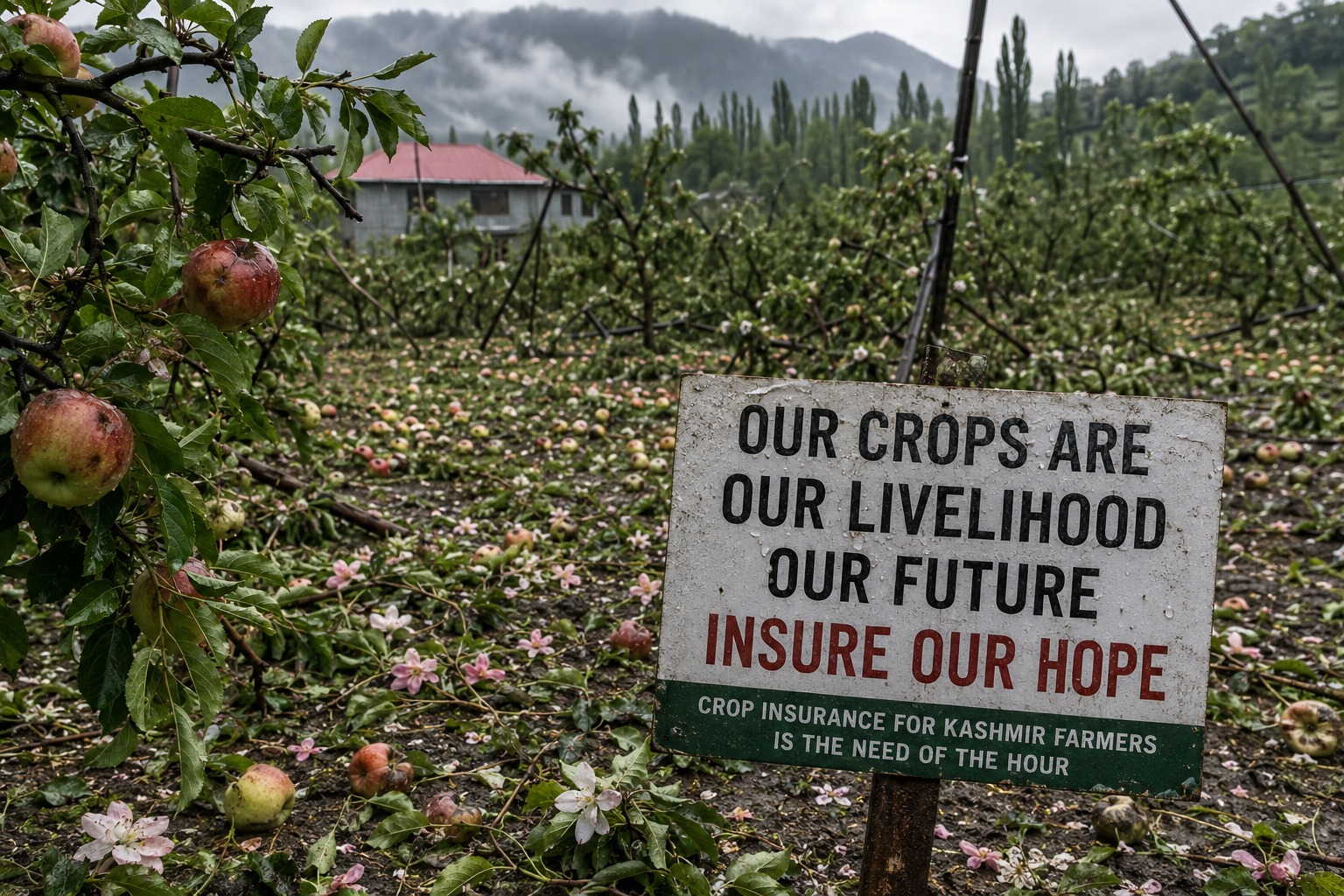
A chain of extreme weather events — beginning with the unseasonal disturbances of April 18, intensifying during the violent storms of May 12, and culminating in the catastrophic hailstorms of May 22, 2026 — has unleashed unprecedented damage across the Valley’s agricultural landscape. Standing crops have been flattened. Tender fruit blossoms have been shredded before maturity. Vegetable fields have drowned under relentless rainfall. Gusty winds have scarred orchards that represented years of labour and investment.
In district after district, the same heartbreaking scenes continue to emerge.
From the high-density apple orchards of Shopian and Kulgam to the vast horticultural belts of Sopore, Baramulla, Kupwara, Rafiabad, and Tangmarg, orchard floors now lie covered with broken branches, scattered blossoms, and bruised fruit. In villages such as Watergam, Lessar, Dandiwacha, and Tral, growers describe the destruction not merely as crop loss, but as the erasure of an entire year’s hope within minutes.
Local estimates suggest that in some severely affected areas, nearly 60 to 70 percent of fruit production has either been completely destroyed or suffered irreversible quality deterioration. What survived the hailstorms now faces secondary threats from fungal infection, bruising, moisture damage, and declining market value.
This is no longer an isolated agricultural setback.
It is a structural climate emergency unfolding in real time across the fragile Himalayan ecosystem of Jammu & Kashmir.
Agriculture and horticulture in Jammu & Kashmir are not merely economic sectors; they form the emotional and financial backbone of society.
According to official economic assessments, the horticulture sector alone supports more than seven lakh families and provides direct and indirect employment to nearly twenty-three lakh people. The sector generates an annual turnover exceeding ₹6,300 crore and contributes significantly to the Union Territory’s economy. Apples alone dominate the horticultural landscape, making Kashmir one of the most important fruit-producing regions in South Asia.
Yet behind these impressive macroeconomic figures lies a far more fragile human reality.
More than ninety percent of orchard owners in Kashmir are small and marginal growers whose livelihoods depend entirely on one successful harvest cycle. A single weather disaster can push entire families into debt traps from which recovery becomes nearly impossible.
For such households, crop failure does not remain confined to agriculture. It affects school fees, healthcare expenses, marriage arrangements, household consumption, and long-term social stability. When orchards fail, rural dignity itself begins to fracture.
The crisis becomes even more dangerous because farming in Kashmir has already become increasingly expensive. High-density apple cultivation requires massive investment in pesticides, fertilizers, anti-fungal treatments, labour, transportation, packaging, and irrigation. Many growers operate through borrowed capital and seasonal loans. When climatic disasters destroy produce before harvest, repayment becomes impossible.
This explains why repeated demands for loan waivers and special relief packages have emerged from fruit growers’ associations across the Valley following the recent hailstorms.
But relief alone is no longer enough.
The events unfolding in Kashmir today cannot be dismissed as random seasonal disturbances. They are deeply connected to the accelerating realities of climate change.
Scientists and environmental experts have repeatedly warned that Himalayan ecosystems are among the most climate-sensitive regions in the world. Rising temperatures, irregular snowfall, changing rainfall patterns, sudden cloudbursts, prolonged dry spells, and unseasonal storms are rapidly altering the agricultural calendar of Jammu & Kashmir.
Winters are becoming shorter and warmer. Snowfall patterns have grown inconsistent. Spring now arrives unpredictably. Hailstorms increasingly strike during crucial flowering and fruit-setting stages, when orchards are most vulnerable.
Traditional farming wisdom, once passed down through generations, is losing reliability in the face of rapidly changing climatic conditions.
Paddy cultivation, too, has entered a phase of uncertainty. In several parts of Kashmir, farmers are gradually abandoning traditional rice cultivation due to water scarcity, erratic rainfall, and declining profitability. Vegetable growers complain that sudden temperature fluctuations are increasing pest attacks and reducing productivity.
The ecological stability upon which Kashmir’s agrarian society historically depended is steadily weakening.
And yet, despite the growing frequency of climatic shocks, farmers continue to remain largely unprotected.
Every year after major storms, a familiar administrative cycle repeats itself. Political leaders visit affected areas. Survey teams are constituted. Damage assessments are ordered. Relief announcements dominate headlines for a few days. Yet on the ground, growers repeatedly complain that compensation arrives late, remains inadequate, and fails to reflect the true scale of losses.
The recent hailstorms have once again exposed the limitations of reactive governance.
For many orchardists, the losses are not merely physical but economic. Apples damaged by hail may survive on trees, but bruised or scarred fruit loses its market value entirely. Current compensation systems often fail to account for such quality deterioration.
This disconnect between official assessments and lived reality has deepened frustration among farming communities.
Many growers argue that existing relief mechanisms continue to function as temporary political responses rather than long-term agricultural protection frameworks.
That is precisely why the debate around crop insurance has now become urgent and unavoidable.
Why Crop Insurance Matters More Than Ever
India’s flagship agricultural insurance initiative, the Pradhan Mantri Fasal Bima Yojana (PMFBY), was introduced to protect farmers against crop losses caused by natural calamities, pests, and weather-related disasters.
Official records indicate that more than 11.6 lakh farmer applications from Jammu & Kashmir have been enrolled under the scheme over the years, with claims amounting to over ₹166 crore reportedly settled.
On paper, these numbers appear significant. Yet on the ground, a critical mismatch persists between policy design and Kashmir’s horticultural realities.
The scheme was largely designed around conventional agricultural patterns of the plains, where crop-loss calculations often depend on measurable yield reductions in cereals such as wheat or paddy. Kashmir’s horticulture economy, however, functions very differently.
Apple cultivation, walnut orchards, cherry production, and saffron farming operate under complex climatic and quality-sensitive conditions. A single hailstorm may not uproot a tree, but it can destroy the commercial value of the produce entirely.
This distinction is crucial.
A damaged apple may technically survive, yet become unsellable in premium markets. Similarly, saffron exposed to untimely rainfall can lose both quality and value despite partial physical survival.
Current insurance structures fail to adequately account for these nuanced realities of temperate horticulture.
Structural Gaps in the Existing Insurance Framework
-
Generic Insurance Models for Specialized Horticulture
Kashmir requires insurance frameworks specifically designed for high-value horticulture. Standardized models fail to capture region-specific vulnerabilities associated with apple orchards, walnut cultivation, cherry production, and saffron farming.
-
Delayed Assessments and Claim Settlements
Farmers frequently complain that lengthy procedural delays weaken trust in insurance mechanisms. By the time compensation arrives, growers have often already fallen into debt cycles.
-
Exclusion of Quality Loss
Most existing compensation systems focus primarily on quantity loss rather than market-quality deterioration. Bruising, scarring, fungal infections, and moisture damage remain insufficiently recognized despite causing enormous financial losses.
-
Poor Awareness and Documentation Challenges
Many small growers remain unfamiliar with enrollment procedures, documentation requirements, and claim processes. Tenant farmers, oral lessees, and sharecroppers often remain excluded altogether.
-
Weak Technological Integration
Although initiatives like YES-TECH and remote sensing technologies exist nationally, localized deployment in Kashmir remains limited. Real-time digital assessment systems are urgently needed.
The crisis demands more than sympathy. It demands structural reform.
If Jammu & Kashmir wishes to safeguard its rural economy against future climate shocks, a modern and region-specific agricultural protection architecture must emerge.
Weather-Indexed Insurance Systems
Localized weather-index insurance can dramatically improve transparency and efficiency. Automatic payouts triggered through weather stations measuring hail intensity, rainfall levels, or wind velocity can bypass bureaucratic delays.
Drone and Satellite-Based Damage Mapping
Advanced technologies should be integrated for rapid orchard assessment. Satellite imagery, AI-assisted crop mapping, and drone surveys can help establish accurate compensation frameworks.
Specialized Apple Insurance
Kashmir’s apple economy deserves a dedicated insurance mechanism tailored specifically for quality-sensitive horticulture.
Revival of Market Intervention Schemes
Alongside insurance, the government must revive and strengthen the Market Intervention Scheme (MIS) to provide price support for hail-damaged produce.
Inclusion of Marginal and Tenant Farmers
No insurance system can succeed while excluding vulnerable cultivators who bear operational risks despite lacking formal land ownership documents.
When crops fail in Kashmir, the consequences extend far beyond agriculture: A damaged orchard often means a daughter’s education interrupted, a medical treatment postponed, a family pushed into debt, or a lifetime of savings erased. The emotional devastation borne by farming households rarely appears in official statistics.
A farmer standing helplessly as hailstones strip his orchard does not merely lose fruit. He loses accumulated labour, inherited tradition, financial security, emotional stability, and the fragile hope upon which rural life survives.
This human dimension must remain central to every policy discussion on climate resilience and agricultural protection.
The Urgency of Political and Institutional Will
Jammu & Kashmir stands at a critical crossroads. The climate realities confronting the region are no longer temporary disruptions. They are becoming recurring patterns. Extreme weather events that once occurred once in decades now strike multiple times within a single season.
The old approach of reactive relief packages can no longer sustain rural Kashmir.
What is required instead is a comprehensive strategy combining climate-resilient agriculture, scientific forecasting, localized insurance models, digital transparency, market stabilization, and institutional accountability.
The Valley’s farmers do not seek charity. They seek security, dignity, and recognition for sustaining one of the most vital economic sectors of the region.
The farmer who feeds society should not remain abandoned before the fury of changing skies. If Kashmir’s orchards are to survive the storms ahead, crop insurance must evolve from symbolic paperwork into genuine ground-level protection. And that protection cannot wait any longer.
“Winters are becoming shorter and warmer, snowfall patterns increasingly irregular, and spring seasons dangerously unpredictable, weakening the traditional farming wisdom once passed down through generations.”
Comments are closed.