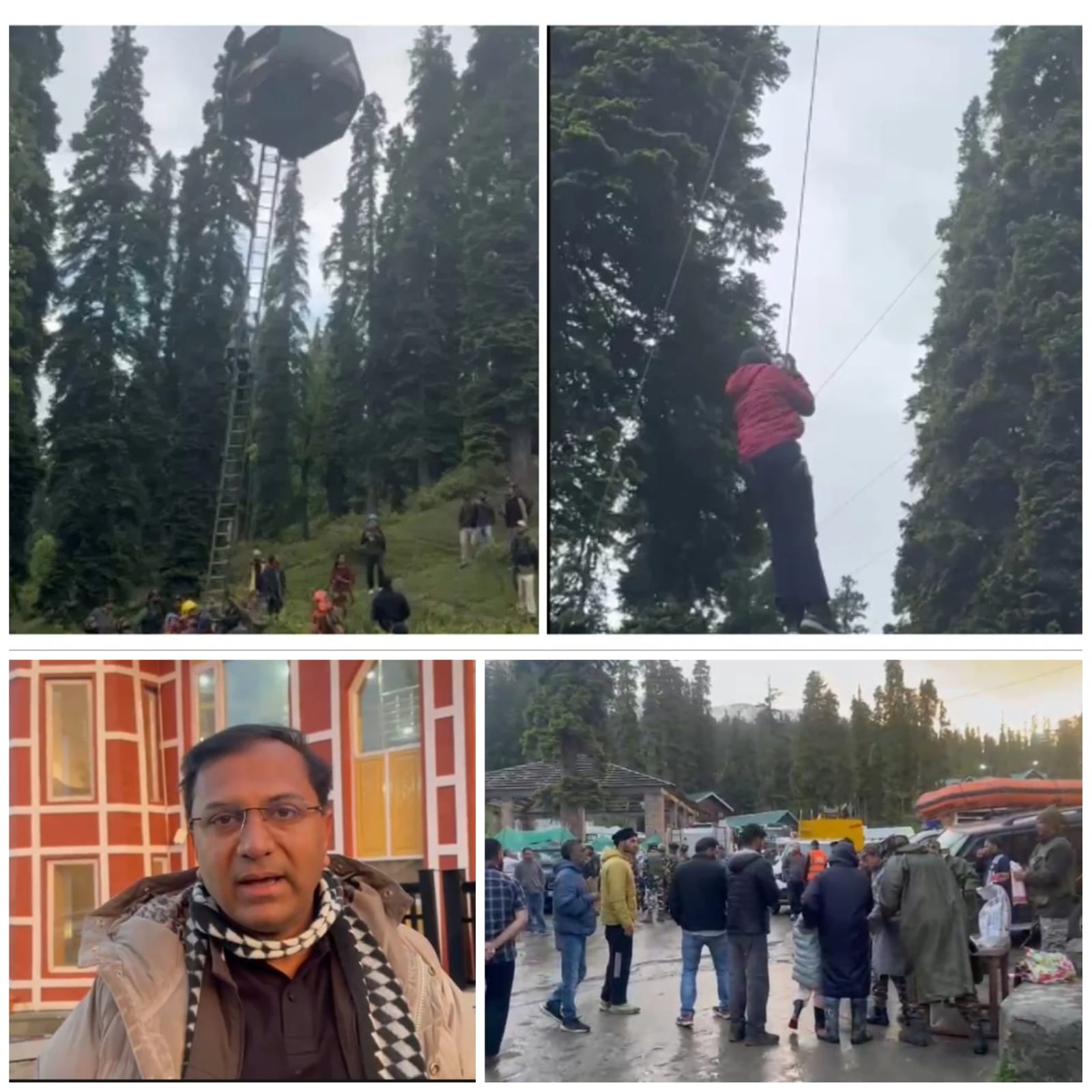
Gulmarg, May 25: The cable car swung without warning. Then it stopped. Mid-air. With 300 people inside.
For tourists aboard the Gulmarg Gondola on Monday, what began as a scenic ride over the snow-dusted Himalayas quickly turned into a fight against fear. Then, just as quickly, relief — as Jammu and Kashmir’s administration, police and the Army turned a potential tragedy into a masterclass in disaster response.
“I held my daughter and prayed. That’s all I could do,” said Sanjina, a tourist from Gujarat, her voice still trembling minutes after being lowered to safety. “When the gondola stopped suddenly, everyone started crying. Children were screaming. An old lady in our cabin kept saying ‘Hai Ram, Hai Ram.’ I thought we would never come down.”
She paused, wiping her tears. “But then we saw the Army men reaching us. They were climbing, shouting ‘Mat ghabrao, hum hain.’ I have never felt so safe in my life. I want to touch their feet.”
For Priya Sharma, travelling from Delhi with her 68-year-old mother, the moment the cable car stopped was the longest of her life.
“My mother clutched her chest and said she felt dizzy. I lost all hope. I screamed for help even though no one could hear,” Priya told Kashmir Convener. “Then a police officer somehow reached our cabin. He gave my mother water, held her hand and said, ‘Aapki maa mere upar chhod do, main safely leke jaunga.’ He didn’t leave her side until we were on the ground. I don’t even know his name. But I will never forget his face.”
Ramesh Nair, a tourist from Mumbai, said the panic inside his cabin was indescribable. “My daughter was crying uncontrollably. I didn’t know what to say to her. The man next to me — a grown man in his 40s — started crying. He said he had never been so scared in his life.”
But Ramesh said the rescue changed everything. “Within minutes, we saw rescue teams climbing up. The police were on the loudspeaker asking us not to panic. The Army reached our cabin first. A young jawan looked me in the eye and said, ‘Sir, aapke bachche ko kuch nahi hoga. Main khud utha ke le jaunga.’ And he did. Despite the harsh weather, they made us feel comfortable. The administration deserves a standing ovation.”
As rescue teams from the Army’s 9 Raj Rif, J&K Police, SDRF and civil administration worked in coordinated shifts, stranded passengers watched from above as personnel rappelled and secured each cabin one by one.
“No doubt we were very afraid,” Sanjina said. “But the efforts of the administration made everything easy. They helped us step out, gave us water, biscuits, and took us to a warmer place. One officer even gave his own jacket to a shivering child. I will never forget what they did for us.”
Another tourist, Meera Das from Kolkata, said the rescuers kept talking to them to prevent panic. “A jawan was telling us jokes. Can you believe it? Hanging mid-air, and he was telling jokes to keep us calm. He said, ‘Madam, aap toh Kashmir ka view dekh rahe ho free mein. Aur kya chahiye.’ We laughed. We were still scared, but we laughed. That’s when I knew we were in safe hands.”
A young couple from Bengaluru, married just six months ago, said the experience brought them closer — but only because of the rescuers.
“We were on our honeymoon,” said Aarav, 28. “We thought this was the end. My wife kept saying ‘I love you’ again and again. But then we heard the Army’s siren from below. And then we saw them coming up. One of them shouted, ‘Aap logon ko kuch nahi hoga, hum hain na.’ That one line — ‘hum hain na’ — that gave us more strength than anything else.”
His wife, Neha, added: “They didn’t let us lose hope for a single moment. Not once. Even when the wind picked up and the cabin started swinging again, they kept assuring us. We are going back home tomorrow, but we will never forget what these men and women did for us.”
The Mumbai tourist who had earlier broken down returned to the base with a different expression. “At one point I was crying uncontrollably. I called my mother and told her I might not come back. It was no doubt a terrible situation,” he said, his voice heavy. “But within no time, the administration’s rescue operation made us feel comfortable. One rescuer sat with me and said, ‘Bhai, aap Mumbai se ho? Mera bhai bhi Mumbai mein rehta hai. Chai peene kabhi aana.’ He made me smile in the middle of all that. They took us back to Gulmarg safely. Their efforts deserve a great applause. Really.”
Despite the trauma, some tourists said the rescue had restored their faith in Kashmir.
“I was angry at first. I thought, why did I come here?” said Vikram Singh from Rajasthan. “But after seeing how they rescued us — how every single person from the Army, police, and administration worked like clockwork — I feel differently. I will bring my family again next year. Not despite what happened. Because of how they handled it. That takes courage.”
As the last cabin was emptied and families reunited on the ground, the Gulmarg Gondola — one of the highest cable car systems in the world — remained shut for technical inspection. But for the 300 who lived through those hours, the image that will last isn’t of the stalled ride. It’s of the soldiers, police and rescuers who didn’t let them lose hope.
“Jai Ho,” Sanjina said, wiping her tears, her daughter now sleeping in her arms. “To the Army, to the police, to everyone. They saved us. Not just from the cable car. They saved us from our own fear.”
Another tourist, an elderly man from Punjab who had been silent throughout, finally spoke as he walked toward a waiting bus: “Main 70 saal ka hoon. Bahut kuch dekha hai zindagi mein. Aaj jo dekha, woh kabhi nahi bhoolunga. Yeh log mahan hain.”
Managing Director of the Cable Car Corporation, Syed Qamar Sajjad, confirmed four specialised rescue teams were deployed alongside police and SDRF personnel.


Comments are closed.