

Shabeer Ahmad Lone
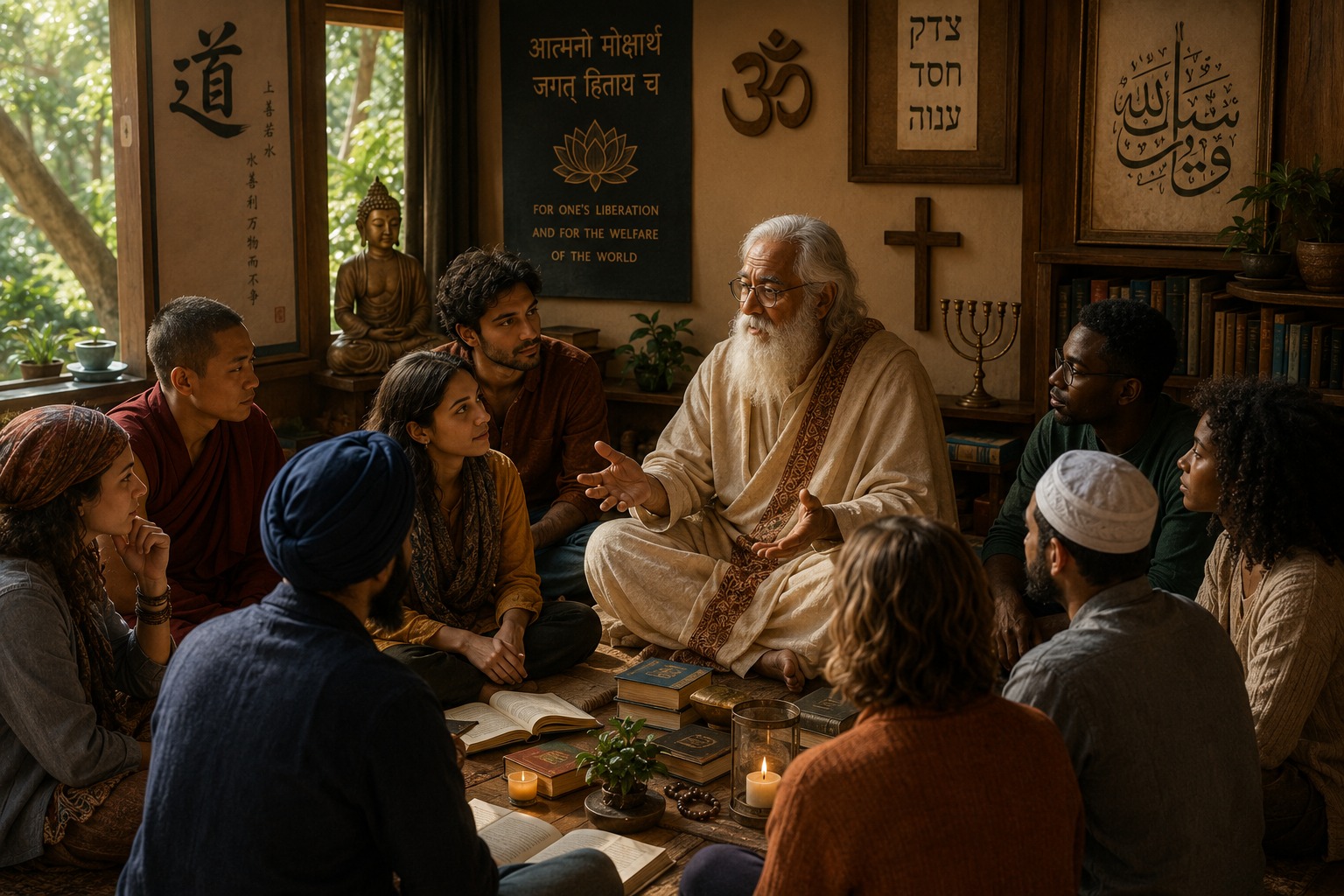
The phrase The Living Master: Practical Wisdom and the Path to Wholeness gathers within itself one of humanity’s oldest recognitions and one of its newest needs: that no civilization can survive on information alone, and no person can become whole through technique alone. We inherit scriptures, philosophies, sciences, constitutions, markets, and machines, yet the decisive question remains unchanged across ages: what kind of human being do these produce? The answer has always depended less on systems than on persons in whom truth becomes character, compassion, steadiness, and luminous responsibility.
Every culture has therefore honored some form of the realized guide: the guru, sage, rabbi, philosopher, elder, lama, monk, murshid, saint, teacher, mother of wisdom, healer, reformer, or just neighbor whose life quietly demonstrates that human beings are capable of more than appetite, fear, vanity, and imitation.
To speak of the living master today is not to advocate blind obedience or romanticize authority. Modern memory has witnessed cults, spiritual fraud, ideological fanaticism, clerical abuse, political demagoguery, and charismatic narcissism. Suspicion toward authority is often earned wisdom. Yet societies that reject all guidance do not become free; they become vulnerable to subtler masters-advertising, algorithms, addiction, tribal outrage, celebrity culture, and the marketization of attention. When visible sages disappear, invisible manipulations often take their place. The central issue is therefore not whether we shall be guided, but by whom, by what, and toward which ends.
The authentic guide in every tradition does not replace conscience but awakens it. Such a person does not seek worship but maturity, not dependency but responsibility, not applause but growth. The false master narrows the soul; the true master enlarges it. The false master fears questions; the true one deepens inquiry. The false master thrives on secrecy and flattery; the true one welcomes accountability. The false master promises borrowed greatness; the true one teaches the dignity of inner labor. Discernment is therefore itself a spiritual virtue.
The Hindu tradition long understood that wisdom is transmitted not merely through propositions but through transformative relationship. The Upanishadic teacher often answers by silence, paradox, or questions that reorder consciousness. The Bhagavad Gita places instruction in the midst of moral crisis, showing that genuine guidance must address confusion, duty, grief, courage, and action in history rather than escape from it. Bhakti saints and later teachers such as Ramakrishna, Vivekananda, Mirabai, and Anandamayi Ma widened the path by showing that love, service, song, and surrender can become schools of liberation. The guru at its noblest is not owner of disciples but remover of darkness.
The Taoist tradition offers a wisdom especially urgent for mechanized and anxious societies. Laozi and Zhuangzi warn that excessive forcing often creates the very disorder it seeks to solve. The deepest mastery may appear as humility, patience, proportion, and attunement to the hidden rhythms of reality. In a world addicted to domination, Taoism reminds us that gentleness can be stronger than hardness, emptiness more useful than clutter, and non-display more fertile than spectacle.
The Jewish tradition binds wisdom to memory, justice, and covenantal responsibility. Prophets challenged kings when power betrayed righteousness. Rabbinic culture honored disciplined disagreement, textual interpretation, and ethical reasoning. Learning was never meant to remain abstract; it was to shape honesty in trade, care for the widow, dignity for the stranger, and reverence in daily conduct. Hasidic teachers later added joy, inward sincerity, and sanctification of ordinary life. Here the living master is one who remembers God by refusing to forget the vulnerable.
The Graeco-Roman tradition contributes one of humanity’s clearest accounts of practical wisdom. Socrates made philosophy a moral awakening rather than an academic specialty. Plato sought the ordering of desire by truth. Aristotle named phronesis, the art of judging rightly amid changing circumstances. Stoics such as Epictetus and Marcus Aurelius taught that freedom lies less in controlling events than in governing responses. Their counsel speaks freshly to an age ruled by reaction: one may lose possessions, status, and certainty, yet still preserve dignity, proportion, and inward sovereignty.
The Buddhist tradition remains among the most penetrating diagnoses of suffering. It identifies craving, ignorance, and clinging as engines of dissatisfaction. Yet its genius is practical: attention can be trained, compassion cultivated, reactivity softened, illusion seen through. The awakened teacher points not to dogma alone but to disciplined observation of mind and conduct. Later Mahayana traditions enlarged the horizon through the Bodhisattva ideal: seek liberation in solidarity with all beings. Zen added the sacrament of ordinary presence. Contemporary mindfulness research, trauma healing, and compassion science increasingly rediscover insights that contemplatives cultivated centuries ago.
The Christian tradition centers the paradox that the highest authority kneels to wash feet. In Jesus, greatness is joined to service, truth to mercy, power to sacrificial love. Desert monastics sought purification from distraction; Augustine analyzed the restless heart; Francis of Assisi embodied joyful poverty and kinship with creation; Teresa of Ávila and John of the Cross mapped the interior life; Julian of Norwich offered hope amid catastrophe; Thomas Merton critiqued the false self manufactured by conformity. Christianity’s enduring gift is the claim that transformation occurs not through domination but through love willing to bear wounds without surrendering truth.
The Sufi tradition, flowering within Islam, speaks in the language of polishing the heart. Rumi saw love as the fire that burns vanity. Ibn Arabi described the human being as mirror of divine names when cleared of distortion. Al-Ghazali joined theology, ethics, and psychology, warning against knowledge without sincerity. Rabia al-Basri transformed devotion into pure love beyond fear and reward. The true murshid is physician of the inner life, helping the seeker recognize subtle forms of pride, heedlessness, and self-deception. Remembrance becomes medicine for fragmentation.
The Sikh tradition offers one of the most integrated syntheses of devotion and public ethics. Guru Nanak proclaimed the unity of God, equality of humanity, rejection of caste arrogance, dignity of honest labor, and sanctity of service. The Gurus shaped communities where prayer and courage, contemplation and resistance to tyranny, humility and honor coexist. The Guru Granth Sahib stands as living wisdom, while langar embodies radical hospitality. Sikh tradition reminds modern societies that spirituality without equality is unfinished.
Yet a truly global understanding of the living master must also honor Indigenous, African, and other marginalized wisdoms too often neglected by formal canons. Many Indigenous traditions understand elders as keepers not merely of ideas but of relationships-between generations, land, ancestors, ritual, and responsibility. African philosophies such as Ubuntu affirm that a person becomes a person through other persons. Aboriginal traditions teach belonging to country rather than possession of it. Latin American liberation voices insist that the cry of the poor is itself a theological text. These traditions widen the meaning of mastery: wisdom is communal, ecological, and historical, not merely individual.
The modern world also reveals non-sectarian masters whose authority emerged through public courage rather than formal sanctity. Gandhi experimented with truth through disciplined nonviolence. Nelson Mandela transmuted bitterness into reconciliation. Martin Luther King Jr. joined prophetic religion to democratic hope. Viktor Frankl found meaning amid degradation. Abdul Sattar Edhi converted compassion into institutions of mercy. Such figures show that the living master may wear no robe, belong to no monastery, and speak in civic rather than devotional language.
Women mystics and guides deserve special remembrance because history often preserved their light inadequately. Hildegard of Bingen united spirituality, music, medicine, and cosmology. Mirabai defied convention through ecstatic devotion. Rabia purified love of calculation. Teresa of Ávila combined mystical depth with administrative brilliance. Julian of Norwich spoke tenderness in plague-ridden times. Anandamayi Ma radiated serenity to seekers across divides. Their witness corrects any assumption that spiritual authority is male by nature.
What all these traditions and figures share is not doctrinal sameness but a recurring diagnosis: the deepest human obstacles are inwardly rooted and socially amplified. Ego, greed, fear, resentment, envy, forgetfulness, compulsive comparison, tribal hatred, and disordered desire deform persons and institutions alike. Yet the crisis today is intensified by structural forces: inequality that humiliates, war that traumatizes, displacement that uproots, economies that reward restlessness, technologies that monetize distraction, and cultures that confuse visibility with worth. Many suffer not only from personal vice but from systems that fragment attention, community, and dignity.
For this reason, the path to wholeness cannot be reduced to private self-help. It must include healing of trauma, fair institutions, meaningful work, ecological responsibility, truthful media, humane education, and cultures of belonging. A hungry child needs food before metaphysics; a war survivor needs safety before lofty abstractions; the unemployed need opportunity as well as advice. Spiritual maturity that ignores material injustice becomes decorative.
Wholeness itself must be understood carefully. It does not mean perfection, permanent serenity, or immunity from grief. It means integration. Thought, conscience, desire, body, memory, and action gradually cease sabotaging one another. One’s outer life begins to resemble one’s deepest recognized values. The whole person still struggles, but no longer lives fundamentally divided. Carl Jung named a related process individuation; contemplatives called it recollection, union, awakening, surrender, or return.
The means of such integration are both ancient and newly validated: silence, prayer, meditation, breath discipline, gratitude, truthful speech, fasting from excess, beauty, service, honest labor, study, companionship with the wise, ethical habits, and remembrance of mortality. Neuroscience now speaks of neuroplasticity; psychology studies habit formation; trauma therapy emphasizes regulation and safety; behavioral science confirms that repeated small acts reshape life. Traditions long knew what laboratories increasingly map: attention can be trained, character cultivated, compassion strengthened, impulses moderated.
Death, long banished from polite conversation, remains one of the great teachers. Stoics remembered mortality to clarify priorities. Buddhists contemplated impermanence to loosen attachment. Sufis spoke of dying before death through ego-transcendence. Christian traditions cultivated ars moriendi, the art of dying well. Sikh history sanctified fearlessness before tyranny. Awareness of death can rescue life from triviality.
Art and beauty too are underappreciated masters. Sacred music, qawwali, bhajans, chant, iconography, temple architecture, calligraphy, poetry, gardens, and silence-filled spaces educate perception without argument. Beauty can reconcile what logic cannot. It can awaken gratitude, humility, longing, and tenderness where slogans fail.
Young people especially need renewed forms of guidance. Screen-saturated generations often inherit stimulation without steadiness, options without orientation, networks without intimacy. Education that trains employability but neglects wisdom leaves many technologically skilled yet existentially adrift. Schools and universities must again become places where character, civic responsibility, emotional maturity, and contemplative depth are honored alongside competence.
Communities themselves can function as living masters. Sangha, sangat, church, synagogue, ethical friendship circles, healthy families, neighborhood solidarities-all teach habits of patience, accountability, and shared meaning. In some cases communities protect seekers better than charismatic individuals. The path need not always pass through extraordinary personalities; it often proceeds through ordinary fidelity sustained together.
Transformation usually arrives quietly. Rising early for silence. Refusing gossip. Returning a lost wallet. Caring for aging parents. Simplifying consumption. Telling the truth when costly. Listening without rehearsing reply. Repairing harm through apology. Serving without advertisement. Beginning again after failure. Small fidelities accumulate into character, and character gradually becomes destiny.
At the civic level, democracies depend on citizens capable of self-government, and self-government presupposes some measure of self-mastery. A population unable to restrain appetite, evaluate claims, resist demagogues, or sacrifice immediate gratification for long-term goods becomes politically fragile. Thus practical wisdom is not private luxury; it is public infrastructure.
The deepest meaning of The Living Master: Practical Wisdom and the Path to Wholeness may therefore be twofold. It honors those luminous persons, communities, and traditions whose lives reveal what humanity can become. And it points inward to the latent sovereignty within each conscience-the capacity to govern fear by trust, appetite by proportion, resentment by mercy, power by justice, and freedom by responsibility. External guides are worthy only insofar as they awaken this inner dignity.
Our age does not chiefly lack data, devices, or noise. It lacks integrated human beings. It lacks elders with credibility, leaders with conscience, teachers with depth, healers with tenderness, citizens with discipline, and institutions with soul. Wherever humility joins courage, clarity joins compassion, strength joins gentleness, and wisdom joins service, the living master appears again-not as relic of the past, but as necessity of the future.
Comments are closed.