

Yamin Mohammad Munshi
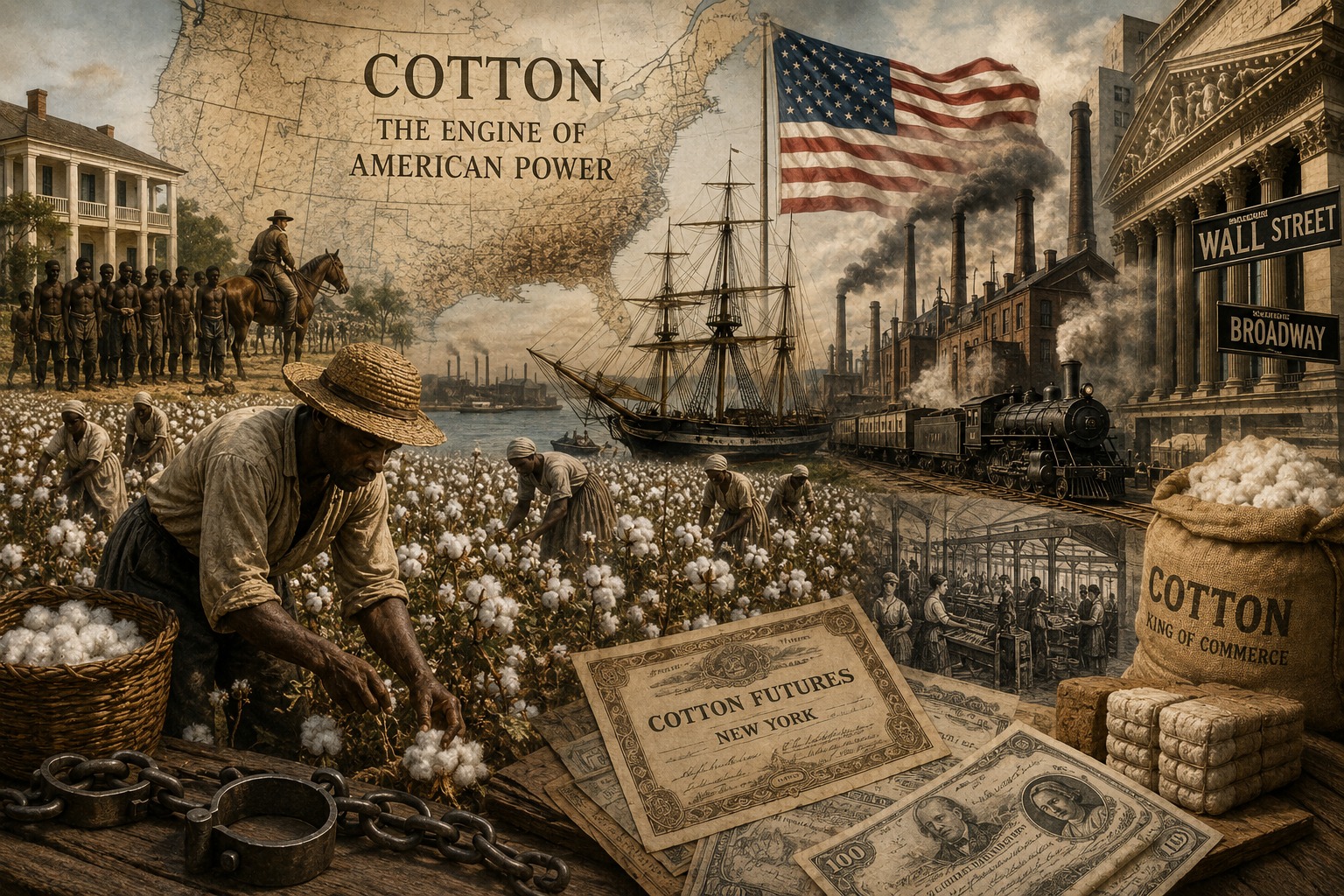
The story of America’s rise to global dominance is often narrated through the language of democracy, constitutional ideals, technological innovation, and entrepreneurial spirit. Yet beneath these celebrated narratives lies a far more uncomfortable reality: the United States emerged as a superpower through the immense economic and geopolitical transformations unleashed by cotton.
Among the innumerable commodities that traversed the arteries of the early modern and modern world-system, none exercised a more transformative influence upon the geopolitical, economic, and civilizational ascent of the United States than cotton. Iron, coal, petroleum, and steel undoubtedly became indispensable to later phases of industrial expansion, yet prior to their dominance there existed a softer but infinitely more consequential substance whose cultivation reorganized continents, intensified slavery, accelerated industrial capitalism, expanded imperial finance, and repositioned the United States from a peripheral agrarian republic into the nucleus of an emerging global order. Cotton was not merely an agricultural commodity; it was the metabolic fuel of Atlantic capitalism itself.¹
The rise of the United States into a superpower cannot be analytically isolated from the vast “cotton chain reaction” that unfolded between the late eighteenth and early twentieth centuries. The phrase “chain reaction” here refers not metaphorically alone, but structurally: cotton stimulated one economic transformation which generated another, thereby producing cumulative and self-reinforcing historical consequences. Textile mechanization intensified demand for raw cotton; demand for raw cotton expanded plantation slavery; plantation slavery accelerated territorial conquest; territorial conquest enlarged financial markets; financial expansion facilitated industrial infrastructure; industrial infrastructure strengthened military and geopolitical capability. Cotton thus operated as a catalytic mechanism within the broader emergence of industrial modernity.
The history of American cotton is simultaneously a history of coerced labor, settler colonialism, racial capitalism, and transnational accumulation. The cotton economy linked Mississippi plantations to Manchester textile mills, enslaved African laborers to London credit markets, Indigenous dispossession to global industrialization, and Wall Street finance to imperial commerce. In this sense, cotton constituted the connective tissue binding together capitalism’s agricultural, industrial, and financial phases.²
Moreover, cotton destabilizes triumphalist narratives of American exceptionalism. The United States did not ascend solely through democratic ideals, constitutional innovation, or entrepreneurial ingenuity. Its rise was materially underwritten by plantation violence, slave labor, speculative finance, and global commodity integration. The American republic proclaimed liberty while simultaneously constructing one of the most profitable systems of human bondage in modern history. Cotton stood at the center of this contradiction.
This article argues that cotton functioned as the foundational accelerator of American superpower formation. It examines how cotton transformed the United States economically, territorially, politically, and internationally, while simultaneously embedding structures of racial inequality and capitalist extraction into the fabric of modern America. More significantly, it contends that cotton was not ancillary to American development but constitutive of it. The United States became a superpower not despite cotton, but through the immense accumulative processes cotton unleashed across the Atlantic world.
I. Cotton and the Reorganization of the Atlantic World-Economy
Prior to the eighteenth century, cotton occupied a relatively modest position within the hierarchy of global commodities. Indian textile producers dominated international cotton manufacturing for centuries, while European states largely depended upon Asian imports.³ However, the Industrial Revolution radically altered the economic geography of cotton production and consumption.
The mechanization of textile manufacturing in Britain generated an unprecedented demand for raw cotton inputs. Innovations such as James Hargreaves’s spinning jenny, Richard Arkwright’s water frame, and Edmund Cartwright’s power loom exponentially increased productive capacity within British textile industries.⁴ Yet mechanization created a paradox: factories could manufacture textiles at extraordinary speed, but raw cotton supplies remained insufficient.
The American South emerged as the solution to this industrial crisis. Climatic conditions, fertile soil, and expanding territorial frontiers rendered the region ideal for cotton cultivation. However, large-scale production required an immense labor force. It was at precisely this conjuncture that the plantation-slavery complex intensified dramatically.
The invention of the cotton gin in 1793 by Eli Whitney transformed cotton from a difficult crop into an extraordinarily profitable one.⁵ Whitney’s machine accelerated seed separation efficiency to such an extent that plantation expansion became economically irresistible. Contrary to later myths that technological innovation naturally diminishes coercive labor, the cotton gin intensified slavery by dramatically increasing the profitability of slave-based production.
Thus, industrial capitalism and plantation slavery developed symbiotically rather than antagonistically. British industrialization required American cotton; American cotton required enslaved labor; enslaved labor required territorial expansion and political protection. The Atlantic economy consequently reorganized itself around a triangular structure connecting industrial Europe, plantation America, and coerced African labor.
By the early nineteenth century, cotton had become the single most important export commodity of the United States.⁶ Entire regional economies, financial institutions, and political systems became structurally dependent upon its continued expansion.
II. Slavery, Racial Capitalism, and the Political Economy of Cotton
The rise of cotton transformed slavery from a declining institution into the engine of American economic expansion. Between 1790 and 1860, the enslaved population of the United States increased from approximately 700,000 individuals to nearly four million.⁷ This demographic expansion reflected not merely population growth but the increasing commodification of human beings within plantation capitalism.
Historians increasingly employ the term “racial capitalism” to describe the relationship between slavery and capitalist accumulation.⁸ Enslaved Africans were not external to capitalism; they were central to it. Plantation owners implemented sophisticated accounting systems, productivity measurements, debt instruments, and labor-management practices designed to maximize output and profitability. Cotton plantations operated less like feudal estates and more like vertically integrated capitalist enterprises.
The domestic slave trade became a mechanism of internal colonialism. Hundreds of thousands of enslaved individuals were forcibly relocated from the Upper South into expanding cotton territories across Alabama, Mississippi, Louisiana, and Texas.⁹ Families were fragmented, bodies commodified, and labor extracted with industrial precision.
Moreover, enslaved persons themselves became financial instruments. Banks accepted enslaved bodies as collateral for loans, thereby transforming human life into securitized capital.¹⁰ The plantation economy consequently intertwined with emerging financial markets in New York, Liverpool, and London.
Northern commercial interests also profited enormously from slavery. Shipping firms transported cotton internationally; insurance corporations insured slave property; textile mills processed Southern cotton; financiers speculated on cotton futures markets. The notion of a morally distinct industrial North versus a slaveholding South therefore obscures the degree to which Northern capitalism was deeply implicated in plantation accumulation.¹¹
By 1860, cotton accounted for nearly sixty percent of all American exports.¹² Southern political elites derived immense power from this dominance, believing the world economy itself depended upon their plantations. The slogan “King Cotton” was therefore not rhetorical hyperbole but an expression of material reality.
III. Cotton, Settler Colonialism, and Territorial Expansion
The expansion of cotton cultivation profoundly reshaped the territorial geography of the United States. Plantation profitability generated insatiable demand for fertile land, thereby accelerating settler colonial expansion into Indigenous territories.
The Louisiana Purchase dramatically enlarged the spatial horizons of plantation agriculture.¹³ Subsequent territorial incorporation enabled slaveholders to transform millions of acres into cotton-producing regions.
Yet this expansion necessitated the removal of Indigenous populations. The forced displacement of Native American nations, including the Cherokee, Creek, Choctaw, Chickasaw, and Seminole peoples, was inseparable from cotton capitalism.¹⁴ Policies culminating in the Trail of Tears were fundamentally economic projects disguised beneath civilizational rhetoric.
Settler colonialism and plantation slavery thus functioned as mutually reinforcing systems. Indigenous land was appropriated to expand cotton cultivation, while enslaved African labor transformed conquered territory into profitable agricultural infrastructure.
The annexation of Texas and the Mexican-American War similarly reflected the geopolitical ambitions of slaveholding elites seeking additional plantation territories.¹⁵ Southern expansionists feared that limitations on slavery’s territorial growth would undermine both political influence and economic profitability.
Manifest Destiny consequently operated as both ideological mythology and material strategy. Beneath theological language regarding providence and civilization lay the economic imperative of cotton expansion.
IV. Cotton and the Financialization of American Capitalism
Cotton not only generated agricultural wealth but also accelerated the development of sophisticated financial systems. Plantation production required extensive credit networks because cotton cultivation demanded substantial initial investment in land, labor, transportation, and equipment.
Banks emerged as critical intermediaries within this system. Financial institutions in New Orleans, New York, and London extended credit to plantation owners based upon anticipated cotton revenues.¹⁶ Cotton thereby became a globally recognized commodity underpinning international finance.
The emergence of futures markets further integrated cotton into capitalist speculation. Merchants and financiers traded contracts based on projected cotton prices, contributing to the development of modern commodity exchanges.¹⁷ Risk management, credit expansion, and speculative investment increasingly revolved around cotton’s fluctuating value.
Wall Street itself benefited substantially from cotton commerce. Northern financiers accumulated enormous wealth through shipping insurance, export financing, and international trade facilitation. Cotton profits flowed into railroads, canals, ports, and industrial infrastructure, thereby stimulating broader economic modernization.
The Panic of 1837 illustrates cotton’s systemic importance. Declining cotton prices triggered financial instability throughout the American economy, demonstrating the extent to which national prosperity had become dependent upon a single commodity.¹⁸ Cotton thus represented both extraordinary wealth generation and structural vulnerability.
Importantly, cotton contributed to capitalism’s transition from mercantile exchange toward integrated industrial-financial systems. Commodity production, industrial manufacturing, and financial speculation became increasingly interconnected through transatlantic cotton markets.
V. Industrialization and the Global Textile Revolution
No commodity contributed more directly to the Industrial Revolution than cotton. Textile manufacturing constituted the leading sector of early industrial capitalism, and cotton stood at the center of textile production.
British industrialization depended heavily upon American cotton imports. By the mid-nineteenth century, approximately four-fifths of British cotton originated from the American South.¹⁹ Industrial cities such as Manchester became global manufacturing centers because of access to plantation-produced cotton.
The relationship between Britain and the United States consequently evolved into a transatlantic industrial symbiosis. Southern plantations supplied raw materials; British factories manufactured textiles; international markets consumed finished products. Cotton linked continents within a unified capitalist system.
The United States itself also industrialized through cotton. New England textile mills expanded rapidly during the early nineteenth century, generating urbanization, wage labor, and factory production systems.²⁰ Cotton profits financed infrastructure projects that later facilitated broader industrial growth.
Railroads, steamships, telegraph systems, and mechanized transportation networks expanded alongside cotton commerce. The infrastructure originally designed to support plantation exports later strengthened national industrial integration.
Cotton therefore functioned as the bridge between agrarian capitalism and industrial modernity.
VI. The Civil War and the Crisis of Cotton Hegemony
The American Civil War represented the culmination of contradictions embedded within cotton capitalism. Southern elites believed that global dependence upon cotton would compel European intervention on behalf of the Confederacy.²¹
This strategy; commonly termed “cotton diplomacy”, rested upon the assumption that Britain and France could not economically survive without Southern exports. Confederate leaders imagined cotton as a geopolitical weapon capable of forcing diplomatic recognition.
However, this calculation proved flawed. Britain diversified cotton imports through increased production in Egypt and India, thereby reducing dependence upon Confederate supplies.²² Although European textile industries experienced disruption, foreign governments ultimately refrained from direct intervention.
The Civil War devastated plantation infrastructure and destabilized global cotton markets. Yet the destruction of slavery paradoxically accelerated American industrial capitalism. The Union emerged economically strengthened, possessing expanded manufacturing capacity, centralized federal authority, and modernized financial systems.²³
The abolition of slavery transformed labor relations but did not eliminate cotton’s dominance within Southern agriculture. Systems such as sharecropping preserved economic dependency and racial hierarchy despite formal emancipation.²⁴
The Civil War thus marked not the end of cotton capitalism but its reconfiguration.
VII. Cotton, Empire, and American Superpower Formation
By the late nineteenth century, the United States had evolved from a regional republic into an industrial power with expanding international influence. Cotton’s earlier contributions to capital accumulation, financial integration, and infrastructure development helped facilitate this transformation.
Industrial expansion accelerated after the Civil War. Steel production, railroad construction, mechanized manufacturing, and urban growth expanded rapidly.²⁵ Yet these developments emerged atop economic foundations partially constructed through earlier cotton accumulation.
Cotton also shaped global imperial competition. European empires increasingly sought territorial control over cotton-producing regions to secure industrial supply chains. British involvement in Egypt, for instance, was deeply connected to cotton interests following disruptions caused by the American Civil War.²⁶
The United States similarly embraced overseas expansion during the late nineteenth century. The Spanish-American War symbolized America’s emergence as a global imperial actor.
By the twentieth century, American power rested upon industrial production, military capability, financial dominance, and technological innovation. Yet cotton had played a foundational role in generating the wealth and institutional infrastructure that enabled these later developments.
The transition from cotton republic to industrial superpower was therefore evolutionary rather than discontinuous.
VIII. The Moral Contradictions of Cotton Modernity
Cotton’s historical significance cannot be disentangled from the immense violence embedded within its production. The prosperity generated by cotton rested upon systems of coercion, racial domination, and environmental exploitation.
Millions of enslaved Africans endured forced labor, physical brutality, family separation, and dehumanization under plantation regimes designed to maximize productivity.²⁷ Indigenous nations experienced dispossession and forced migration as cotton expansion consumed ancestral territories.
Industrial workers likewise suffered exploitative labor conditions within textile factories characterized by dangerous machinery, child labor, and extreme working hours.²⁸ Cotton capitalism generated wealth through the systematic extraction of human labor across racial and geographic boundaries.
The legacy of these structures persists into the present. Contemporary racial wealth disparities within the United States reflect historical inequalities produced during the era of plantation accumulation.²⁹
Cotton thus reveals the paradoxical foundations of modern liberal capitalism: extraordinary economic growth coexisted with extraordinary human suffering.
Conclusion
The rise of the United States into a global superpower cannot be comprehended adequately without recognizing cotton’s central historical role. Cotton stimulated industrialization, intensified slavery, accelerated territorial conquest, expanded financial capitalism, strengthened infrastructure development, and integrated the United States into global markets.
The “cotton chain reaction” was fundamentally cumulative. Each transformation generated additional transformations, producing a self-reinforcing cycle of economic expansion and geopolitical consolidation. Cotton profits financed industrial growth; industrial growth strengthened military capacity; military capacity facilitated imperial expansion; imperial expansion reinforced global economic dominance.
Yet cotton’s legacy remains morally contradictory. The same commodity that financed American prosperity also institutionalized racial slavery, Indigenous dispossession, and exploitative labor systems. American hegemony emerged not solely through democratic ideals but through structures of extraction embedded deeply within the Atlantic capitalist order.
Cotton was therefore more than fabric. It was capital, empire, labor discipline, territorial conquest, industrial acceleration, and geopolitical power woven together into the material fabric of modern history.
Refrences
-
Sven Beckert, Empire of Cotton: A Global History (New York: Alfred A. Knopf, 2014), xv–xxii.
-
Immanuel Wallerstein, The Modern World-System, vol. 1 (New York: Academic Press, 1974), 87–112.
-
Giorgio Riello, Cotton: The Fabric That Made the Modern World (Cambridge: Cambridge University Press, 2013), 41–58.
-
David Landes, The Unbound Prometheus (Cambridge: Cambridge University Press, 1969), 82–91.
-
Eli Whitney, in Walter Johnson, River of Dark Dreams (Cambridge: Harvard University Press, 2013), 67–71.
-
Beckert, Empire of Cotton, 178.
-
Ira Berlin, Many Thousands Gone (Cambridge: Harvard University Press, 1998), 217–219.
-
Cedric J. Robinson, Black Marxism: The Making of the Black Radical Tradition (Chapel Hill: University of North Carolina Press, 2000), 9–28.
-
Steven Deyle, Carry Me Back: The Domestic Slave Trade in American Life (New York: Oxford University Press, 2005), 6–12.
-
Edward E. Baptist, The Half Has Never Been Told (New York: Basic Books, 2014), 128–150.
-
Sven Beckert and Seth Rockman, eds., Slavery’s Capitalism (Philadelphia: University of Pennsylvania Press, 2016), 3–27.
-
Gavin Wright, Slavery and American Economic Development (Baton Rouge: Louisiana State University Press, 2006), 17.
-
Louisiana Purchase, in Robert V. Remini, A Short History of the United States (New York: HarperCollins, 2008), 63–66.
-
Claudio Saunt, Unworthy Republic (New York: W. W. Norton, 2020), 93–117.
-
Amy Greenberg, A Wicked War: Polk, Clay, Lincoln, and the 1846 U.S. Invasion of Mexico (New York: Alfred A. Knopf, 2012), 29–41.
-
John Steele Gordon, An Empire of Wealth (New York: Harper Perennial, 2005), 140–146.
-
Jonathan Levy, Freaks of Fortune (Cambridge: Harvard University Press, 2012), 102–119.
-
Peter Temin, The Jacksonian Economy (New York: W. W. Norton, 1969), 121–134.
-
Riello, Cotton, 287–301.
-
Jonathan Prude, The Coming of Industrial Order (Cambridge: Cambridge University Press, 1983), 44–59.
-
American Civil War, in James M. McPherson, Battle Cry of Freedom (New York: Oxford University Press, 1988), 381–395.
-
Roger Owen, Cotton and the Egyptian Economy (Oxford: Clarendon Press, 1969), 84–97.
-
Heather Cox Richardson, The Greatest Nation of the Earth (Cambridge: Harvard University Press, 1997), 55–71.
-
Eric Foner, Reconstruction: America’s Unfinished Revolution (New York: Harper & Row, 1988), 102–129.
-
Paul Kennedy, The Rise and Fall of the Great Powers (New York: Random House, 1987), 242–267.
-
Owen, Cotton and the Egyptian Economy, 112–135.
-
Baptist, The Half Has Never Been Told, 321–347.
-
Friedrich Engels, The Condition of the Working Class in England (London: Penguin Classics, 2009), 97–118.
-
Thomas Piketty, Capital in the Twenty-First Century (Cambridge: Harvard University Press, 2014), 158–164.
Comments are closed.