SRINAGAR, MAY 22: The Jammu & Kashmir Biodiversity Council marked the International Day for Biological Diversity at Dachigam on Friday, with officials stressing that economic growth cannot come at the cost of nature — and that conservation must move beyond symbolism.
The theme for 2026 was “Act Locally, Impact Globally.”
The chief guest, Sheetal Nanda, Commissioner Secretary of Forests, Ecology and Environment, as per Kashmir Convener, said the day was “a vital reminder of humanity’s deep dependence on the natural world.”
“Humans have a core responsibility to conserve biodiversity because our very survival depends on it,” she said.
Nanda called for a balance between infrastructure development and environmental preservation. She directed the Biodiversity Council to prepare a comprehensive catalog of the region’s flora, fauna, and avian species, and advocated for ex-situ conservation areas to protect vulnerable species.
Sarvesh Rai, PCCF/HoFF J&K and Chairman of the J&K Biodiversity Council, said on the occasion that 48 percent of the region’s geographic area is under forest cover, with 25 percent of that dedicated to Wildlife Protected Areas. He added that local Biodiversity Management Committees (BMCs) had collected ₹25 crore over the last three years from Non-Timber Forest Products.
Chaturbhuj Bahera, PCCF/CWW/Director SFRI, said biodiversity includes agricultural and cultural diversity — not just dense forests. He noted that 2,490 active BMCs across J&K are documenting local resources.
Professor Anzar Khuroo of Kashmir University said India is one of 20 megadiverse countries, hosting four of the world’s 36 biodiversity hotspots. “The Himalayan ecosystem boasts 12,000 flowering plant species, 5,000 of which are found in Kashmir alone,” he said, calling for a “course correction” in development practices.
A biodiversity atlas of Kashmir was unveiled. The event ended with a collective pledge read out by environmentalist Nazir Benazir.
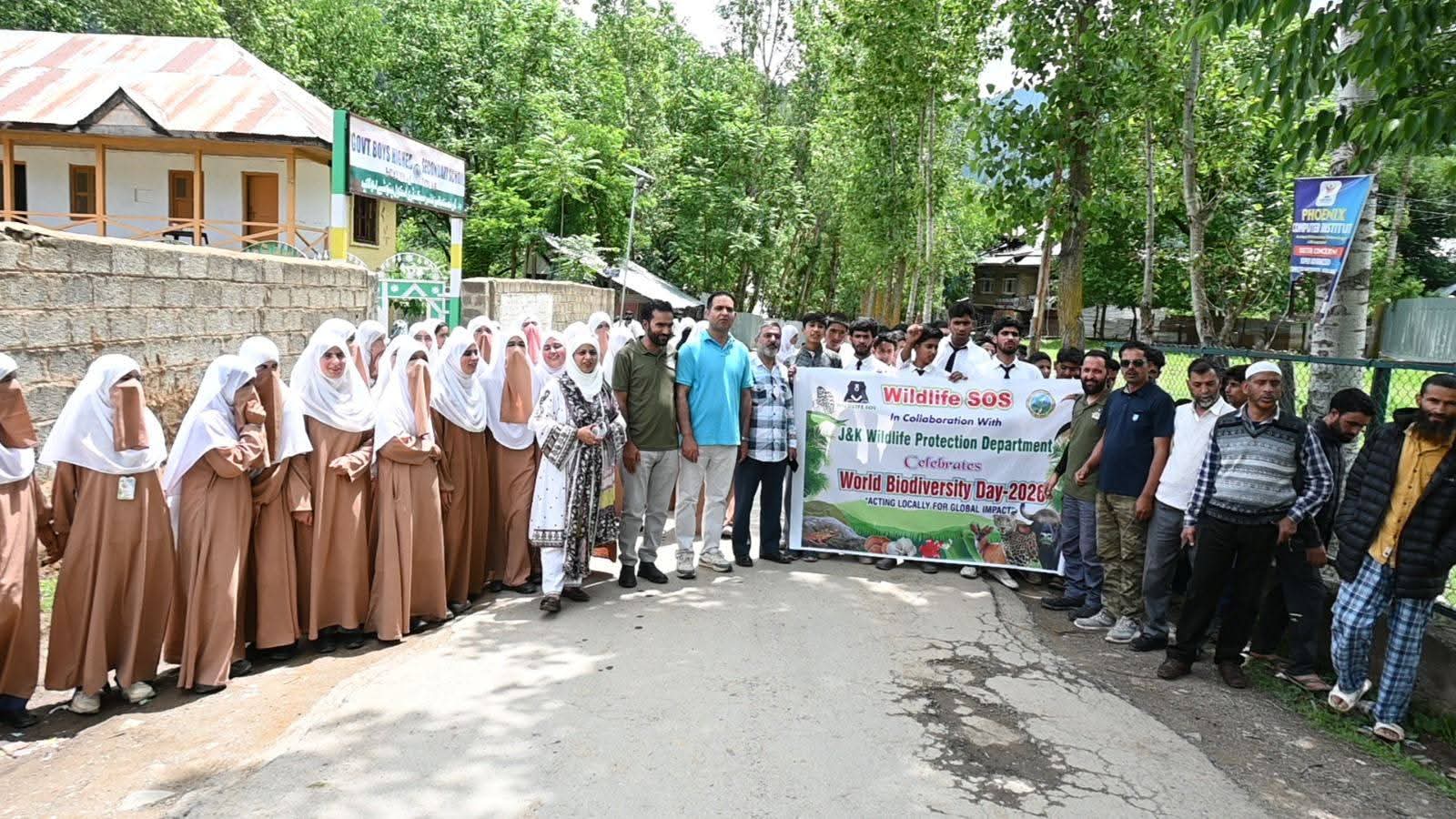
Meanwhile, at Government Higher Secondary School Potushai in Lolab Valley, north Kashmir’s Kupwara district, students were told that biodiversity is not just about wildlife.
“Biodiversity is not merely about wildlife protection,” said Aaliya Mir, Project Head of the Wildlife SOS J&K Chapter. “It is about safeguarding ecosystem services that sustain human life — including clean water, climate regulation, food security, and disaster resilience.”
The event was organised by Wildlife SOS, the J&K Department of Wildlife Protection, and the Forest Protection Force. Officials said no government agency or civil society group can succeed alone — local communities remain the missing piece in most conservation efforts.
The Lolab event concluded with a road rally and a collective pledge. Organisers admitted the real test lies ahead: keeping conservation conversations alive in educational institutions and rural landscapes, especially in ecologically sensitive pockets like Lolab.
Meanwhile, speaking to Kashmir Convener, Er. Ajaz Rasool, Governing Council Member, said: “A rich variety of plants, microbes, insects, and ecosystems contributes to fertile soil, water purification, climate regulation, and food system support. Protecting biodiversity is essential for clean air, water, medicine, and planetary stability.”
Dr. Raja Muzaffar Bhat, environmental activist, offered a sharper critique. Speaking to Kashmir Convener, he said: “The theme this year is ‘Acting Locally for Global Impact.’ We do its opposite — we act locally by axing trees, destroying water bodies, wetlands and forests, plus dumping waste unscientifically. Its impact will be felt across Kashmir and then globally. We are acting — but negatively.”
Notably, similar events on this day were held in other parts of Kashmir.
In Sopore, International Biodiversity Day was celebrated under the theme “Acting Locally for Global Impact” at Ningli Wular.
MLA Wagoora Kreeri, Irfan Hafeez Lone, was the chief guest on the occasion. Environmentalist Dr. Shaikh Ghulam Rasool, along with organiser Naseer Ahmed Dar of the Fisherman Union Wular, also attended the programme.


Comments are closed.