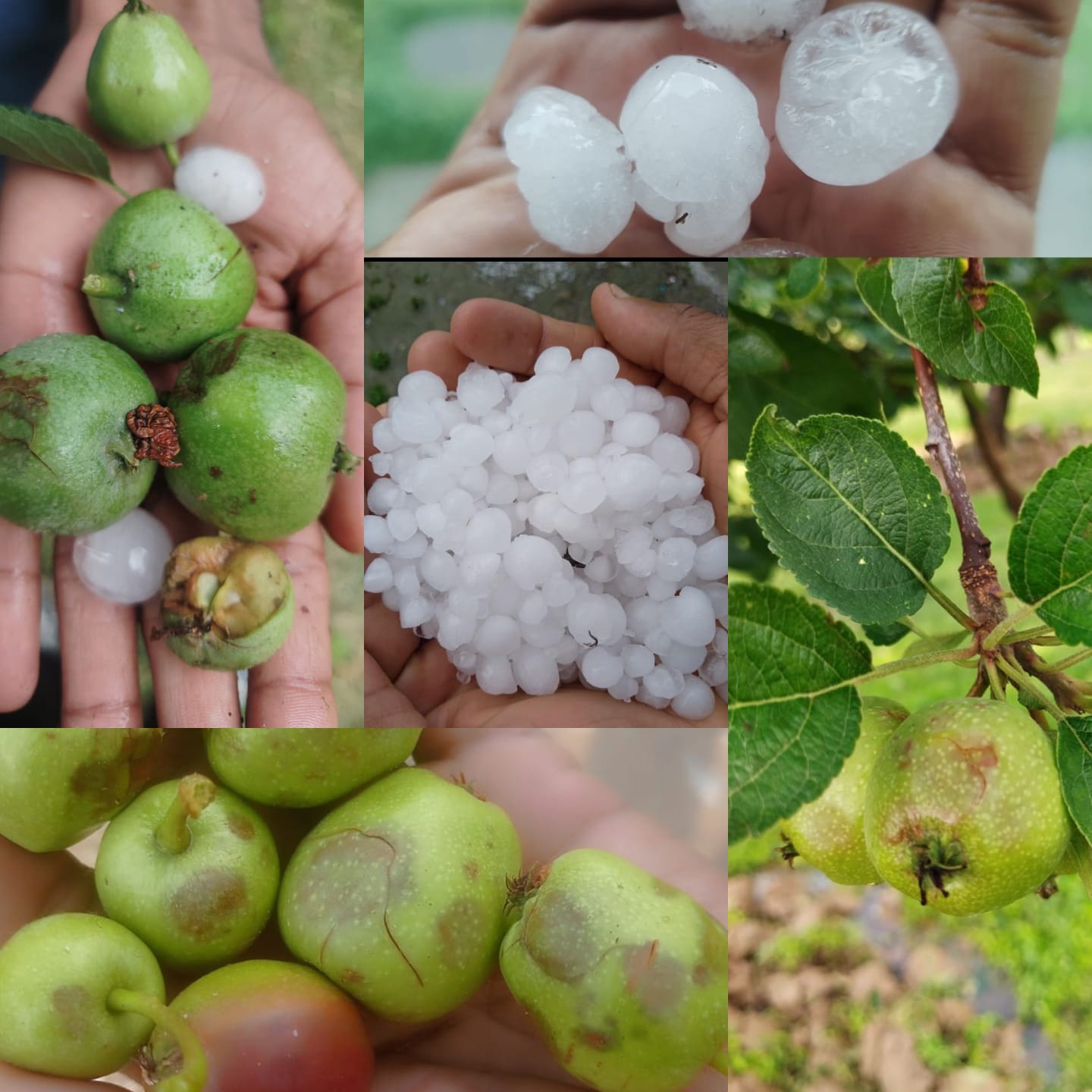
SRINAGAR, MAY 22: For eight minutes, the sky turned cruel. When it was over, Mohammad Ashraf’s apple orchard in Laiser village looked like a battlefield. Shredded petals lay plastered to the mud. Branches that had been heavy with promise now hung bare and broken.
“I couldn’t even cry. I just stood there. My hands were shaking,” said Ashraf, 58, who has been tending his orchard for three decades. “Every morning for two months, I would come here and talk to the trees. ‘You are looking beautiful this year,’ I would tell them. The flowers had opened so fully — white and pink, like a wedding. Now? Look at them. They are not flowers anymore. They are tears.”
Just across the flooded field, Ghulam Mohammad Dar stared at what was once his paddy nursery. The water had turned brown with uprooted saplings.
“The nursery was my child. I raised it for 45 days. I slept next to it some nights to chase away birds,” said Dar. “My son asked me yesterday, ‘Abba, when will we eat the new rice?’ I said, ‘Soon, beta. The bloom has been good. The paddy will be good.’ Today, I have no answer for him.”
The storm, accompanied by heavy rain and strong winds, struck around 5 pm on Friday, ravaging Rafiabad, Zaingeer, Sopore and adjoining areas including Saripara, Chijhama, Laiser, Dulgund, Behrampora, Shangergund, Chatloora, Watergam, Saidpora and Dangerpora.
For apple growers, the timing could not have been worse. After years of erratic weather, pest attacks, and low prices, this spring had brought something rare: hope. Regular showers arrived on time. Farmers sprayed high-quality fungicides and nutrients, many taking loans at high interest. The result was a bloom that old-timers called “one of the healthiest in a decade.”
“When the flowers opened, the entire valley looked like it was covered in snow — but it was petals,” recalled Abdul Rahim Rather, 62, from Chijhama. “We were hugging each other. ‘This is the year,’ we said. ‘This is the year we pay off our debts.’ My wife had already planned to buy a new fridge. My daughter’s wedding was going to be in December, paid for by the apple money. Now I have to tell them… I don’t know how to tell them.”
Farmers say the hailstones, some as large as marbles, ripped through the delicate flowers before pollination could even be completed. That means no fruit set at all.
“It’s not a bad crop. It’s zero,” said Bilal Ahmad Shah, a young farmer from Shangergund who had taken a loan of Rs 2.5 lakh for fertilisers and sprays. “The bank came to inspect the orchard last week. They were impressed. They said, ‘Good season coming.’ Now the bank will come again — and they will take everything. My father always said, ‘Don’t take loans for apples.’ I should have listened.”
For paddy growers, the devastation is no less absolute. Across north Kashmir, families had completed their preparations for the upcoming sowing season. Nurseries were raised on elevated beds. Fields were ploughed, levelled, and flooded. Mothers had begun soaking the first batch of seeds in earthen pots, a ritual passed down for generations.
“We were waiting for the traditional signal — the first call from the mosque after the morning prayer, telling us it’s time to start transplanting,” said Fatima Begum, 51, from Dulgund, wiping her eyes with the edge of her dupatta. “That call was supposed to come in three or four days. Now I look at my field and I see nothing but mud and dead leaves. My husband is a daily wager. This paddy was going to feed my children for the next six months. What do I feed them now?”
Farmers explained that the standing crop from the previous cycle, which was meant to be harvested and used as seed stock for the new season, has been completely flattened. With waterlogging rotting whatever remains, families are left with neither grain to eat nor seed to sow.
“We didn’t just lose a crop. We lost the next two seasons,” said Ghulam Hassan Bhat, 67, from Behrampora. “The seed we saved — we stored it in gunny bags in the barn. The roof leaked during the storm. Everything is soaked. Mould has already started. That seed was our future. Now our future is rotting.”
Younger farmers, many of whom had convinced their families to invest in high-density apple plantations and certified paddy seeds, spoke of a future that now looks blank.
“I came back from Saudi Arabia last year. I told my father, ‘Let me farm. Let me try something of my own,’” said Umar Nisar, 29, from Dangerpora. “I put all my savings — everything I earned in three years — into this orchard. I bought the best sprays. I followed YouTube videos of Kashmiri horticulturists. I thought I was being smart. Now I stand here and I am the biggest fool. My father is not saying anything. That’s the worst part. He just looks at me and sighs.”
“Last year they said the same thing after the floods,” said Mohammad Maqbool, 55, from Watergam. “We filled forms. We went to the tehsildar’s office five times. We never saw a single rupee. My son spent more money on photocopies than what we got as compensation. This time we don’t even have money for photocopies.”
Speaking to Kashmir Convener, Agriculture Minister Javid Ahmad Dar termed the incident “unfortunate.”
“Directions have been issued for preliminary damage assessments. Officers will conduct field visits. A complete report will be submitted. Compensation will be provided as per SDRF norms once the process is completed,” he said.
MLA Sopore Irshad Rasool Kar urged Chief Minister Omar Abdullah to announce a special relief package for affected growers.
“Farmers were hoping for a good apple bloom. The paddy sowing season was all set to start. Families had invested everything — their savings, their loans, their dreams. Now they have nothing. Horticulture and paddy are the backbone of our economy. This is not just a crop loss. This is a humanitarian crisis in the making. Timely assistance is not a favour. It is a duty,” Kar said.


Comments are closed.