
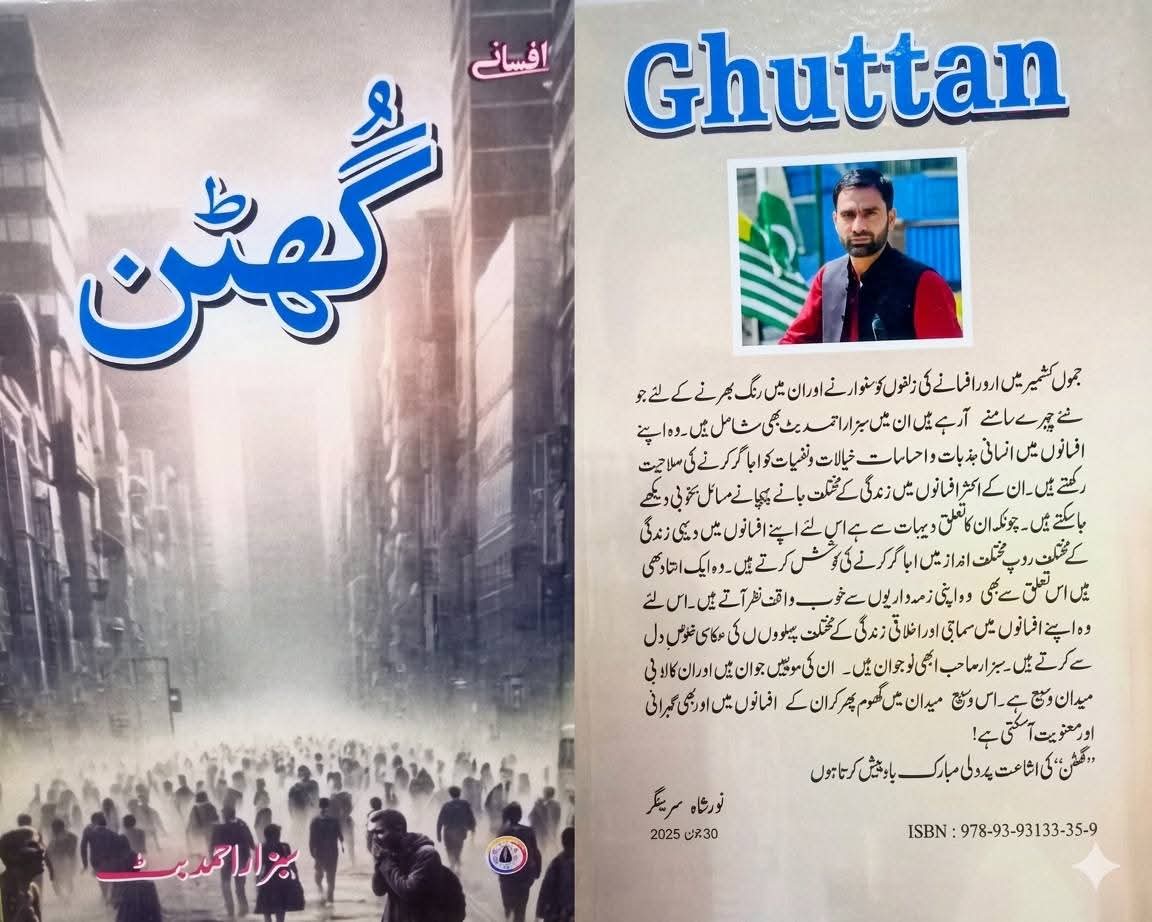
Ghuttan and the Grammar of Suffocation: Reading Sabzar Ahmad Bhat’s Short Stories as a Social Autopsy of Our Times


Mohammad Arfat Wani


“These stories together guide the reader back toward forgotten humanity, fading emotions, and neglected moral responsibilities, while also carrying a strong message of reform and awareness for society.”


In Urdu literature, the short story is not only a literary form but a mirror that reflects human consciousness, social truths, and psychological complexity. Through the medium of short stories, individuals and society can view and observe themselves in reality.

The role of a short story writer is not only to write stories but to reveal the unseen aspects of life, to voice human emotions, and to keep alive issues that are often forgotten due to social apathy and indifference.

Urdu short story writing has always progressed through writers who, instead of relying on their imagination and creativity, used to derive inspiration from life’s bitter and sweet experiences. In this rich tradition, Sabzar Ahmad Bhat’s collection “Ghuttan” emerges as a meaningful and valuable addition.

Ghuttan is more than just a book comprising stories since it is an embodiment of inner turmoil, social pressure, and mental conflict. Written in the year 2026, this book proves that the author is a good observer of his environment and portrays it in a literary manner. This is evident from his dedication of the book to his elders, which denotes the profound relationship that he shares with his roots and culture.

The book contains 36 short stories that portray different elements of life. The stories give an account of the rustic and urban life, the fragility of human interactions, and contradictions in society in an interesting manner. Ghuttan, Purana Ghar, Kabootar Baaz, Gidh, Chaska, Angaray, Bazgasht, Bahadur Uncle, Zameer, Drama Baaz, Maa Hoon Na, Aanch, Khirki, Baddua, Pagal Aurat, Sila, Paraya Shehar, Bahaar, Urooj, Anokha Tohfa, Aulaad Na-Khalaf, Naqsh-e-Qadam, Sapnay Chand Ke, Saboot, Naraz Maa, Award, Roshni, Man Ka Bojh, Ehsaas, Shortcut, Hatmi Faisla, Positive, Main Sarma Mein Lecturer Banunga, Aghosh, Ghanti, and OTP entertain the reader and make them think critically about their life experiences. Through his simplistic language, realism, and versatility, the author shows his sense of duty and accountability as a writer.

Ghuttan is an exceptional literary creation. This work not only captures the essence of Kashmiri society but also talks about universal human behavior and emotions. The fact that the work is written for a small audience cannot diminish the depth of its ideas and significance, as it can easily gain a prestigious place in Urdu literature. Ghuttan is not just a book filled with narratives; rather, it invites the reader to think and analyze the society, which proves that its author was a true novelist.

Noor Shah, the renowned fiction writer, considers Sabzar Sahab to be one of the promising names for the future of Urdu fiction. The author successfully manages to bring human emotions, psychology, and social reality into his narrative stories. Considering him a teacher, one can notice his sense of social and moral responsibility. According to Noor Shah, he is a broad-minded young novelist whose work shows great signs of growth.

Parvez Manoos sahab regards Bhat Sabzar as an accomplished story writer of the present era. He states that Bhat has progressed from traditional narrative to a more realistic and socially oriented way of storytelling. His stories carry within themselves an elegant mixture of aspects of rural and urban life, of human interactions, of class conflict and psychological insightfulness. As he claims that Bhat’s story named Ghuttan not only reaches out to one’s heart but also provokes the mind into deep reflection; thus becomes an invaluable addition to the body of Urdu literature.

Dr. Gulzar Ahmad Wani Sahab regards the stories of Bhat as a kind of surgery on social evils. They not only pinpoint those problems but offer remedies as well. He is a simple yet effective writer whose characters reflect real life persons. Malik Manzoor sahab sees in Bhat an honest, humble soul who possesses a passion for literature opening new avenues of thought and healing social maladies through literature.

Sabzar Bhat Sahab considers this book as an expression of silent protest against inner pain, his own personal observations, and social injustices. With this book, he attempts to communicate the feeling of suffocation that is prevailing in the life of common people.

At last, he wants his literary creation to get into the heart of readers and, in fact, his book is having all such qualities. Subzar Ahmad Bhat’s stories carry profound meanings and high intellectual level. Every story invites the readers into deep thinking.

The story of ghuttan portrays the difference between the innocence of a village and the alienation of an urban city. It shows how the development of technology is making people restless and emotionally exhausted. However, purana ghar represents warmth and affection. It serves as a reminder that the real path to tranquility should be taken through sincerity and respect for tradition.

Kaboootar baaz represents themes of bravery in the face of tyranny, solidarity, and defiance. The message conveyed by this story is that only a united front can stand up against oppressors. Gidh portrays the cruelty and callousness of society, which includes greed and selfishness in even close personal relations.

Chaska reflects the modern addiction to mobile phones and the emotional distance it creates among human relationships. It is presented in a subtle yet deeply meaningful way.

In angare, the issue of truth and justice is illustrated in the brave and determined character of Shuja, a journalist who remains strong irrespective of any difficulty he faces. The play clearly conveys that there can be no truth without any sacrifice. Bazgasht illustrates the cruelty of the society and the misusing of power, wherein an innocent mother and her family suffer because of this weakness. Bazgasht depicts that the one who makes family members suspicious of each other will ultimately cause themselves destruction.

The story zameer relates pride in money and corruption with the powerful concept that at some point in life a man would appear before himself like a criminal. In drama baaz, satire plays an important role to express any serious problem with some ironical twist. In the story maa hoon na maa, the unselfish nature of mother is depicted in a way along with their neglectful nature as children, which ultimately shows their unique superiority. The theme of aanch is the demolition caused by an illegitimate source of earning along with addiction to drugs.

Khidki signifies patience, endurance, and the persistent struggle for justice that results in ultimate triumph of truth. Baddua refers to the law of karma or consequences indicating that whatever you do comes back to you. Pagal aurat symbolizes the sad story of human psychology and negligence as each cracked mind symbolizes great pain and shattered dreams.

Sila refers to the tragedy of ingratitude when selfishness breaks even familial ties. Paraya shehar emphasizes the theme of belongingness versus urban indifference whereby one can feel comforted only among his kin.

In bahar, there triumphs the idea of truth and righteousness amid doubt and misunderstandings. Uruj refers to the deterioration of values brought about by forgetting parents during the mad rush for fame.

Anokha tohfa highlights the pain inflicted on ungrateful offspring through the workings of nature and law of justice. Aulad-e-na-khalaf shows how spoiled parenting leads to disastrous outcomes. Naqsh-e-qadam exposes the betrayal covered up by pretense of love and social connection. Sapne chaand ke reveals the gap between reality and dreams with tragic irony. Finally, Saboot sheds light on the issue of domestic abuse and society’s indifference voiced through the helplessness of a child.

In Naraaz maa, the role of parental wrath and its dire ramifications is discussed. In Award, favoritism and deceit in the education system are criticized. In Roshni, the disintegration of a family caused by negligence and irresponsibility is depicted. In Mann ka Bojh, the emotional torment of a mother and the callousness of her children are portrayed. Ehsaas captures the awakening of the conscience and the destruction of corruption. Shortcut cautions about the hazards associated with achieving success through illicit means.

In Hattmi Faisla, the power of divine justice and the demise of human arrogance are captured. In Positive, the solitude of a good-hearted individual in an ethically ambiguous society is revealed. In Main Sarmay Mein Lecturer Banunga, the hardships, dignity, and injustices in the education system are revealed. In Aaghosh, maternal love and the agony caused by an unfortunate occurrence are profoundly expressed. In Ghanti, the hypocrisy and inconsistency of religion are revealed. The final story otp reflects the fragility of trust and relationships in the digital age.

In conclusion, all the stories of Subzar Ahmad Bhat Sahab together guide the reader back toward forgotten humanity, fading emotions, and neglected moral responsibilities. They not only mirror society but also carry a strong message of reform and awareness. I sincerely congratulate Subzar Ahmad Bhat on his remarkable collection ghuttan and pray that his pen continues to reflect truth, awaken conscience, and bring light into the world of literature.


Author is a nursing student from Kuchmulla, Tral. He writes on social issues, culture, and public concerns with the aim of raising awareness and inspiring positive change. He can be reached at wania6817@gmail.com)

Comments are closed.