


Muqeet Mubashir
“Institutions meant to bridge aspiration and opportunity are increasingly seen as sources of anxiety. Repeated delays, allegations of irregularities, and unpredictable examination patterns have weakened trust. When preparation loses meaning due to sudden changes in exam structures, motivation itself begins to collapse.”
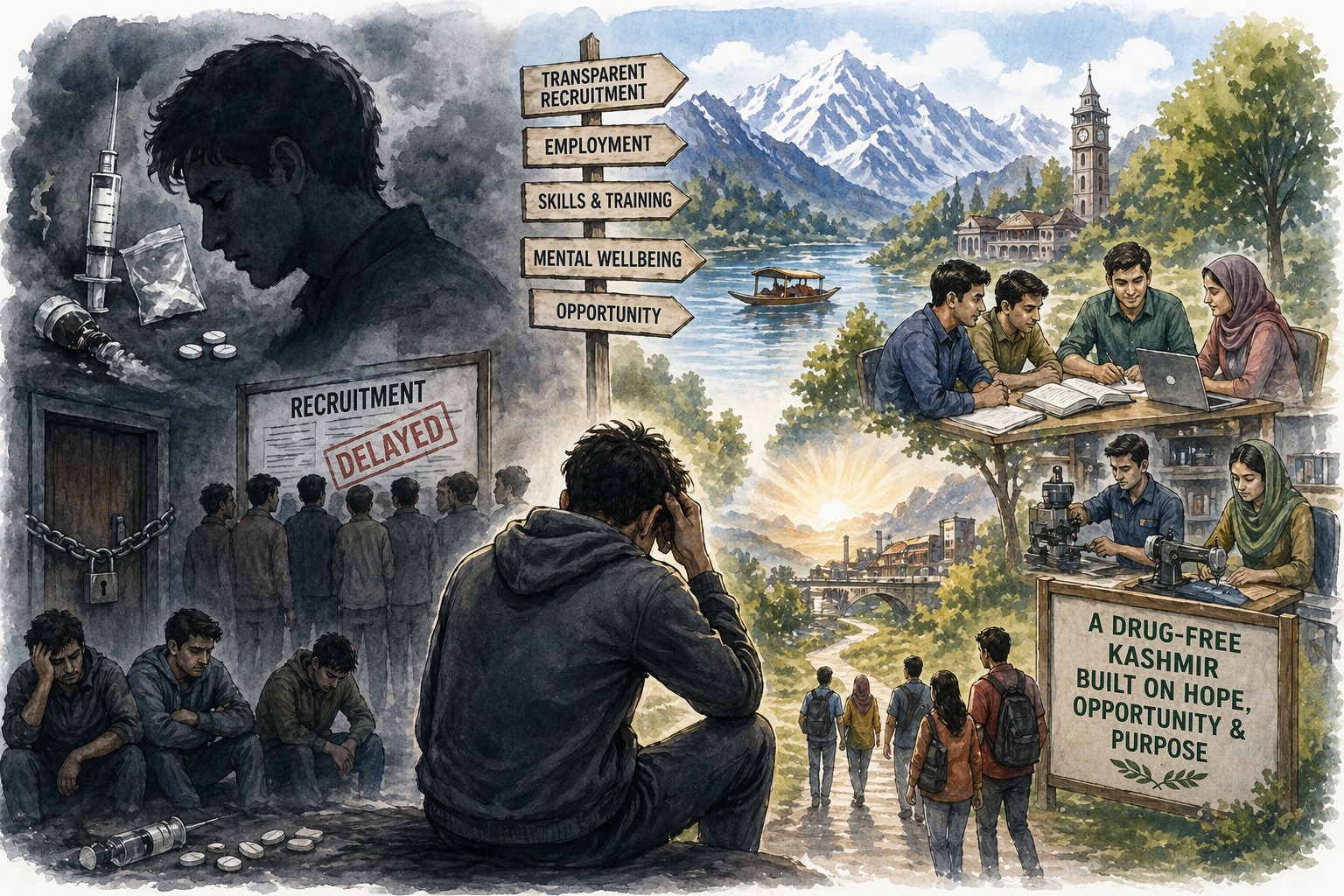
The ongoing “Nasha Mukt Jammu & Kashmir Abhiyan” has brought renewed focus to a crisis that Kashmir can no longer afford to ignore. Drug abuse, once whispered about in private, is now a visible and growing threat to the Valley’s social fabric. The government’s 100-day campaign, driven by enforcement, awareness and rehabilitation, signals urgency.
But urgency alone is not enough. Because if we are serious about a drug-free Kashmir, we must be equally serious about confronting the conditions that allow addiction to take root. And one of those conditions, undeniably, is unemployment.
To be clear, unemployment is not the only reason behind drug abuse in Kashmir. Addiction is a complex issue shaped by multiple factors: social influence, psychological distress, peer pressure and in some cases, the easy availability of narcotics. However, several studies and ground-level observations increasingly point to a troubling reality: unemployment, particularly among educated youth, is emerging as one of the most significant contributors to this crisis. Ignoring this connection would be a mistake.
A Crisis Beyond Numbers
Jammu & Kashmir today stands at a difficult crossroads. With an overall unemployment rate of around 6.7%, nearly double the national average of 3.5% (According to the North Asian International Research Journal of Multidisciplinary), the region continues to lag behind much of the country in job creation. More concerning is the situation of the youth.
Youth unemployment in J&K is estimated at over 17%, and in some urban pockets of Kashmir, it is believed to be significantly higher. Thousands of educated young people, graduates, postgraduates and even professional degree holders remain without stable employment. In fact, estimates suggest that lakhs of educated youth are currently without jobs, while many more are underemployed or stuck in prolonged preparation cycles. Recent studies reveal that over 3.6 lakh educated youth have remained unemployed and nearly 4.7 lakh people are willing to work but have no jobs.
This is not merely an economic issue. It is a social and psychological one. Because in Kashmir, employment is not just about income. It is about dignity, identity and stability.
What Happens When Recruitment Becomes Disillusionment
In most parts of the country, the private sector absorbs a large share of educated youth. In Kashmir, that safety valve barely exists. Industrial growth is limited, private investment is weak, and job opportunities outside government service remain scarce.
As a result, government recruitment has become the primary aspiration for the majority of educated youth. But what happens when even that pathway becomes uncertain?
Institutions like the Jammu and Kashmir Services Selection Board are meant to serve as bridges between aspiration and opportunity. Instead, for many aspirants, they have become sources of anxiety.
Over the years, aspirants have faced repeated delays in recruitment, allegations of paper leaks, cancellation of examinations and prolonged waiting periods have already shaken their confidence. Each disruption chips away at trust. Each delay extends uncertainty. But what has further aggravated frustration is the unpredictability of examination patterns. The recent Junior Assistant examination is a case in point.
A post that is clerical in nature, expected to assess basic aptitude and fundamental knowledge, was reportedly set at a level far beyond its scope and that bore little resemblance to those expectations. Candidates described it as unusually complex, with sections resembling high-level competitive examinations rather than a standard clerical test. General studies, computer knowledge and analytical components were perceived to be far beyond the expected scope.
For aspirants who had prepared based on previous patterns, this was not just unexpected; it was destabilising.
Examinations are supposed to reward preparation. But when patterns shift abruptly and without clarity, preparation loses meaning. And when preparation loses meaning, so does motivation.
The Weight of Waiting
What is often missing from policy discussions is the human cost of this uncertainty and policymakers often fail to understand that ‘Unemployment is not just about numbers. It is about psychology.’
Behind every application form is a young individual who has invested years in preparation. Behind every delayed recruitment is a family that continues to wait. Behind every unexpected exam pattern is a candidate who begins to question not just the system, but his own future.
This prolonged state of waiting creates a silent but powerful psychological burden.
Frustration builds.
Confidence declines.
Direction fades.
And in the absence of opportunity, even resilience begins to weaken.
Understanding the Link to Drug Abuse
This is where the conversation around drug abuse needs to be more honest and nuanced.
Drug abuse in Kashmir is often discussed as a law and order issue. But that is only half the story. Substance abuse in Kashmir cannot be reduced to a single cause. It is influenced by a combination of factors: social environment, accessibility of drugs, peer influence and mental health challenges.
However, it is increasingly evident that unemployment and lack of meaningful engagement act as powerful enablers, especially among educated youth.
When effort does not translate into opportunity, when years of education do not lead to stability and when the future appears uncertain, many young people find themselves struggling with stress, anxiety and a loss of purpose. In such conditions, vulnerability increases.
For some, that vulnerability takes the form of withdrawal. For others, it manifests as frustration. And for a growing number, it becomes a gateway to substance abuse. This is not speculation; it is a pattern that communities, educators and even enforcement agencies are beginning to acknowledge.
Why Campaigns Alone Will Fall Short
The “Nasha Mukt Kashmir” campaign is a necessary step. Awareness drives are important. Enforcement is critical. Rehabilitation must be strengthened. But campaigns alone cannot address structural issues. Because the real antidote to addiction is not just awareness. It is a purpose. And purpose comes from meaningful engagement, employment and opportunity.
You cannot educate away unemployment. You cannot police away hopelessness. You cannot rehabilitate a society without rebuilding opportunity.
If the underlying conditions remain unchanged, the cycle will continue regardless of how many awareness programmes are conducted.
A System That Must Rebuild Trust
If there is one immediate step that can restore some confidence among the youth, it is fixing the recruitment system.
Recruitment must be:
-
Transparent in process
-
Consistent in examination patterns
-
Time-bound in execution
Unexpected shifts in exam difficulty, especially for lower-tier posts, only deepen anxiety. Recruitment bodies must align examinations with job roles, not with abstract standards of competitiveness.
A fair system does not just select candidates: it builds trust. And right now, that trust needs rebuilding.
Thinking Beyond Government Jobs
For years, unemployment in J&K has remained consistently higher than the national average. This is not a recent spike. It is a structural issue.
-
The economy remains heavily dependent on limited sectors
-
Industrialization is weak
-
Private investment has not translated into large-scale employment
-
Government jobs remain the primary aspiration
This imbalance has created intense competition for a small number of posts, turning recruitment into a high-stakes gamble rather than a fair process. And when even that process appears inconsistent, frustration multiplies.
As long as government jobs remain the only viable aspiration, the pressure on recruitment systems will remain unsustainable. Kashmir needs a functioning ecosystem of employment beyond the public sector. This means:
-
Encouraging private investment that translates into real jobs
-
Supporting entrepreneurship at the local level
-
Creating skill-based opportunities aligned with market demand
Without this, unemployment will continue to rise and so will frustration.
From Awareness to Opportunity
If the goal is truly a “Nasha Mukt Kashmir,” then the approach must evolve. Yes, awareness is necessary. Yes, enforcement is essential. But above all, opportunity is indispensable. Because when a young person has a clear path forward, when effort leads to progress, when education leads to employment, the appeal of destructive alternatives diminishes.
What Needs to Change
If the government is serious about a “Nasha Mukt Kashmir,” it must move beyond symbolic campaigns and address the root causes.
-
First, fix the recruitment system.
Transparency, consistency, and predictability must be non-negotiable. Exam patterns should reflect job requirements that do not surprise candidates. Recruitment delays must be minimised, and accountability must be enforced.
-
Second, expand opportunities beyond government jobs.
Without a functioning private sector, the pressure on government recruitment will remain unsustainable. Industrial growth, entrepreneurship and local enterprise must be actively supported, not just announced.
-
Third, acknowledge the mental health dimension.
Comments are closed.