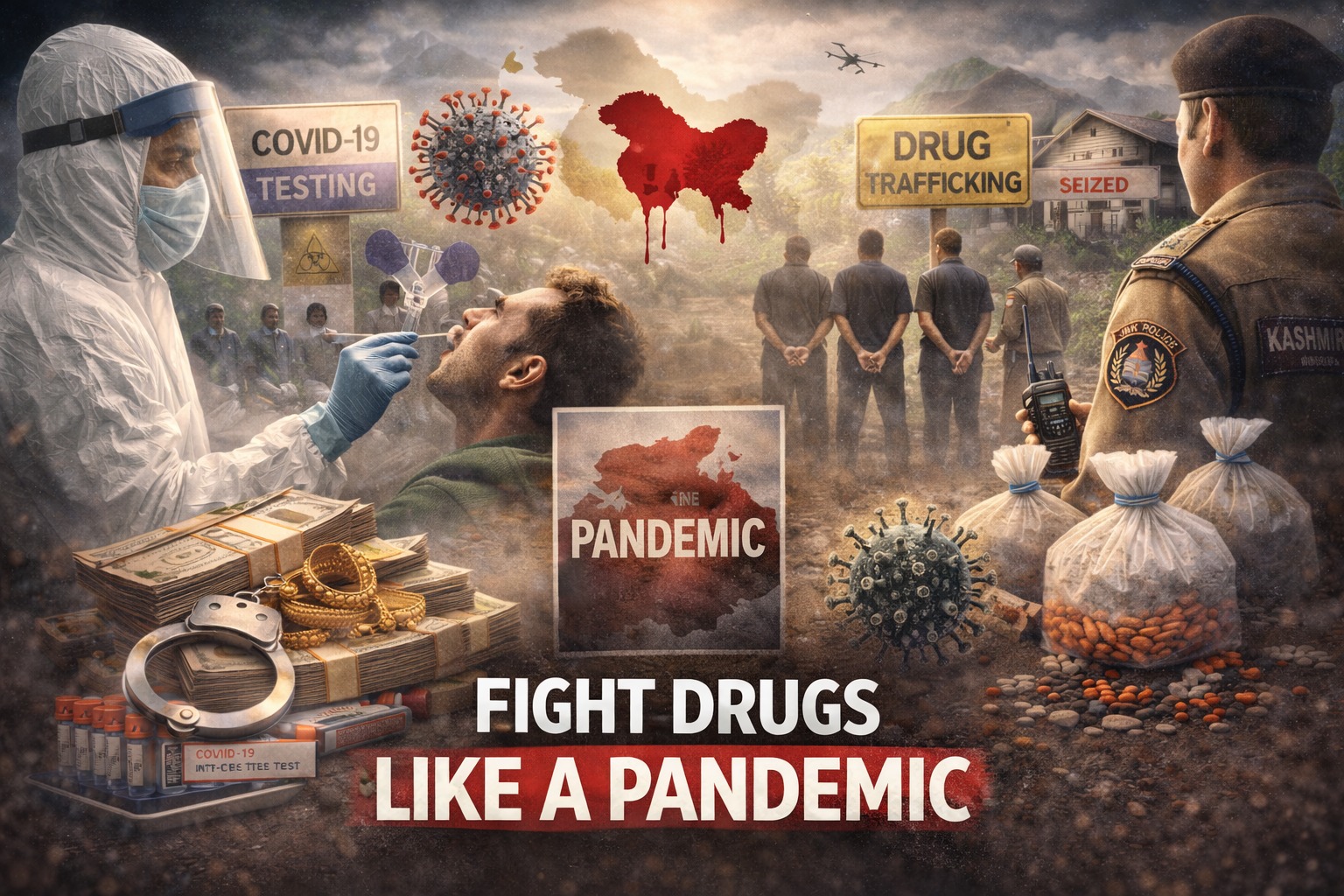
Kashmir today faces a crisis as dangerous as any public health emergency—only quieter, slower and pushed under the carpet. Drug addiction is spreading through towns and villages like an invisible contagion, hollowing out families, draining the energy of youth, and feeding a shadow economy that thrives on despair. This is no longer a routine law-and-order issue. It demands the urgency, scale, and discipline of a pandemic response—much like the world witnessed during COVID-19. The launch of the 100-day campaign by Lieutenant Governor Manoj Sinha is first-of-its-kind large-scale effort to sensitise the public and build support for tough, even extreme, measures in an all-out war against this menace. Actions such as confiscation of properties and passports and cancellation of licences, underline the seriousness of intent. But intent must translate into sustained, uncompromising action. When COVID-19 struck, governments did not rely on half-measures. They declared emergencies, set up war rooms, enforced lockdowns, tracked contacts, and communicated relentlessly. The same clarity and resolve are now required—at least for these 100 days—to confront the drug menace. Anything less will only prolong the damage. The first step is to treat drug abuse as a public emergency. Awareness alone will not suffice. We live in a time when people continue to smoke despite graphic warnings on cigarette packets; mere messaging rarely changes behaviour. As a society, denial has long been our biggest weakness. Like a virus, drug networks spread through clusters. Certain localities have already emerged as hubs of distribution and consumption. These must be treated as containment zones—subjected to sustained surveillance, frequent raids, and strict monitoring. The goal is clear: make it operationally impossible for peddlers to function, while compelling residents to shed the stigma of being identified as drug “hotspots.” During the pandemic, testing and contact tracing formed the backbone of containment. A similar approach is needed here. Every arrest must trigger a chain reaction—mapping suppliers, financiers, and consumers, followed by targeted and random testing of contacts. Each case is not an endpoint, but the beginning of a deeper investigation. While the J&K Police have taken steps in this direction, the effort needs to be intensified and systematised. Habitual offenders and major traffickers cannot be allowed to re-enter society and resume operations within days. The supply chain, too, must be choked with the same rigour seen during pandemic lockdowns. Cross-border smuggling—now aided by drones and sophisticated networks—requires a coordinated response involving police, security forces, and intelligence agencies. Technology must be deployed not as an option, but as a necessity. Teachers, religious leaders, community elders, and families must become the first line of defence, much like frontline workers during the pandemic. Awareness campaigns must be continuous, clear, and direct. Silence and stigma only allow the problem to grow. Teenage social media influencers are the best tools available with us to pass a message to the same age group in their own stylebook, language and medium. Yet, there is one crucial difference between a virus and this crisis: drug addiction has victims who need care, not punishment. De-addiction centres must be expanded and strengthened to provide immediate treatment and long-term rehabilitation. Compassion for the addicted and zero tolerance for the trafficker—this balance is essential. Kashmir stands at a tipping point. If the drug menace is not confronted with pandemic-level urgency today, it risks becoming a generational catastrophe tomorrow. The choice is stark: fight this like a war—or watch it consume the future.


Comments are closed.