


Kifayatullah Malik
“Enrolment figures may look impressive on paper, but they hide the physical cost some children pay simply to attend school. Accessibility cannot be claimed where safety is absent.”
In policy documents and public speeches, education is celebrated as the foundation of progress. But in a remote corner of Bandipora district, the journey to school tells a far harsher story.
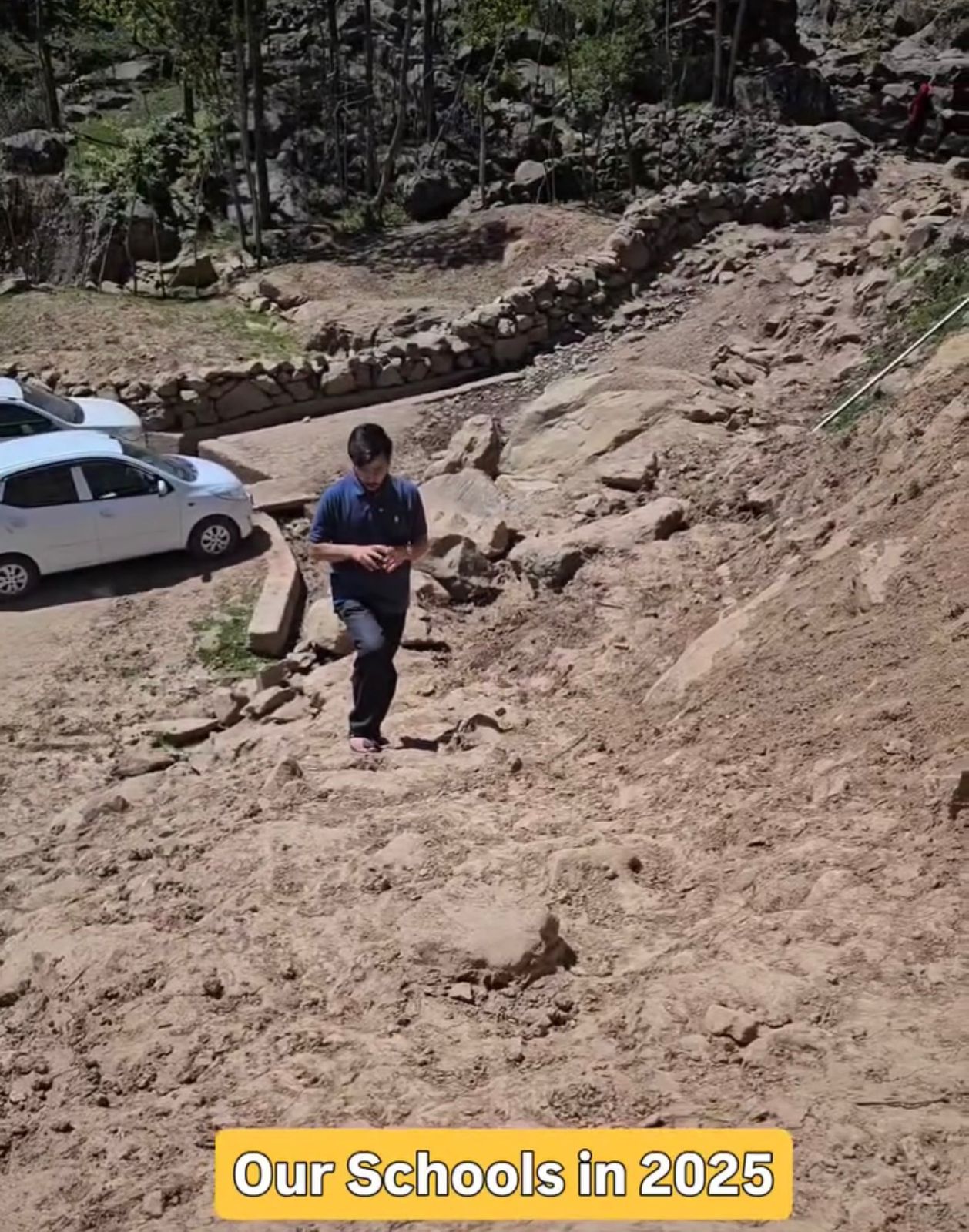
Students of Government Middle School Gujarnar Malangam begin their day not with morning assembly, but with a perilous descent along a steep, rocky hillside. There is no motorable road leading to the school, no paved footpath, no protective railing. Instead, a narrow, uneven trail carved into the mountainside serves as the only access route. For young children carrying school bags, this fragile strip of earth is the thin line between education and injury.
Last year, during a visit to the area, I witnessed the terrain firsthand. The slope was sharp, the stones loose, the soil unstable. Visual documentation captured then showed children negotiating the incline with visible caution. The concern was raised with relevant authorities. Yet, months later, little appears to have changed.

Now, as the rains lash Kashmir, the danger has multiplied. Recent visuals show students inching their way down the same muddy slope, their shoes slipping against wet soil and scattered rocks. There are no steps cut into the hillside, no retaining wall, no basic safety features. The risk of a fall—especially for younger children—is not hypothetical; it is imminent.
Children often hold onto one another for balance, forming a fragile human chain as they descend. Their laughter, which should define childhood, is replaced by careful calculation of every step. Education, in such circumstances, does not begin with curiosity. It begins with survival.
. .

What makes this neglect more troubling is the contrast visible across many rural landscapes. In several villages, tiled pathways and small infrastructure projects have been constructed leading to individual homes or areas of local influence. Development, it seems, finds its way selectively. Yet in remote tribal belts—where access to education should be the foremost priority—the most basic infrastructure remains absent.
This is not a demand for grand buildings or ambitious schemes. The community is asking for something elementary: a safe, structured pathway that allows children to reach their classrooms without risking broken bones—or worse. A few concrete steps, a railing, proper drainage during monsoon months—these are modest interventions with life-saving consequences.
Safe access to school is not merely an infrastructural detail; it is a question of dignity and equity. When the state speaks of educational reforms, digital classrooms and inclusive policies, it must also reckon with the physical realities that stand between a child and a blackboard. For students in Gujarnar Malangam, the right to education is mediated by gravity and weather.
We often measure educational success through enrolment rates and examination results. Rarely do we measure the physical cost some children pay simply to attend school. If a child must scale a hazardous slope each morning, can we truly say the system is accessible?
A safe path to school should be the starting point of education—not a daily trial. The situation in this village is not an isolated inconvenience; it is a reminder that development cannot be selective, and that equity begins with the basics.
If we are serious about building an educated and empowered generation, we must ensure that the road to learning does not endanger the very children it seeks to uplift.
Comments are closed.