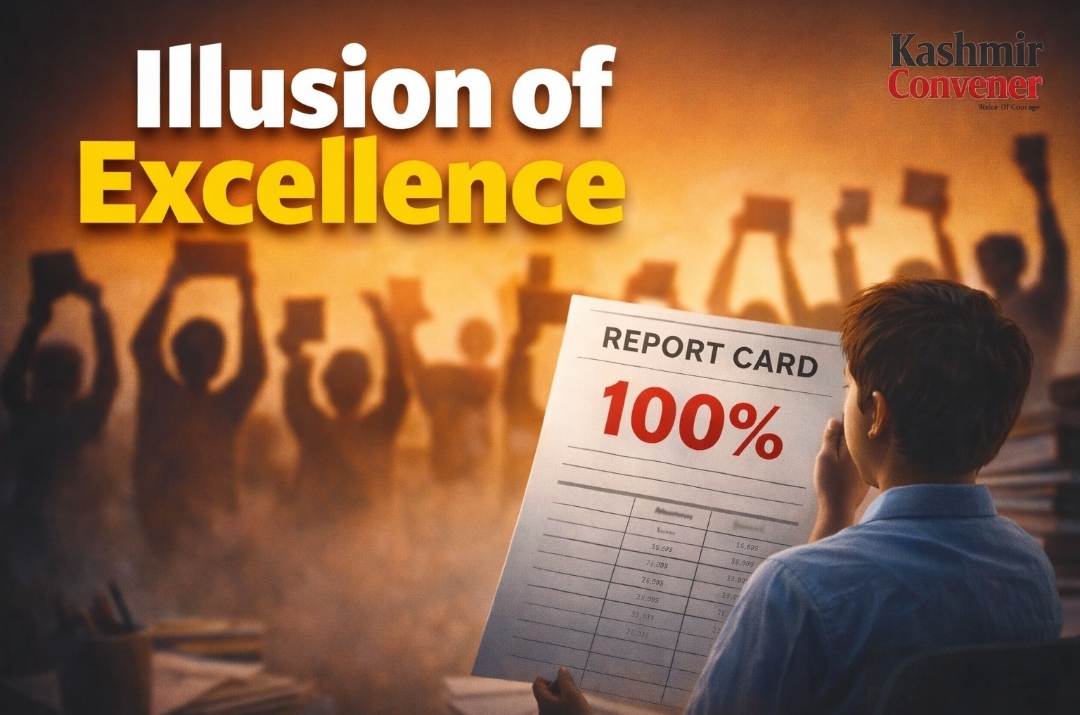
The declaration of Class 10 and 12 results by the Jammu and Kashmir Board of School Education on Wednesday has yet again sparked an uneasy debate within academic circles. An unusually high number of students securing 100 percent marks has prompted teachers, parents, and academicians to question not the sincerity of students, but the credibility and rigour of the evaluation system itself. In a competitive, concept-driven academic environment, achieving full marks across all subjects is an exception rather than the norm.
When such outcomes appear in large numbers, they point to a deeper and more troubling issue—the dilution of academic standards. Education is meant to test comprehension, analytical ability, and application of knowledge. When assessments fail to differentiate between excellence and mediocrity, the very purpose of evaluation is compromised. The most damaging consequence of inflated marks is the false sense of achievement it creates.
Students who previously struggled to cross average thresholds are suddenly projected as toppers. This artificial elevation often breeds misplaced confidence, which becomes a serious handicap when students encounter national-level competitive examinations or higher education institutions, where assessment standards are uncompromising. The inevitable shock of underperformance at that stage can be academically and psychologically distressing. Parents, too, become victims of this illusion. High scores lead to unrealistic expectations and create the impression of exceptional competence, masking fundamental learning gaps. Instead of identifying weaknesses early and addressing them constructively, deficiencies remain hidden behind impressive-looking scorecards, doing long-term damage to the student’s academic journey.
Equally concerning is the injustice such practices inflict on genuinely meritorious students. When excellence becomes commonplace due to lenient evaluation, true hard work loses its distinction. Over time, this erodes faith in the Board’s certification and undermines the credibility of students from Jammu and Kashmir on national and international platforms. Education is not about producing headline-friendly numbers or artificially high pass percentages. It is about nurturing capable, confident, and competent individuals. Lowering academic benchmarks may offer temporary comfort, but it ultimately weakens institutions, misleads students, and compromises the future workforce.
The Jammu and Kashmir Board of School Education must urgently introspect. Transparent evaluation processes, strict moderation, examiner accountability, and alignment with national assessment standards are essential to restore trust. Honest assessment—even if it results in lower scores—is far more valuable than inflated marks that prepare students for failure rather than success. The choice before the system is clear: prioritize real learning over artificial results, and long-term student growth over short-term applause. Anything less would be a disservice to education and to the future of Jammu and Kashmir.


Comments are closed.