

Shoiab Mohmmad Bhat
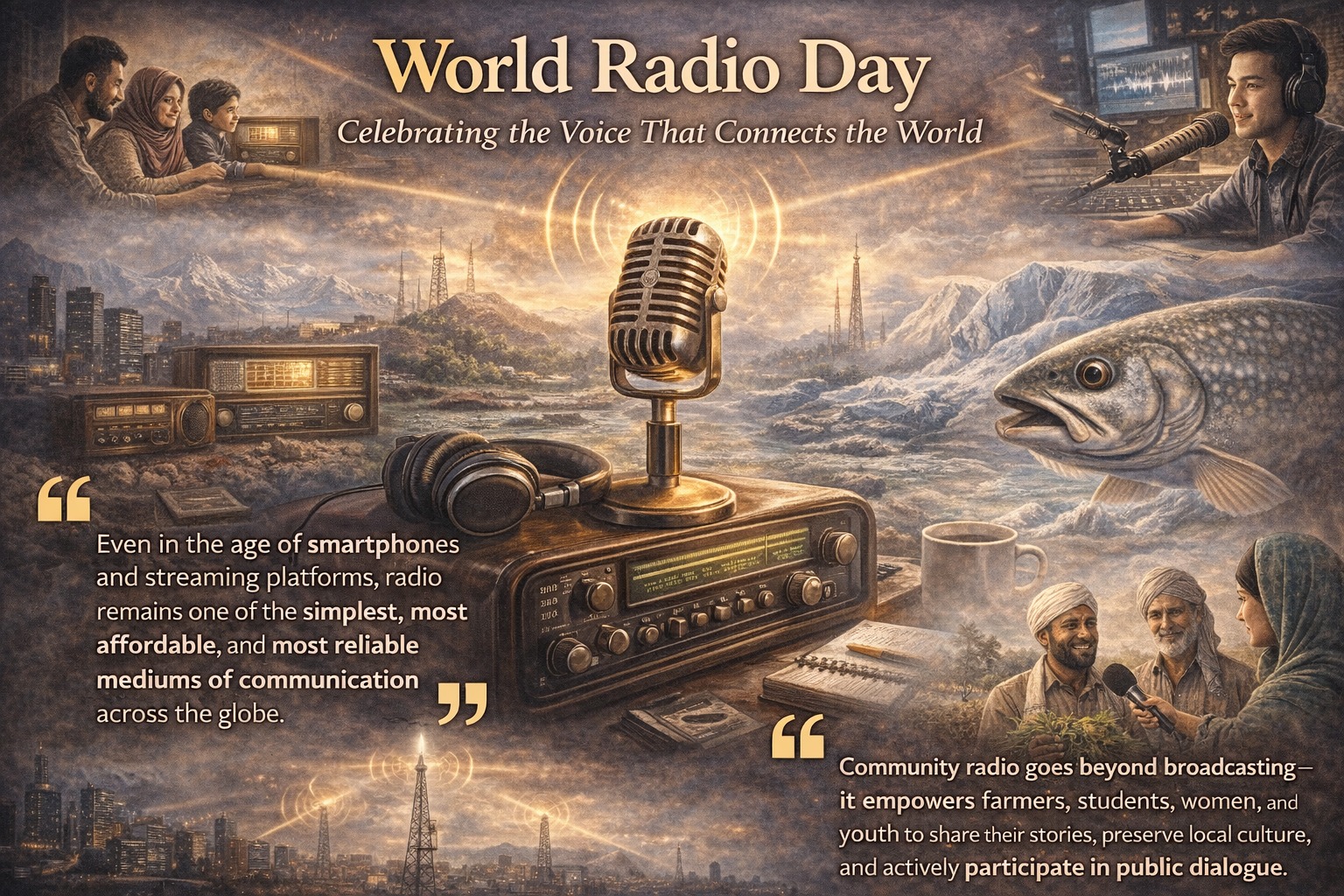
“Even in an age of smartphones and streaming platforms, radio remains one of the simplest, most affordable, and most reliable mediums of communication across the globe.”
World Radio Day is an annual event held on 13 February to appreciate the significance of radio as one of the most effective and available means of communication in the world. Proclaimed by UNESCO in 2011 and subsequently by the United Nations General Assembly in 2012, this day celebrates the role of radio in society and its incredible capacity to unite people across borders, cultures, and communities. The date was selected to commemorate the anniversary of the founding of United Nations Radio in 1946, a milestone that underscored the increasing importance of radio in international communication.
Radio has been a companion of human life for more than a century. Radio has shaped public opinion and everyday life, whether through the delivery of breaking news and the broadcasting of educational programs or the sharing of music, cultural discussions, and emergency alerts. Radio still occupies a special place even in the age of smartphones, streaming services, and social media platforms due to its simplicity, affordability, and reliability.
The history of radio began in the early 20th century, and soon became one of the most powerful inventions of the modern era. It kept citizens informed of significant developments during wars and entertained families sitting around a single device during peaceful times, and carried the speeches of world leaders, commentaries on historic events, and voices of ordinary people whose stories had to be heard. Over the years, radio has been able to keep up with the changes in technology without losing its main role, which is communication.
Why Radio Still Matters Today.
Radio may seem questionable in an era of social media, mobile phones, and instant messaging. The response is a resounding and resounding yes – and there are numerous reasons why.
-
Accessibility and Reach
Radio is one of the most available media in the world. Unlike television and internet platforms, it does require complex and expensive technology. A simple radio device can be powered by batteries or solar energy, which is particularly useful in places where electricity or the internet is not always available. Radio remains the main source of information in most rural or mountainous areas where digital infrastructure is scarce. Radio waves can travel long distances and reach millions of listeners even in the most distant parts of the world. This wide coverage ensures that no community is left behind and helps bridge the gap between urban and rural populations.
-
Credible Information Source.
Radio has been a trusted source of news for decades. Radio broadcasting is usually professional and accountable compared to social media platforms, where misinformation spreads rapidly. During natural disasters, extreme weather events, public health emergencies, or conflicts, the radio often becomes a lifeline when other forms of communication fail. It provides timely updates, safety guidelines, and confirmed information that can save lives. This consistency has enhanced public trust in radio as a reliable medium.
-
Cultural Relation and Interaction.
Radio is not just a transmitter of information, it is a creator of community and identity. Local radio stations broadcast in regional languages and mirror the culture, traditions, and values of the listeners. They celebrate local festivals, deliberate on local issues and offer a platform for public participation. Community radio, in particular, empowers ordinary farmers, students, women, and youth to express their experiences and concerns. Radio gives marginalised groups a voice and promotes dialogue and decision-making in many places.
-
Education and Empowerment
Radio has been a potent educational and awareness tool. Radio programs have educated and empowered millions of listeners through literacy campaigns and agricultural advice, public health messages and environmental education. Radio-based lessons have helped both students and teachers in areas where access to schools or digital learning platforms is scarce. Radio has become relevant again during the global crisis, like the COVID-19 pandemic, as it aired educational information when schools were shut down. It is a powerful tool in curbing information inequality because it can reach a wide range of audiences irrespective of their socio-economic status.
These attributes render radio a medium that remains relevant despite the fast technological transformations – a medium that listens, adapts, and responds to the demands of society.
Radio and Artificial Intelligence: World Radio Day 2026.
World Radio Day is celebrated every year with a particular theme that brings out new challenges and opportunities in broadcasting. In 2026, the theme is Radio and Artificial Intelligence. This theme is an indication of the impact of modern technology on the future of radio. Artificial Intelligence (AI) provides broadcasters with new opportunities.
Nevertheless, technology can help but not to substitute the human voice and creativity that characterize radio. The friendliness of the voice of a presenter, the compassion in narration, and the rapport between the broadcasters and the listeners are all distinctly human traits. The modern radio dilemma is to apply AI in a responsible manner without losing trust, authenticity, and values.
The World Radio Day Celebration.
World Radio Day is celebrated globally by special broadcasts, panel discussions, workshops, and awareness campaigns. Radio stations develop special programs that look back at the history and future of radio. Schools and colleges hold seminars on journalism and communication, and media houses emphasise the need to have free and independent broadcasting. The day is also promoted through social media campaigns where listeners are encouraged to share their best radio memories. International cooperation among broadcasters also enhances international knowledge and unity.
World Radio Day is not merely a celebration of a communication tool; it is a tribute to the enduring power of voice and connection. For over a hundred years, radio has informed societies, entertained families, educated communities, and strengthened democracy. It has adapted to technological revolutions while maintaining its core mission — to communicate truthfully, inclusively, and effectively.
In a rapidly changing digital world, radio continues to stand strong as a symbol of accessibility, trust, and unity. As we celebrate World Radio Day each year on 13 February, we honour not only the medium itself but also the countless voices behind the microphone who work tirelessly to inform, inspire, and connect the world.
World Radio Day: A celebration of the communication device is not only about recognising the device but also acknowledging the power of speech and communication. It has been more than a hundred years since the device has helped societies learn, kept families entertained, educated societies, and promoted democracy globally. It has survived technological innovations while continuing to do the job it has always done: to communicate with honesty, inclusiveness, and efficiency.
In this dynamically shifting digital landscape, radio endures as both a beacon of access, reliability, and unity, and we commemorate World Radio Day on 13th February every year and honour the medium of communication as well as the voices beyond the mic/medium of communication that are working hard to inform and connect the whole world.

Comments are closed.