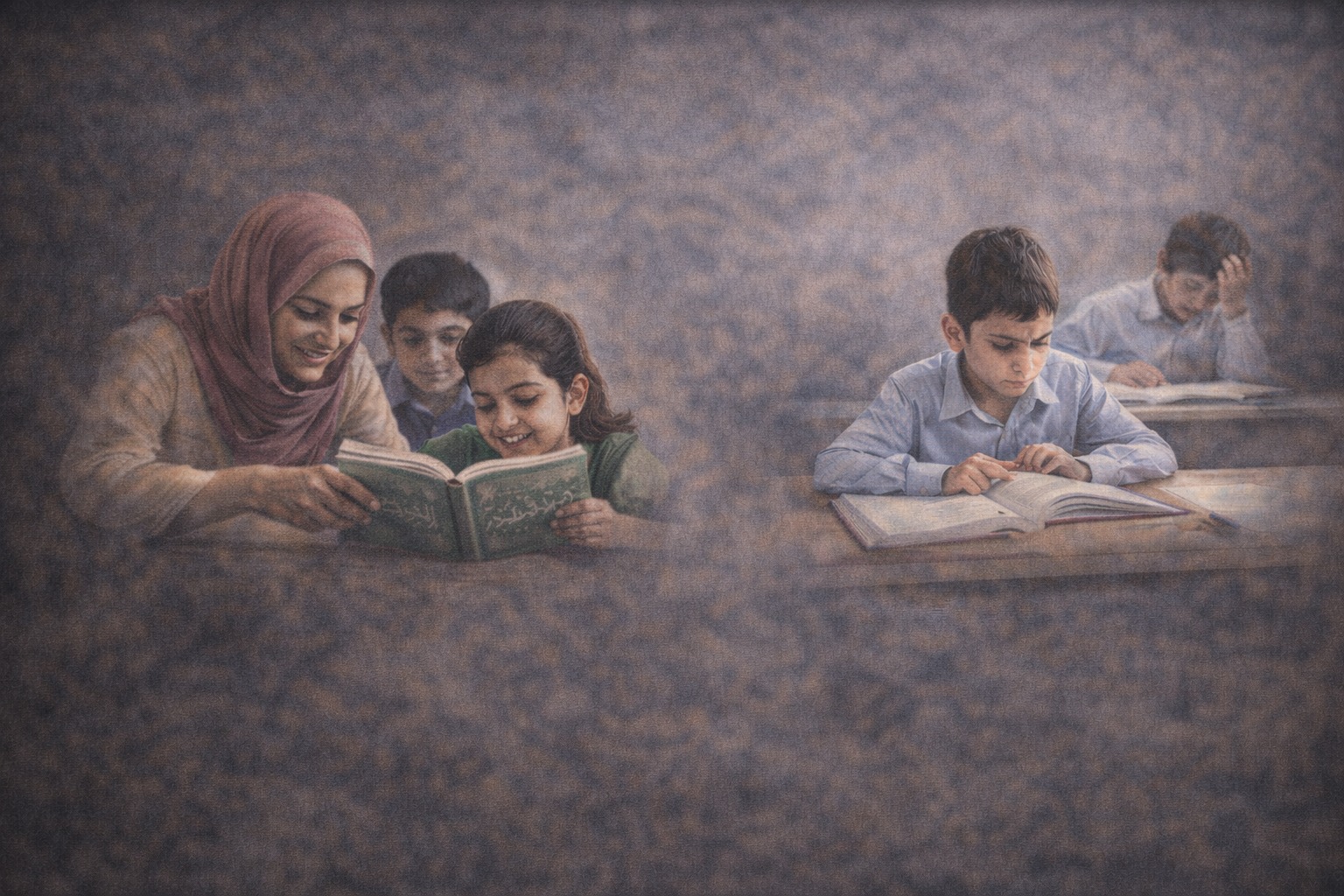
Why Mother Tongue Matters in the Classroom?

Firdous Ahmad Najar

 “When education is delivered in the mother tongue, comprehension and memory develop together. When it is not, learning becomes a two-stage struggle—decoding unfamiliar words first, and understanding much later, if at all.”

Education is not simply the transfer of information; it is the development of understanding within the human mind. At the heart of this process is language: the medium through which knowledge is received, interpreted, and remembered. Any meaningful discussion on educational reform must therefore begin with a fundamental question: in which language does a child think, feel, reason, and most naturally make sense of the world?

Research in cognitive science and education offers a clear and consistent answer: the child’s mother tongue. It is through this language that the brain establishes its earliest neural connections, links meaning to lived experiences, and builds the essential foundation for all future learning.

When education is delivered in a child’s mother tongue, learning becomes a single, integrated cognitive process. New information is directly encoded in the brain, allowing comprehension and memory to develop together. In contrast, when the language spoken at home differs from the language used in textbooks and instruction, learning becomes divided and less effective. The child is forced into a two-stage process: first decoding unfamiliar words, then trying to memorise them, and only later working toward understanding their meaning.

This added cognitive load reduces conceptual clarity, slows academic progress, and can lead to long-term learning gaps. For these reasons, the mother tongue should be the language of textbooks and the primary medium of instruction, especially in the early years of schooling; not merely as a cultural or emotional choice, but as a neurological and educational necessity.

Cognitive studies show that the brain processes information most efficiently in the language it has emotionally and socially internalised. A child’s mother tongue is not merely a communication tool; it is the language of thinking, reasoning, questioning, and meaning-making. Concepts taught in this language are absorbed naturally, without the friction of translation. In a mother-tongue-based system, remembering and understanding happen together, leading to stronger recall, deeper comprehension, and the ability to apply learning meaningfully. When this principle is violated, education becomes mechanical and alienating rather than transformative.

When a language other than the mother tongue is imposed as the medium of instruction or the language of textbooks, it places a disproportionate cognitive load on learners. In such environments, students often hesitate to participate actively, struggle to ask questions, and find it difficult to express their doubts freely, not because they lack understanding, but because of linguistic insecurity. This barrier undermines the very purpose of classroom engagement, a challenge that becomes especially acute in multilingual Indian classrooms.

Children who think and form concepts in their mother tongue but are expected to respond in English or any other second lunguage frequently experience cognitive overload, leading to silence rather than dialogue. Research on bilingual education consistently shows that while such learners may understand concepts well, they often struggle to express that understanding in a second language, which can result in their true cognitive abilities being underestimated.

When children are taught in their mother tongue, learning becomes closely tied to their home environment, cultural background, and everyday experiences, which helps them grasp ideas more quickly and with greater confidence. Understanding lessons in a familiar language supports stronger academic progress, active classroom participation, and a more positive sense of self-worth. It also allows learners to think more deeply, share their thoughts comfortably, and build knowledge with clarity. Education in the first language strengthens pride in cultural roots and social identity, while also creating a solid foundation that supports the learning of additional languages later on.

The National Education Policy (NEP) 2020 stands as one of the most progressive reforms in the country’s educational landscape, particularly for its strong emphasis on using the mother tongue as the language of textbooks and the medium of instruction up to Class 5. This approach rightly recognises the cognitive, emotional, and cultural advantages of early education in a familiar language.

However, a serious concern emerges during the transition from primary to middle school, especially at Class 6, which calls for careful examination within the framework of NEP 2020. While the policy promotes learning in the home language during the foundational years, it remains unclear how students from linguistically disadvantaged backgrounds are expected to cope when they are suddenly required to shift to a different medium of instruction; most often English, at such a crucial stage of their academic journey.

The challenge becomes even more critical and evident in the context of higher education, especially in disciplines such as engineering, medicine, and artificial intelligence. These challenges arise from the severe shortage of quality textbooks, reference materials, and technical literature in regional languages, as the vast majority of such resources remain predominantly available in English. Although initiatives such as AICTE’s AI-based translation tool Anuvadini aim to bridge this gap by translating academic content into eleven Indian languages, yet hundreds of regional and tribal languages spoken by large populations still remain outside the reach of these efforts.

This reality raises a serious concern: how will students from linguistically marginalised communities navigate this abrupt and often unsupported linguistic transition when they enter middle school, particularly at the Class 6 level?

This stage of schooling marks a decisive shift from learning to read to reading to learn. At this stage, reading fluency is assumed, and reading becomes the primary means through which students access academic knowledge across subjects. The foundational stage, from nursery to Class 3, is explicitly designed to build foundational literacy.

However, when an abrupt change in the medium of instruction occurs after Class 5, students lose the cognitive advantage gained during these formative years. Instead of focusing on conceptual understanding, they are forced to struggle with an unfamiliar language, leading to confusion, reduced comprehension, and declining engagement. Knowledge begins to feel abstract and disconnected from lived experience, and subjects that once felt accessible gradually become intimidating.

If this challenge is taken lightly, it can have serious consequences for students from linguistically underprivileged backgrounds, as my own generation experienced. During my schooling, the textbook language in government schools was Urdu. However, on entering Class 9, the language of textbooks shifted abruptly to English. Managing an unfamiliar language while trying to grasp subjects such as mathematics, science, and social science became an overwhelming struggle.

Subjects that once sparked curiosity gradually became sources of fear and anxiety, not because the content was beyond our ability, but because the language barrier made learning feel inaccessible.

This transition, which occurred around 1996–97, had a visible impact on academic outcomes, particularly in the Class 10 board examinations. A similar pattern risks repeating itself if deliberate and well-planned policy measures are not undertaken today.

These measures must include either extending the use of the mother tongue as the medium of instruction beyond Class 5, or ensuring that English is taught with sufficient depth, continuity, and intensity during the foundational years, so that students attain the required level of proficiency before English once again becomes the language of textbooks from Class 6 onwards.

At the same time, the significance of English cannot be ignored within any realistic education policy framework. As an international language, it holds undeniable relevance in the contemporary world. English is the dominant language of scientific research, historical documentation, technological innovation, artificial intelligence, coding, and digital knowledge systems. Access to global education, professional collaboration, and emerging domains of knowledge is closely linked to proficiency in English, and disregarding this reality would restrict learners’ meaningful participation in the global knowledge economy.

However, recognising the importance of English does not require positioning it as the primary medium of instruction across all stages of schooling. The National Education Policy 2020 itself draws a clear distinction between teaching English effectively and imposing it prematurely as the sole medium of learning. English can and should be taught as a strong subject alongside the mother tongue, enabling learners to gradually acquire global linguistic competence without compromising conceptual clarity during the foundational and school years. Such an approach preserves cognitive depth while expanding communicative reach.

The central policy challenge, therefore, is not a binary choice between the mother tongue and English, but the structural readiness of the education system to support either approach in a meaningful and sustained manner. India is home to hundreds of languages and dialects, yet only a small number possess complete academic ecosystems. In many regional and minority languages, textbooks beyond the primary stage remain unavailable or inadequate; scientific, mathematical and technological terminology is underdeveloped, and materials for higher education and professional courses are largely absent. Implementing mother-tongue instruction without addressing these structural gaps risks creating new academic disadvantages for students from linguistically marginalised communities rather than empowering them.

NEP 2020 rightly acknowledges the linguistic risks faced by learners and calls for the development of high-quality learning materials in regional languages. However, at present, only a limited number; about eleven regional languages, have been included in this initiative, and it must be extended logically and equitably to other underprivileged languages as well. The government must not only implement mother-tongue instruction beyond the foundational stage but also ensure the availability of textbooks and reference materials up to Class 12, followed by continuity in higher education and professional pathways: including medicine, engineering, technical education, and emerging technological disciplines. Without such continuity, transitions across educational stages may result in greater academic disruption than educational benefit.

Moreover, if learning materials continue to be developed only in a few dominant languages, the educational landscape risks becoming increasingly unequal, deepening existing linguistic and social divides. In the long run, this may even lead to the reproduction of a pre-independence style education system, where access to knowledge and opportunity was confined to a privileged linguistic elite, thereby undermining the constitutional vision of inclusive and equitable education.

Language policy in education must ultimately be guided by how children actually learn, not by symbolic intent alone. Teaching in the mother tongue is not a cultural or ideological preference; it is a cognitive necessity grounded in how understanding is formed. English, in turn, is not a threat to Indian languages but an essential global resource. The true responsibility of policy lies in balancing these realities with foresight, sequencing, and preparation. Unless complete academic and professional pathways are deliberately built in regional languages, premature implementation risks undermining the very learners it seeks to support. A strong mother-tongue foundation, complemented by robust and systematic English education; as envisaged in NEP 2020, offers the most sustainable, equitable, and pedagogically sound path forward for India’s education system.

The writer is a teacher based in Arin, Bandipora. He can be reached at njfirdous090@gmail.com.

Comments are closed.