In an age dazzled by supercomputers, billion-dollar laboratories, and cutting-edge scientific instruments, it is easy to assume that progress belongs only to those who can afford complexity. We measure innovation in terms of infrastructure, funding, and technology. Yet amid this spectacle of advancement, one discipline stands quietly apart—unchanged in its fundamental requirements, undiminished in its power, and unmatched in its accessibility.
Mathematics.
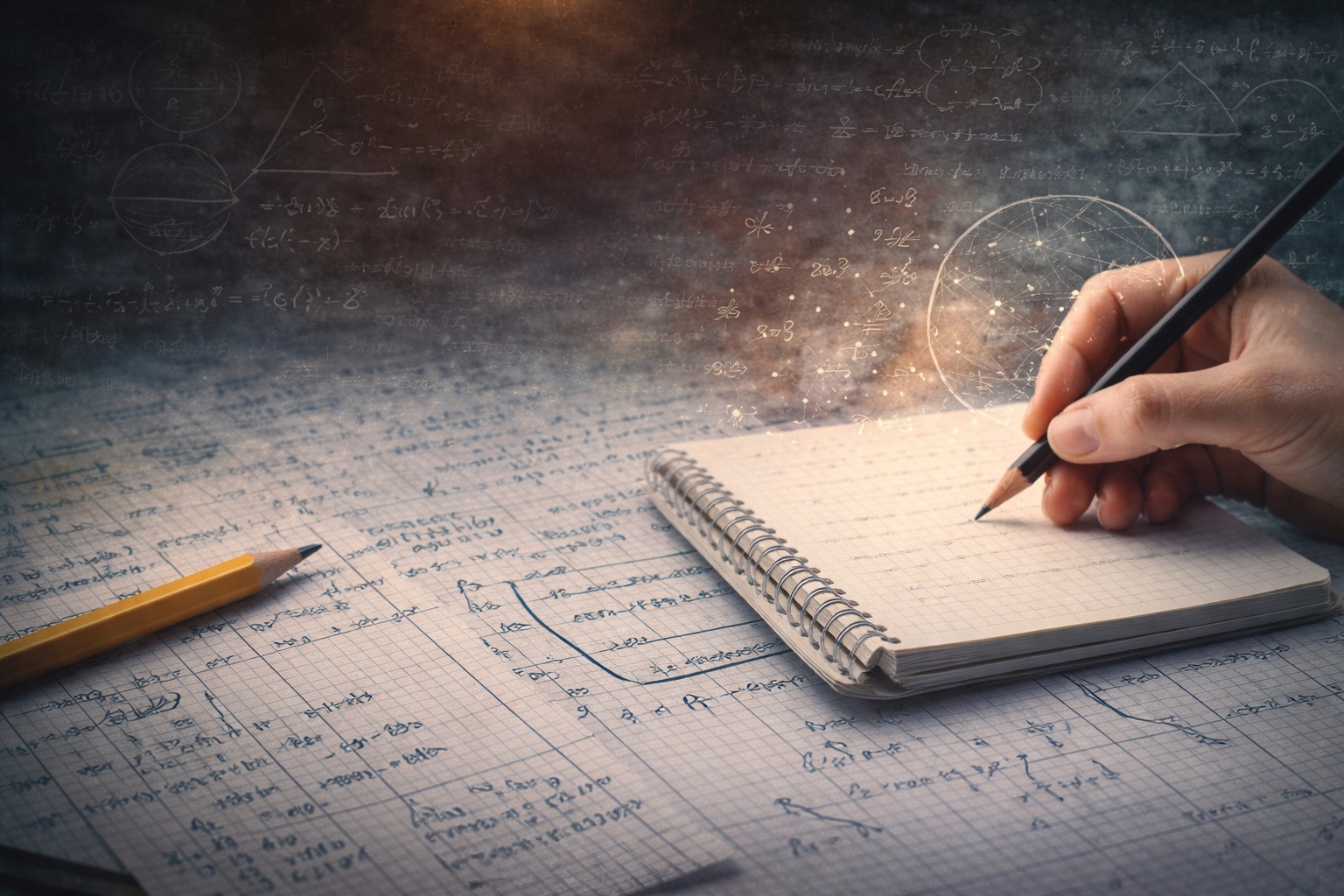
The renowned mathematician George Pólya once remarked, “Mathematics is the cheapest science… All one needs is a pencil and paper.” At first glance, the statement appears almost playful, perhaps even ironic. How can a science that underpins space exploration, artificial intelligence, cryptography, and economic systems be described as “cheap”? But Pólya’s words carry a deeper philosophical truth. Mathematics does not demand laboratories, chemicals, or costly apparatus. It demands something far more fundamental—and far more democratic: thought. In that simplicity lies its revolutionary power.
A Science Without Walls
Unlike physics, chemistry, or biology—disciplines that often rely on experimental setups and sophisticated tools—mathematics is primarily a mental endeavor. Its laboratory is the human mind. Its instruments are logic and imagination. Its experiments unfold through reasoning rather than reaction.
A student sitting beneath a tree in a remote village, armed only with a notebook and a pencil, can grapple with the same theorems that once occupied the minds of Euclid, Newton, Ramanujan, or Gauss. The absence of material resources does not prevent entry into the mathematical universe. The only true barriers are conceptual, not economic.
This universality makes mathematics perhaps the most democratic of all sciences. It does not discriminate based on geography, social status, or institutional privilege. The principles of algebra do not change depending on where they are studied. A geometric proof remains valid whether written in a metropolitan classroom or a modest rural school.
In a world marked by inequality, mathematics offers rare equality of opportunity.
Intellectual Wealth Beyond Material Cost
To describe mathematics as “cheap” is not to trivialize it. On the contrary, it highlights a remarkable paradox: while inexpensive in material terms, mathematics is extraordinarily rich in intellectual value.
Mathematics demands discipline, patience, and perseverance. It requires the ability to hold abstract ideas in the mind, to trace logical consequences with precision, and to confront uncertainty with structured reasoning. It asks not for money, but for mental effort.
Within its abstract symbols lie concepts that shape reality—probability guiding risk assessment, calculus modeling motion, algebra structuring algorithms, geometry influencing architecture. The satellites orbiting Earth, the encryption securing digital communication, the financial systems governing economies—all rest upon mathematical foundations first scribbled on paper.
The most advanced computational systems begin as equations. The most complex engineering designs originate as diagrams. The greatest technological revolutions trace their ancestry back to simple lines drawn by hand.
It is this extraordinary ratio—minimal material investment, maximum intellectual yield—that makes mathematics uniquely transformative.
Mathematics as a Way of Thinking
Too often, mathematics is reduced to numbers and formulas, to examinations and grades. But its true value extends far beyond academic performance. Mathematics is a method of thinking.
When students learn mathematics, they are not merely solving equations; they are training their minds to approach problems methodically. They learn to analyze patterns, identify relationships, test hypotheses, and evaluate conclusions. They cultivate clarity in reasoning and discipline in argument.
In everyday life, mathematical thinking appears in subtle but constant ways: managing household budgets, planning time efficiently, assessing probabilities, interpreting data, and making informed decisions. Logical reasoning, cultivated through mathematics, becomes a life skill.
In this sense, mathematics is not simply preparation for scientific careers—it is preparation for citizenship. A society capable of logical analysis is less vulnerable to misinformation, emotional manipulation, and irrational decision-making.
The Teacher as Catalyst
If mathematics requires only basic tools, its true infrastructure lies in teaching. A passionate teacher can transform a blank blackboard into a universe of ideas. A piece of chalk can become an instrument of discovery.
In resource-limited settings, this truth becomes even more profound. Where laboratories are absent and technology scarce, mathematics can still flourish. A dedicated educator, equipped with clarity and enthusiasm, can bridge the gap between abstraction and understanding.
The role of the teacher is not merely to transmit formulas but to cultivate curiosity. When students are encouraged to ask “why” instead of memorizing “how,” mathematics shifts from intimidation to exploration.
In many developing regions, this simplicity becomes a powerful equalizer. While other sciences may require infrastructure beyond reach, mathematics offers an accessible pathway to intellectual empowerment. A well-trained mathematics teacher may achieve what expensive equipment cannot—confidence, critical thinking, and intellectual independence.
Creativity in Numbers
One of the most persistent myths about mathematics is that it is rigid and mechanical. In truth, it is deeply creative. Solving a mathematical problem often resembles composing music or crafting poetry: it demands imagination, intuition, and elegance.
There are often multiple pathways to a solution. Discovering a novel approach can feel like uncovering hidden symmetry in chaos. The beauty of a concise proof rivals the satisfaction of a well-written stanza.
History reminds us that many groundbreaking discoveries emerged not from elaborate institutions but from individual insight. Mathematical innovation thrives not on machinery but on mindset.
When stripped of distractions, armed only with pen and paper, the mind is free to wander into abstraction, to test patterns, to imagine possibilities. Creativity does not depend on complexity of tools—it depends on clarity of thought.
Confronting the Fear
Despite its accessibility, mathematics is frequently perceived as intimidating. “Math anxiety” has become a widely recognized phenomenon, discouraging countless students from pursuing fields they might otherwise excel in.
This paradox—of the simplest science being the most feared—reveals a flaw not in mathematics itself, but in its presentation. When teaching prioritizes memorization over understanding, when mistakes are penalized rather than explored, mathematics appears hostile rather than inviting.
Reforming this perception requires cultural as well as pedagogical change. Students must be encouraged to experiment, to question, and to see errors as stepping stones rather than failures. Real-life applications should illuminate abstract ideas. Classrooms must become spaces of exploration rather than judgment.
When students realize that mathematics requires no expensive apparatus—only persistence and curiosity—the aura of intimidation begins to dissolve.
Mathematics in the Digital Era
Some may argue that the digital revolution has altered the landscape. Supercomputers perform calculations beyond human capacity. Artificial intelligence systems analyze data at unprecedented scale. Advanced software now dominates mathematical research.
Yet even in this era, the essence of mathematics remains unchanged. Technology accelerates computation; it does not originate insight. Algorithms are born in human reasoning before they are coded. Artificial intelligence rests on linear algebra, probability theory, and calculus—concepts once developed through simple notation.
The most complex technological frameworks still depend on foundational mathematics scribbled on paper. Digital expansion has broadened application, not altered essence.
Pólya’s insight remains intact: the heart of mathematics is thought, not machinery.
Mathematics and Educational Equity
Perhaps the most profound implication of mathematics’ simplicity is its potential to reduce educational inequality. In regions where financial constraints limit access to laboratories, mathematics can still be taught effectively. Basic materials—paper, pencils, blackboards—are sufficient to unlock vast intellectual horizons.
Investing in mathematics education is therefore not merely economical; it is strategic. By strengthening logical reasoning and problem-solving skills, societies equip their citizens to adapt, innovate, and contribute meaningfully to development.
In underprivileged communities, mathematics can become a ladder of mobility. A student who masters mathematical thinking gains entry into fields as diverse as engineering, economics, data science, architecture, and research. The initial investment remains minimal; the potential return is enormous.
A Tradition of Thought
Mathematics’ simplicity also connects us to a long intellectual tradition. Ancient Greek geometers developed rigorous proofs without modern instruments. Indian mathematicians advanced number systems with minimal tools. Across cultures and centuries, scholars expanded mathematical knowledge through dialogue and reasoning.
This continuity underscores a philosophical truth: profound ideas do not require elaborate settings. They require attentive minds.
Mathematics transcends time because its language is universal. A theorem proven centuries ago remains valid today. A geometric principle discovered in one culture speaks to another across borders and generations.
A Message to Students
For students, the lesson is liberating. You do not need expensive devices to excel in mathematics. You need curiosity to ask questions, persistence to attempt solutions, and patience to revisit errors.
Every solved problem strengthens confidence. Every misunderstanding, when corrected, deepens comprehension. Mathematics rewards effort more reliably than almost any other discipline.
A simple notebook can open doors to infinite structures—prime numbers stretching endlessly, geometric patterns unfolding symmetrically, equations mapping the movement of stars.
The tools are simple. The possibilities are not.
A Message to Society
For policymakers and educators, the message is equally powerful. Strengthening mathematics education is both cost-effective and transformative. Training teachers, ensuring access to basic materials, and fostering supportive learning environments can yield long-term societal dividends.
Logical thinkers become innovators. Problem-solvers become leaders. Analytical minds drive economic growth and technological advancement.
Mathematics is not merely a subject in the curriculum; it is an engine of progress.
Conclusion: Greatness in Simplicity
The enduring wisdom of George Pólya reminds us that knowledge does not depend on extravagance. Mathematics stands as a testament to the power of simplicity. It proves that profound discovery can begin with the humblest of tools.
In a world striving for equality, sustainability, and innovation, mathematics offers a rare combination: universal accessibility and limitless depth. It teaches that greatness arises not from what we possess materially, but from how we think intellectually.
A pencil.
A sheet of paper.
A curious mind.
Within these simple elements lies the foundation of science, technology, and human advancement. Let us embrace this simplicity—not as a limitation, but as an invitation.



Comments are closed.