Education debates in India often begin and end with university rankings, board examination results, and competitive entrance tests. These indicators dominate headlines and policy discussions. Yet they overlook a far more basic truth. The real strength of an education system is built long before students reach secondary school or college. It is shaped in the earliest classrooms, where children first learn to read, write, count, and understand the world around them.
In Jammu & Kashmir, this reality carries particular urgency. If education reform in the Union Territory is to succeed, it must begin at the foundational and primary levels. Without strong early learning, reforms at higher levels remain fragile. An education system cannot stand firm if its foundation is weak.
The early years of schooling are not merely about academic instruction. They shape how children think, how confident they feel, and how they relate to learning itself. A child who learns well in the first few years develops curiosity and self-belief. A child who struggles early often carries that burden for years, sometimes for life.
Foundational education refers to the first three to four years of formal schooling. During this period, children are expected to acquire basic literacy and numeracy skills. These include reading simple sentences, understanding basic concepts, and performing elementary mathematical operations. Global research, as well as Indian studies, clearly shows that children who fail to master these skills early face increasing difficulty as they move to higher grades.
A student who cannot read a simple paragraph or solve basic arithmetic problems by Class III is unlikely to cope well with textbooks in Class V or Class VIII. Over time, learning gaps widen. Children memorize without understanding. Fear replaces curiosity. School becomes a place of anxiety rather than growth.
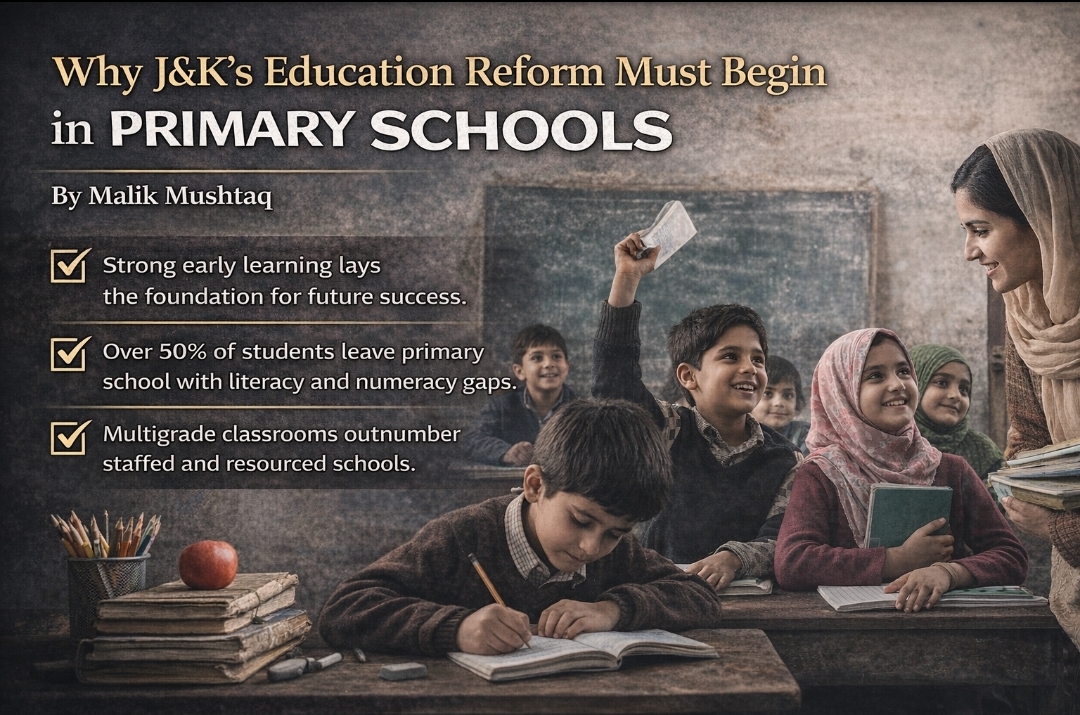
Data from Jammu & Kashmir reflects this challenge clearly. An NCERT study found that nearly 28 percent of Class III students in the Union Territory were unable to complete basic numeracy tasks. These tasks included number identification, simple multiplication, fractions, and date recognition. This figure is significantly higher than the national average, which stands at around 11 percent. In practical terms, this means nearly one out of every three Class III students in J&K is struggling with core mathematical skills.
Reading outcomes present an equally troubling picture. The Annual Status of Education Report, ASER 2024, shows that only about 47 percent of government school students in J&K can read a Class II-level text. Even more concerning is that less than half of students in Class VIII can read basic text fluently. This suggests that literacy gaps formed in early grades continue unchecked for years.
Numeracy weaknesses persist as well. ASER data indicates that only around 28 percent of Class VIII students can perform division. Division is a basic skill expected much earlier in a child’s academic journey. When students reach middle school without mastering such fundamentals, it signals systemic failure rather than individual weakness.
Classroom conditions further complicate learning. A large number of primary schools in Jammu & Kashmir operate under multigrade teaching arrangements. ASER reports that about 84 percent of first primary students are taught in classrooms where children from multiple grades sit together. This is often due to teacher shortages or low enrolment. While multigrade classrooms can work under ideal conditions, they demand specialized training and resources. In most cases, teachers are left to manage diverse learning levels without adequate support.
School size is another important factor. More than 92 percent of primary schools in J&K have fewer than 60 students. Small schools can provide personal attention, but they also face constraints. Limited staff, fewer teaching materials, and reduced administrative support make it difficult to deliver quality education consistently.
On the positive side, enrolment figures are encouraging. Nearly 99.4 percent of children aged 6 to 14 in Jammu & Kashmir are enrolled in school. This reflects successful outreach and access efforts. Children are coming to school. However, enrolment alone does not guarantee learning. Attendance without achievement creates an illusion of progress while real gaps remain unaddressed.
Infrastructure continues to influence learning outcomes. Many schools still struggle with basic facilities. Classrooms may be overcrowded or poorly maintained. Clean drinking water, functional toilets, and child-friendly spaces are not uniformly available. Learning materials are often inadequate, especially in rural and remote areas. In multigrade classrooms, the absence of age-appropriate books and teaching aids makes effective instruction even harder.
Teachers remain central to any reform effort. Yet training gaps persist. ASER 2024 reports that only around 42 to 49 percent of primary schools had at least one teacher trained in Foundational Literacy and Numeracy activities. This is despite national and UT-level directives to prioritise FLN under the National Education Policy 2020. Training efforts often vary from year to year, leading to inconsistency in classroom practice.
Continuous professional development is essential. Teachers need more than subject knowledge. They require pedagogical skills tailored to young learners. They must learn how to identify learning gaps early and respond with targeted support. Without this, even the best policy frameworks remain ineffective on the ground.
Language also plays a crucial role in early learning. Many children in Jammu & Kashmir grow up speaking Kashmiri, Gojri, Pahari, or other local languages. When instruction is delivered primarily in Urdu or English, comprehension suffers. Children struggle to grasp concepts, not because they lack ability, but because the language of instruction feels unfamiliar. Global research consistently shows that early education in a child’s mother tongue improves understanding, participation, and confidence.
Jammu & Kashmir’s overall literacy rate stands at around 82 percent, slightly above the national average. This is an achievement worth acknowledging. However, literacy measured through enrolment and basic certification does not always reflect actual learning. True education means the ability to read with understanding, think logically, and apply knowledge in real life.
Strengthening primary education has ripple effects across the entire education system. Children who learn well early are less likely to drop out later. Strong foundations improve performance across subjects. Teachers become more confident and innovative. Over time, a skilled and capable workforce emerges.
For this transformation to occur, foundational literacy and numeracy must be treated as a priority, not an afterthought. Teacher training must be scaled up and sustained. Learning assessments should be used to guide support, not merely to label failure. Language barriers must be addressed with sensitivity and research-based solutions. Infrastructure improvements must focus on the everyday needs of young learners. Parents and communities must be engaged as partners in education, not passive observers.
Education reform in Jammu & Kashmir cannot begin at the top. It must begin in the first classroom a child enters. The future of the Union Territory depends not on examination scores alone, but on whether children learn well in their earliest years.
When primary schools are strengthened, children gain confidence, teachers gain purpose, families gain hope, and society gains resilience. This is where real reform begins.



Comments are closed.