

Azhar Yousuf
“A system that prioritizes optics over reality risks producing students who can reproduce answers without genuine understanding, thereby weakening the foundation of knowledge itself.”
The recent declaration of JKBOSE Class 10th and 12th results, showing an overall pass percentage of 84% in both streams, has generated a mixture of joy, relief, and concern across society. On one hand, it is a moment of celebration for thousands of students and families who have endured years of rigorous study. On the other, it raises critical questions that demand reflection beyond the superficial glow of numbers. The statistics themselves, while encouraging at face value, hint at deeper systemic and philosophical issues that our educational system must confront.
As an academician, I extend my heartfelt congratulations to all students who passed, acknowledging their dedication, hard work, and perseverance. Yet, as a social observer and activist, I must also stand in solidarity with those who could not succeed this time, reminding them—and society at large—that examination outcomes are neither definitive measures of intelligence nor ultimate verdicts on human potential. In fact, Islam reminds us that human dignity is intrinsic, and failure is a stage in life, not a permanent fate. The Prophet Muhammad (peace be upon him) emphasized the cultivation of character and knowledge together, teaching that success in life is broader than scores or rankings.
However, as someone who has observed the evolution of educational trends over decades, it becomes necessary to critically examine the structural, ethical, and philosophical dimensions underpinning today’s results. We must ask: Are we genuinely fostering learning, or are we simply managing numbers to create the illusion of progress?
From Scarcity of Toppers to Inflation of Excellence
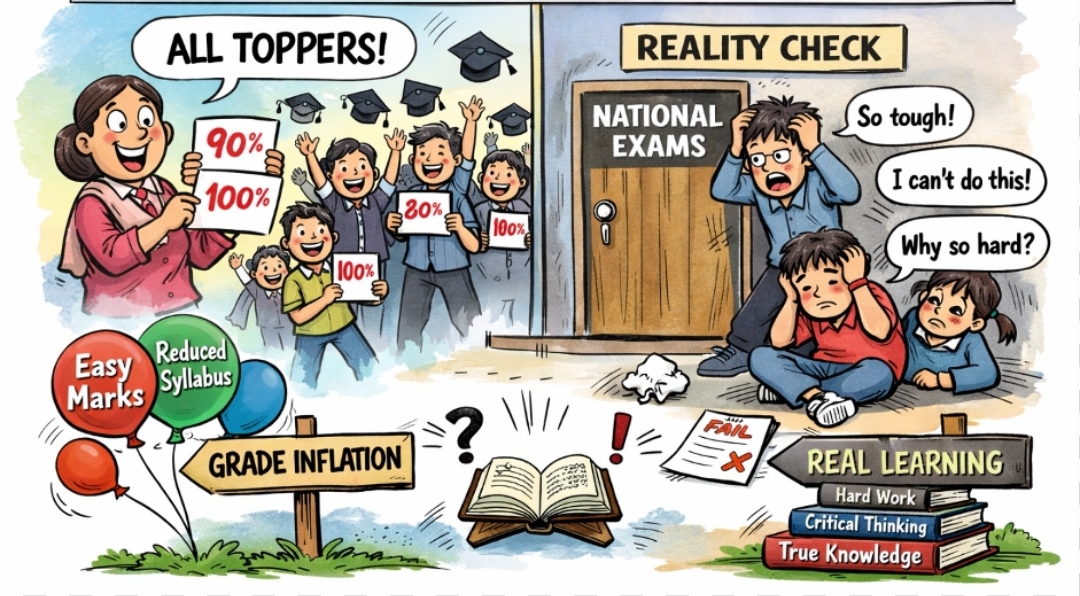
A decade ago, scoring above 90% was an extraordinary achievement. Students who crossed this benchmark were celebrated as toppers—symbols of academic brilliance and hard-earned mastery. Today, the paradox is striking: students scoring 90% often feel anxious, disappointed, or even ashamed, perceiving themselves as underperformers. This dramatic shift does not indicate a sudden surge in genius; rather, it reflects a phenomenon best described as grade inflation, exacerbated by social pressures, parental expectations, and systemic incentives to report high numbers.
When excellence becomes commonplace, its meaning diminishes. A society where everyone is a topper risks diluting the value of achievement itself. The system fails to distinguish between deep understanding, genuine effort, and superficial performance. Islam warns against false measures and distorted scales:
“Give full measure and weight with justice.” (Qur’an 6:152)
Our educational frameworks, too, must maintain just and honest measures—otherwise, we risk fostering a culture where numbers matter more than knowledge.
Facilities, Intelligence, and the Crisis of Character
There is no doubt that today’s students enjoy unprecedented access to infrastructure, digital resources, and academic exposure. Information flows abundantly through online platforms, virtual classrooms, and interactive tools. Yet, access to information is not equivalent to the development of intellect (`aql) or moral consciousness (taqwa). Students may be technically proficient, yet devoid of ethical reasoning and character formation.
We are producing highly qualified engineers, doctors, and administrators, but unethical practices persist in workplaces, institutions, and public life. This disconnect highlights a fundamental flaw: education has become skill-oriented but value-deficient. The Prophet Muhammad (peace be upon him) emphasized:
“The best among you are those with the best character.”
Islamic educational philosophy teaches that knowledge devoid of ethics is not enlightenment; it is a burden. Without moral education, degrees and certificates lose their social purpose, becoming instruments for personal advancement rather than tools for societal benefit.
Policy Decisions and the Question of Academic Integrity
In recent years, we have witnessed repeated syllabus reductions, deletion of substantial portions of textbooks, and generous marks-relaxation policies. While such measures may be justified during emergencies or extraordinary circumstances, their regular application raises serious questions about academic integrity.
As an academician, one must ask: Are we assessing learning, or merely ensuring statistical success? Artificially boosting pass percentages may offer short-term administrative or political comfort, but it undermines long-term academic rigor. Islam cautions against cosmetic success:
“Do not conceal the truth while you know it.” (Qur’an 2:42)
A system that prioritizes optics over reality risks producing students who can reproduce answers without genuine understanding, thereby weakening the foundation of knowledge itself.
Unexpected Scores and the National-Level Paradox
A particularly concerning trend is the frequent reporting of scores far exceeding expectations, including instances of 100% marks. While exceptional students certainly exist, such results must prompt introspection, especially when regional performance is contrasted with national-level outcomes. If board-level results are so uniformly high, why do we see minimal regional representation in national competitive examinations? Why does this excellence fail to translate into consistent performance at broader, more competitive benchmarks?
This gap signals a disconnect between board evaluation standards and actual competency. Islam encourages muhasabah, honest self-accountability. Without acknowledging structural weaknesses and evaluating outcomes critically, meaningful reform remains impossible.
Psychological Pressure and the Dehumanisation of Students
From a social activist’s perspective, the mental health implications of current academic practices are deeply troubling. Students are often reduced to numbers, compared endlessly, and pressured to meet expectations that are increasingly unrealistic. A system in which achieving 90% is seen as failure is neither humane nor educational.
Islam advocates balance and moderation. It rejects extremes—whether of shaming failures or glorifying superficial success. A healthy educational environment nurtures resilience, intellectual curiosity, and ethical growth, rather than obsessive competition and stress-induced anxiety.
Redefining Success: An Islamic Educational Vision
In Islam, success (falah) is holistic, encompassing knowledge, character, intention, and service to society.
“Indeed, the most noble of you in the sight of Allah is the most righteous of you.” (Qur’an 49:13)
Education must aim to produce:
· Intellectually competent individuals, capable of reasoning, analyzing, and innovating.
· Morally responsible citizens, who uphold justice, honesty, and compassion.
· Socially conscious human beings, committed to contributing positively to their communities.
Teachers must impart values alongside subjects. Institutions must prioritize integrity over superficial optics. Parents must celebrate effort, perseverance, and curiosity, not just numerical outcomes. Students, in turn, must understand that knowledge is a trust (amanah), not merely a tool for status, grades, or social recognition.
The real crisis is not rising percentages or declining rigor; it is the loss of purpose in education. Until academic achievement is aligned with ethical grounding and social responsibility, results will remain impressive on paper but fragile in reality.
Ultimately, no examination board delivers the final judgment. That authority belongs to Allah alone—where sincerity, integrity, and moral accountability outweigh any numerical score.
Author is Space Educator (Head of the Training Department), Vyomika Space, ISRO Space Tutor and can be mailed at azharyousf865@zohomail.in

Comments are closed.