

Arooja Bilal
“Schools teach students how to find the right answer, but rarely how to ask the right question.”
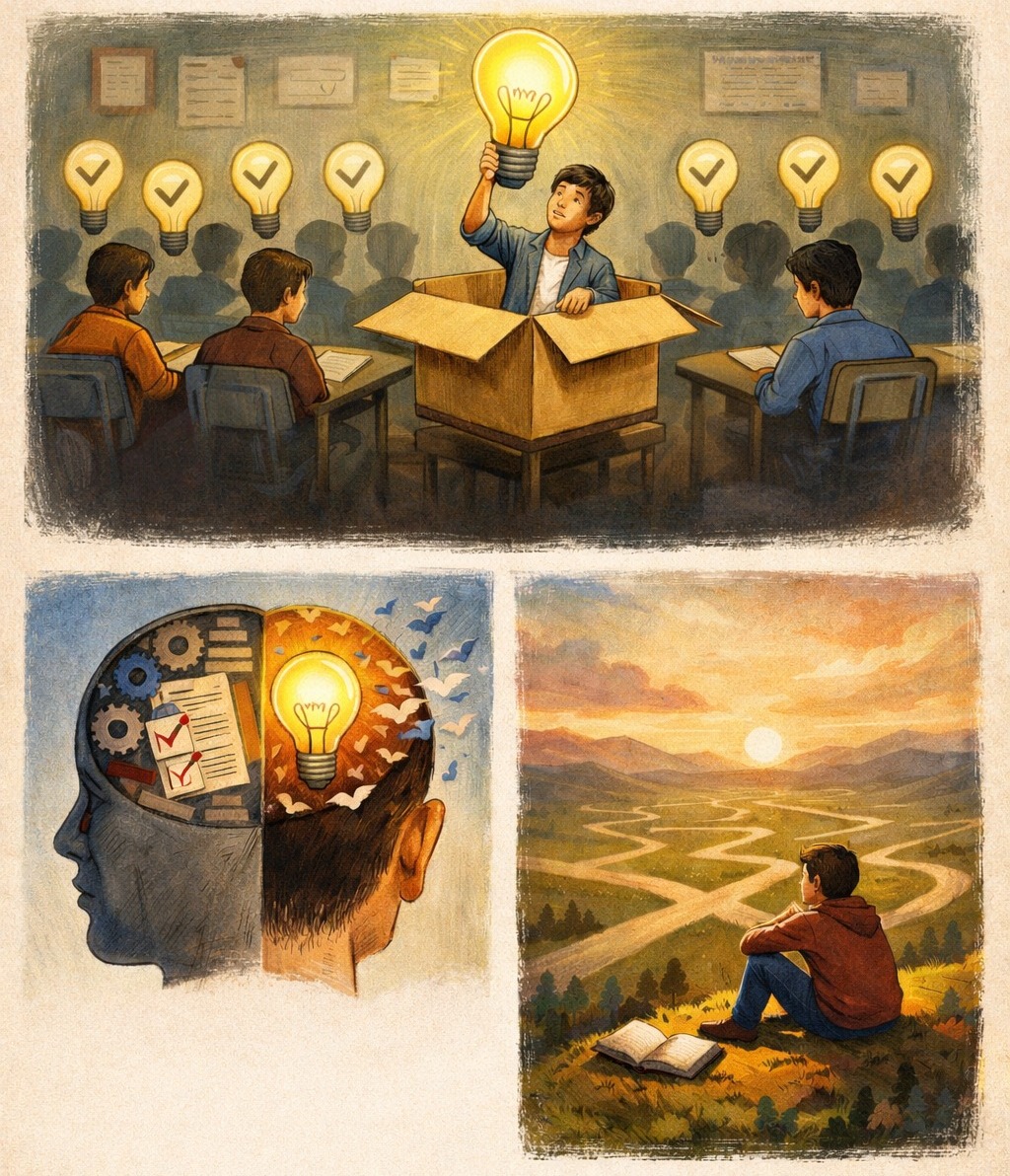
Schools teach many things. It teaches one to memorize, to reproduce the answers, to follow instructions, to score marks, to sit, to stand, to talk, to remain silent, to practice discipline, to develop routines, to practice obedience to a structure, and so on. However, there is one thing that school does not directly teach: independent thinking.
Independent thinking is not rebellion, not arrogance, not disrespect. It is the ability to observe, to question, to sift through information, and to make decisions on one’s own, without blindly absorbing everything that is fed to one’s senses. And independent thinking, ironically, is one of the most important skills to be learned in life.
At a tender age, children in school are trained to look for the “right answer.” There is one correct answer, one correct solution, one correct interpretation, one correct response to every problem. And slowly but surely, the student gets into the habit of not asking “why,” but “what will be in the exam.” The student does not try to understand, but to score marks. The student does not try to form opinions of his/her own, but to reproduce what has already been written down. And slowly but surely,
This, over time, leads to the formation of a habit, where instead of asking “why,” the student asks “what will be on the test.” Instead of understanding, the student thinks about scoring. Instead of having opinions, the student regurgitates what is already written. Slowly, but surely, and unintentionally, the student’s curiosity turns into compliance. But real life does not work like an exam paper.
Outside of school, there is no answer key provided. There is no teacher to verify whether or not what you have provided matches what you have read in your guidebook. It is expected that you analyze what you are given, read between the lines, see manipulation at play, and make decisions that determine your future. Independent thinking is what allows you to be led or to chart your own course.
One of the biggest misconceptions about independent thinking is that it means you have to reject all that you have been taught. Independent thinking does not mean that at all. Independent thinking means you process what you have been given to process rather than swallowing it whole without any thought to what you have been given.
This skill is seldom taught in school because we are geared toward efficiency, not depth. It takes time, patience, and openness to teach a student how to think for themselves, and that causes debate, disagreement, and discomfort. Memorization is so much easier to test, and obedience is so much easier to manage.
Another thing school rarely teaches is how to sit with uncertainty. In most classrooms, students grow used to the idea that every question must have a quick answer. When the teacher asks something, hands go up fast. If no one responds, the silence feels uncomfortable. Many students begin to feel that not knowing an answer is something to be ashamed of. They rush to speak, guess, or repeat what they remember from a textbook. Slowly, this creates a habit of fearing confusion.
Yet confusion is often the starting point of real thinking. Every student who has tried to understand a difficult idea knows this feeling. At first the concept seems unclear. The mind searches for connections. Questions begin to form. With time, the answer becomes clearer. That small journey from doubt to understanding is where genuine learning happens.
The ability to say “I don’t know yet” is not a weakness. It shows honesty and curiosity. Students who allow themselves to stay with a question a little longer often develop deeper understanding. They read more carefully. They ask better questions. They think about problems from different angles. Independent thinkers do not rush toward quick answers. They remain comfortable exploring uncertainty. Over time, this habit strengthens their ability to think, reason, and discover.
School also does not spend much time teaching students how to separate their identity from their performance. From a very young age, marks begin to shape how students see themselves. A good score brings appreciation from teachers and parents.
A low score often brings disappointment. Gradually, numbers on a report card begin to feel like labels. Some students start believing they are naturally intelligent. Others begin to feel they are not good enough. These beliefs slowly become part of how they understand themselves.
This can create a quiet pressure in the minds of many students. A single exam begins to feel like a judgment about their ability. When results drop, confidence also drops. Learning then becomes less about curiosity and more about proving one’s worth. Students begin to worry about how they will appear to others rather than what they actually understand.
Independent thinking requires a healthier way of looking at learning. A student needs to understand that marks measure performance at a particular moment, not the value of a person. Intelligence is not fixed, and learning is not a competition for approval. It is a gradual process that involves mistakes, effort, and patience.
When students separate their self worth from their results, they become more open to challenges. They are less afraid of failure. They try again, ask questions, and improve. In the long run, this attitude builds confidence that is stronger than any number on a report card. It creates learners who value knowledge for its own sake and who continue asking questions long after school ends.
Perhaps the most overlooked lesson is learning how to be alone with your thoughts. Modern schooling is crowded, with noise, competition, comparison, and constant evaluation.
There is little space for quiet reflection. But independent thinking grows in silence. It grows when you read beyond the syllabus, when you observe people, when you reflect on experiences, and when you allow yourself to think without trying to impress anyone.
This is why many people leave school with degrees but without direction. They know how to follow paths, but not how to choose them. They wait for instructions, approvals, and validation. They fear being wrong more than they desire being honest.
Independent thinking does not mean you will always be right. It means you are responsible for your thoughts. It means you are willing to change your mind when presented with better understanding. It means you are not easily swayed by trends, peer pressure, or loud opinions.
The truth is, school gives you tools, but it is up to you to decide how to use them. Independent thinking is something you build quietly, over time. By reading widely. By listening carefully. By questioning respectfully. By trusting your observations. By learning to sit with discomfort instead of running from it.
In the end, education is not just about passing exams. It is about learning how to see the world clearly. And that clarity does not come from memorization alone. It comes from thinking for yourself.

Comments are closed.