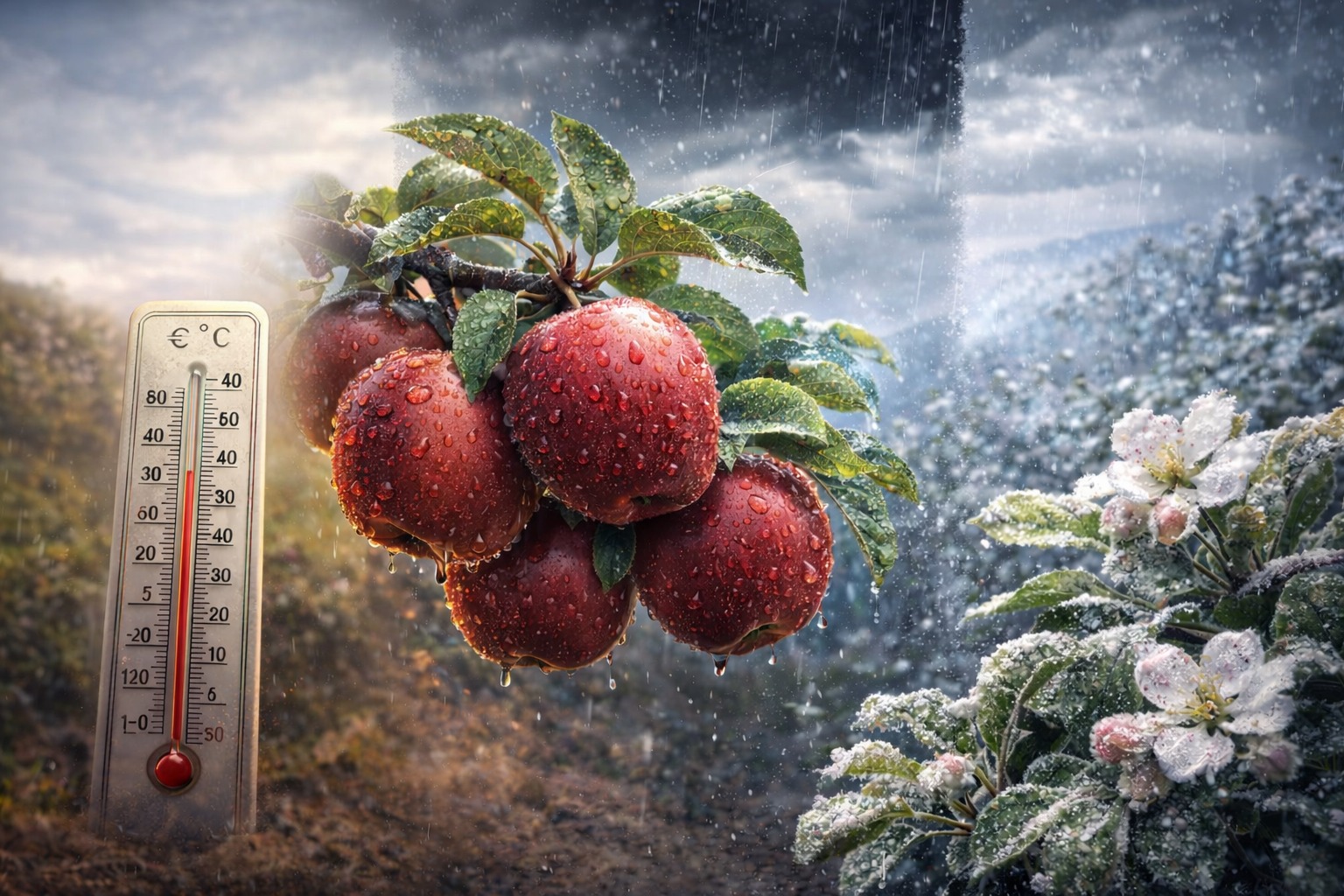
SRINAGAR, APRIL 6: First, an unusual warm spell pushed Kashmir’s apple orchards into a premature bloom. Then came the rain. Now, a sudden dive in temperatures has growers fearing a full-blown pollination disaster — with experts and officials pointing to a changing climate as the prime accused.
Temperatures across the Valley soared 6°C to 11°C above normal from mid-February to mid-March, triggering bud break and flowering nearly a fortnight ahead of schedule. But over the past week, persistent rainfall and a dip in mercury — maximum temperatures in Srinagar stood at 16.3°C and 17.3°C on Saturday and Sunday, both below normal — have turned that early advantage into a potential catastrophe.
“The impact of climate change is no longer an abstract warning in IPCC reports. It is visible on the ground, right here in our orchards,” an official of the Srinagar Meteorological Department told Kashmir Convener.
In key apple belts such as Shopian, Kulgam and parts of north Kashmir, temperatures have stubbornly remained below 15°C — a critical threshold for pollination.
“Low temperatures, especially during the night, are causing ovule death. We are watching our crop die before it is even born,” said Umar Rashid, a third-generation apple grower from Shopian. The ovule, he explained, is the part of the flower that develops into fruit after fertilisation. “If this fails, there is no apple.”
Dr Waseem, Assistant Professor of Plant Pathology at SKUAST-Kashmir, broke down the mechanics of the crisis. “Potential pollinators like bees remain completely inactive and stay inside their hives when temperatures fall below 15°C. This directly affects pollination and fruit set. Even if flowers are abundant, no pollination means no crop.”
“Even one week of this weather at this stage can cut apple yields by 30-40 per cent,” said Dr Waseem. “The window for successful pollination is very narrow — and it may already be closing.”
With apple cultivation being the economic backbone of Kashmir — accounting for nearly 70 per cent of the region’s agricultural GDP — any disruption at the flowering stage can devastate farmer incomes and trigger cascading effects on cold storage, transport, and the fruit mandi system.
“We have never seen such erratic weather back-to-back. First the false spring, now this cold and rain. It’s as if the seasons have forgotten their calendar,” said Mohammad Yousuf Rather, an orchardist from Pulwama. “Last year we lost crop to hail. This year, we may lose it to pollination failure. How many years can a farmer survive?”
Fayaz Ahmed Mir, alias Kakaji, president of Asia’s second-largest fruit mandi in Sopore, told Kashmir Convener, “This is not a localised problem. From Sopore to Shopian, growers are reporting poor bee activity. The government must declare this a climate emergency and provide immediate compensation. Otherwise, we will see a massive debt crisis in rural Kashmir.”
Meanwhile, the MeT department has forecast widespread rain and snow in Jammu and Kashmir from Tuesday afternoon, with flooding risks along the Zojila Pass and Mughal Road — further threatening already fragile access routes for apple logistics.
Director MeT Srinagar, Dr Mukhtar Ahmad, told Kashmir Convener, “Intermittent light to moderate rain is expected from Tuesday forenoon to Wednesday evening, with higher reaches likely to receive light to moderate snowfall. A few places in both divisions may get moderate to heavy rainfall.”
An advisory has warned of thunder, hailstorms, and gusty winds reaching 40-50 km/h on April 7 and 8. “Intense, heavy showers for brief periods may trigger flash floods, landslides in vulnerable areas, and waterlogging in low-lying areas, especially along Zojila and Mughal Road,” the officer added.
From April 9 to 10, isolated light rain and snow over higher reaches are possible, but the weather is expected to remain generally dry from April 11 to 16 — though a brief afternoon spell cannot be ruled out.
Minimum night temperatures showed a mixed trend. Gulmarg recorded the lowest in Kashmir at minus 1.1°C, while in the Jammu division, Bhaderwah was the coldest at 4.0°C. Several parts of Kashmir recorded night temperatures 1-3°C above normal, while many places in Jammu saw readings 0-3°C below normal.



Comments are closed.