

Advocate Mudasir Naqshbandi
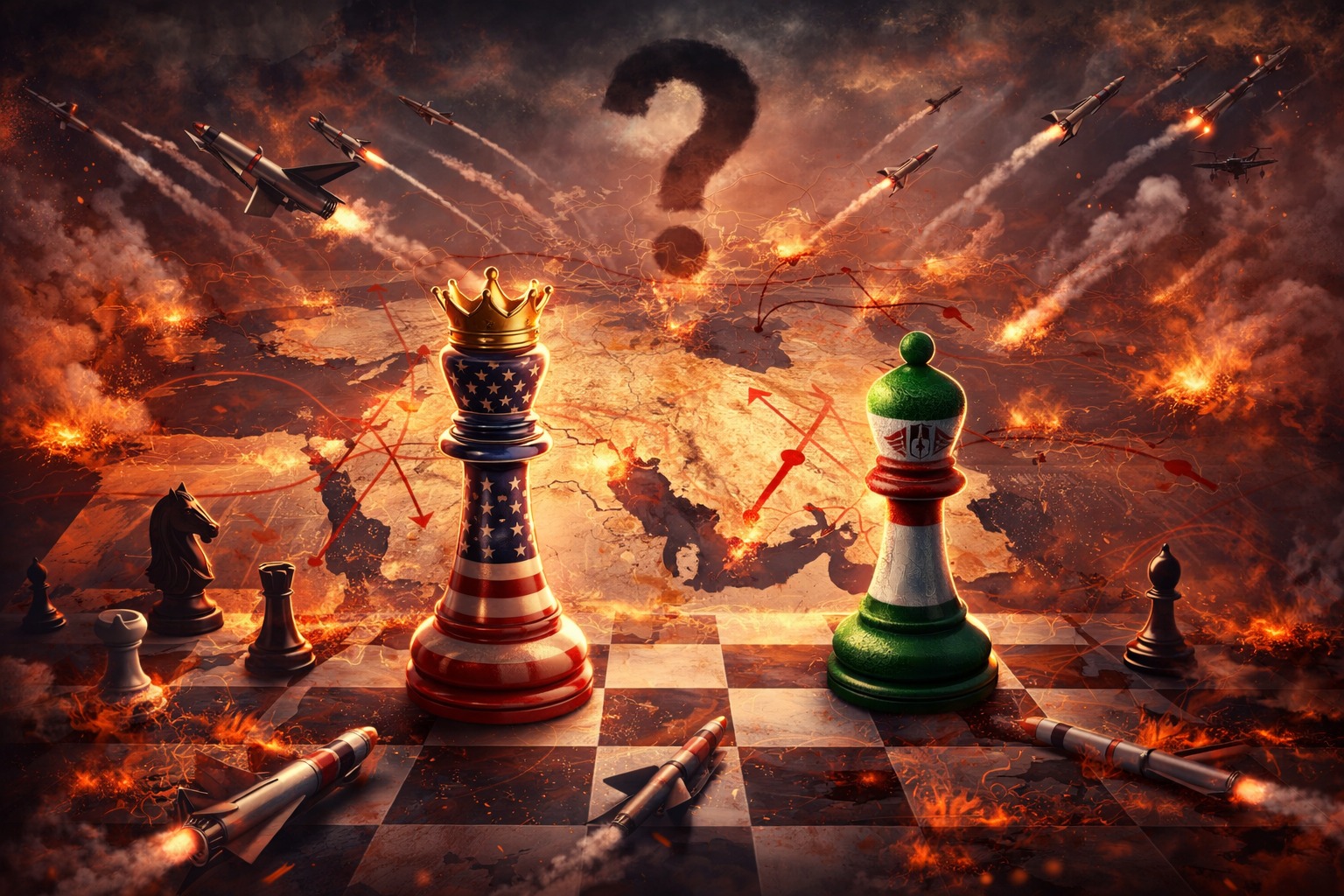
Nearly two weeks into the growing tension between the United States and Iran , one fact is becoming clear: the administration of Donald Trump seems to be involved in a conflict without a clear goal. What started as a show of strength now looks more like a struggle driven by political messaging than by a well-planned strategy.
Wars are usually fought for clear reasons. Countries go to war to defend themselves, remove a threat, or force the other side to negotiate. But in this case, the goals of Washington remain unclear. Is the aim to change the Iranian government? Is it to stop Iran’s nuclear program? Or is it simply an attempt to pressure the leadership in Tehran through military and economic force?
The lack of clarity raises serious concerns about the direction of American policy.
Despite strong pressure from Washington and its allies, the Iranian leadership has not shown signs of weakening. Many had predicted that Iran’s political system would collapse under pressure, but that has not happened. Instead, the government in Tehran has shown unity and resistance.
Iranian Foreign Minister Abbas Araghchi has clearly stated that Iran will not negotiate under pressure or threats. According to him, Iran will not sit at the negotiation table while facing military intimidation. This position has closed the diplomatic door that Washington hoped would open.
This situation leaves the United States in a difficult position. If negotiations are not possible and military pressure is not producing quick results, then the strategy begins to look weak.
Ten days into the conflict, the statements coming from Washington appear less confident than before. Earlier there was talk of a clear plan, but now the language sounds more like hope that pressure will force Iran to change its position.
But hope alone cannot win wars.
History shows that wars without clear political goals often become long and unpredictable. Military strength by itself does not guarantee victory. The experiences of the United States in the Vietnam War and the Iraq War prove that even powerful armies can struggle when political objectives are unclear.
Today’s confrontation is also becoming a battle of narratives. On one side, Washington describes Iran as a dangerous and destabilizing power that must be contained. On the other side, Tehran presents itself as a country defending its sovereignty against foreign pressure.
In modern conflicts, perception is very important. How the world sees a conflict can influence its outcome. At the moment, Iran appears determined to stand firm.
Many critics in the United States and around the world are beginning to question the purpose and legality of the conflict. Some experts warn that the situation could grow into a larger regional crisis without achieving any meaningful result.
For countries like India and many nations in the Global South, the situation is worrying. Instability in the Middle East directly affects global oil prices, international trade, and regional security. A long conflict between Washington and Iran could have serious global consequences.
The Strategic Vacuum
One of the biggest concerns about the current conflict is the lack of a clear strategy from Washington. In earlier wars, the United States at least explained its long-term objectives. During the Vietnam War, the goal was to stop the spread of communism. In Iraq, the justification was the removal of weapons of mass destruction and reshaping the region’s political order.
But in the present situation, the objectives seem to change frequently.
At times the focus is Iran’s nuclear program. At other times officials talk about changing the Iranian government. Sometimes the conflict is described as a way to limit Iran’s influence in the Middle East.
This inconsistency creates confusion not only for Iran but also for the rest of the world. Allies may become uncertain about their role. Neutral countries hesitate to support policies that have no clear outcome. Meanwhile, opponents may gain confidence when they see uncertainty in their rival’s strategy.
Iran appears to understand this situation and is using it to its advantage.
Tehran’s Calculated Resistance
The leadership in Tehran knows that wars are fought not only on battlefields but also in global public opinion. By refusing to surrender to pressure, Iran is trying to present itself as a country resisting foreign domination.
For many nations that have experienced colonialism or foreign interference, this message can be powerful. In regions such as Asia, Africa, and Latin America, the idea of standing against a superpower often gains sympathy.
This is why the narrative of the conflict matters so much.
Military attacks may dominate headlines, but legitimacy and public perception shape how conflicts are remembered in history.
Risks of Escalation
Another serious concern is that the conflict could expand beyond control. The Middle East has always been a complex region where political rivalries and global power interests collide.
A direct conflict between the United States and Iran could pull other countries into the crisis.
Regional powers like Saudi Arabia, Israel, and Turkey all have important interests in the region. Any escalation could lead to a wider regional war.
At the same time, global powers such as Russia and China are watching closely. Both countries maintain relations with Iran and may use the situation to challenge American influence.
All these factors make the absence of a clear American strategy even more concerning.
The Economic Impact
The economic consequences of the conflict could also be serious. The Middle East plays a key role in global energy supply, and instability in the region often leads to higher oil prices.Rising oil prices affect economies around the world. For developing countries already facing inflation and economic pressure, such increases can be very damaging. Countries like India, which import large amounts of oil from the region, could face economic difficulties if the crisis continues.
The Limits of Military Power
At the center of this crisis lies an important question: can military power alone solve complex political conflicts?
History suggests that the answer is no.
Conflicts involving national identity, political ideology, and regional influence cannot be solved only through force. Diplomacy, negotiation, and cooperation are often necessary for long-term peace. However, the current approach appears to rely more on confrontation than dialogue.
By limiting diplomatic options and increasing military pressure, Washington may be creating a situation that becomes harder to control.
The Path Forward
Today’s world is highly interconnected. Regional conflicts quickly become global concerns. Economic shocks spread across countries, political tensions affect international relations, and humanitarian crises can destabilize entire regions. In such a world, clear strategy and diplomacy are essential. The main problem facing Washington today is not simply military. It is political and strategic. Without a clear end goal, the conflict risks turning into a long and uncertain struggle. History has shown that wars without clear strategies rarely end in success.
As this confrontation continues, the real question is no longer about military power.
The real question is whether Washington has a plan.
So far, that answer remains unclear.
And in war, uncertainty is rarely a sign of victory.

Comments are closed.