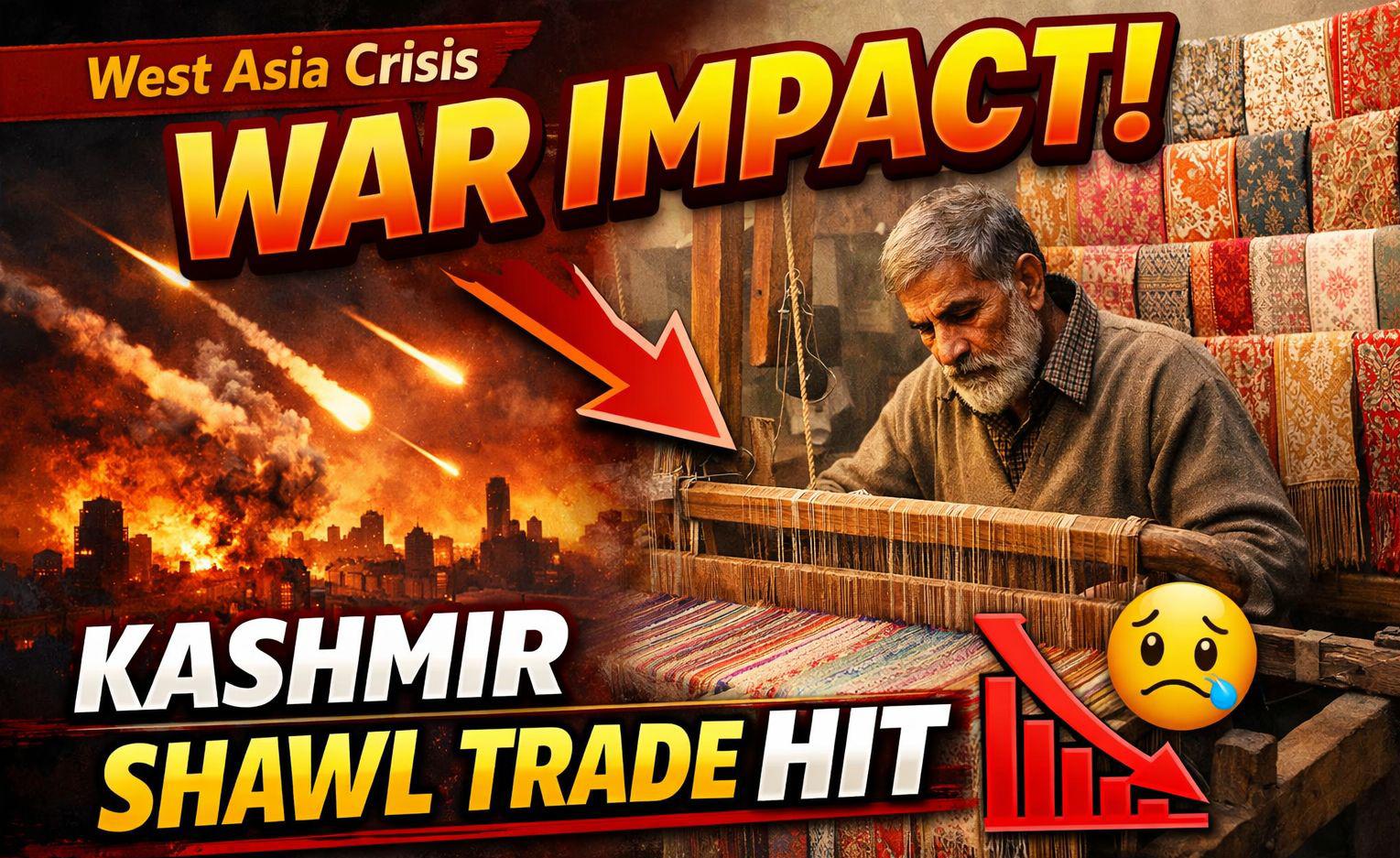
Srinagar, Apr 7: The ongoing West Asia crisis has cast a long shadow over Kashmir’s famous shawl and handicraft sector, with nearly 4.5 lakh artisans rendered idle, export events cancelled, and exporters staring at mounting losses.
Kashmir Chamber of Commerce and Industry (KCCI) president Javid Ahmad Tenga said the import-export of goods to the Middle East has been severely affected. “Kashmir’s merchants are not able to export their goods from here, due to which they are facing huge losses. Many of our exporters have been affected and general trade has taken a hit,” Tenga told Kashmir Convener.
He said no fresh inquiries have come from the Middle East for the past 15 days. Exports to the UK and Europe are also under threat as buyers have adopted a wait-and-watch policy, he added.
The demand for men’s handkerchiefs, locally known as ‘Torma Masar’ — a key item during Eid and Ramzan — has crashed. “Many orders have been cancelled, and there is no news of new orders. Some shipments have gone, but payments have not come,” President Tenga said.
Shipping costs have risen from Rs 3,000 to Rs 4,500 per courier. Bulk buyers from the US and UK have paused large orders of 1,000, 500 and 200 pieces, he said, warning of a massive impact on the craft industry if the situation continues for the next two to three months.
Showroom manager Amir Ahmad said there has been no work since the war began. “Even payments for work completed before the war are stuck. March and April are peak export seasons, but we currently have no business,” he said.
Carpet dealer Fayaz Ahmad Shah, overseeing the creation of the world’s second-largest silk carpet, said prolonged instability could force him to halt the ambitious project. “Right now, the dealers are managing to keep the looms running, but if the situation persists, it will become impossible,” Shah said.
Prominent carpet exporter and Carpet Export Promotion Council (CEPC) member Sheikh Ashiq Ahmad said the carpet and handicrafts sector in the valley has gone into silent mode since the start of the Iran war. “Whenever a war happens, we are the first victims, as people shift their priorities from luxury spending to basic survival,” he said.
According to CEPC and KCCI, stock worth thousands of crores is piled up, while nearly 4.5 lakh artisans and craftsmen have been rendered idle. About Rs 400 crore remains blocked in the Middle East, with around 600 orders already cancelled and zero new business leads from Gulf, European and East Asian markets.
Handicraft exporter Tariq Ghoni said more than 50,000 workers could lose their jobs if the conflict escalates. “Three of our exhibitions have been cancelled, one each in Denmark, the UAE, and Beijing. Spring is the main season for carpets. Around 600 orders have already been cancelled, and more may be cancelled if the war does not stop,” Ghoni said.
Shawl trader Mohammad Yousuf said he has been forced to reduce advances to weavers. “I reduced advances this month because payments have slowed. One weaver borrowed money from relatives to pay school fees.”
Aamir, 19, an apprentice from downtown Srinagar, said his family is asking him to look for other work. “When there is no order, I practice designs on paper. My father asks me to look for other work,” he said.



Comments are closed.