

Mohammad Arfat Wani
“Patwari’s strength lies in his ability to express profound truths in simple and elegant language, allowing each story to unfold as both a philosophical reflection and a deeply human narrative.”
In the vast canvas of Urdu literature, the role of Kashmiri Pandits and Kaistahs is like a star studded galaxy. They not only added to the richness of the language but also lit up the horizon of Urdu literature with their own distinct cultural flair. In this galaxy of literary luminaries, two distinct groups of writers can be identified. The first group consists of writers who not only branched out from Kashmir but also made their mark in Lucknow, Delhi, and other cities, including the likes of Pandit Diya Shankar Nasim, Ratan Nath Sarshar and Chakbast.
The other group comprises writers who remained rooted in their homeland and worked for the cause of Urdu literature. The events of 1990 forced this small but loyal group of writers into exile, but among those who converted their personal tragedy into literary gold are Prem Nath Pardesi, Dr. Birj Premi, and Veerindar Patwari.
Veerindar Patwari is a renowned and revered personality in Urdu literature. Since 1965, he has established a unique identity through his copious and insightful literary productions. Born in a family of scholars in Sopore, he has inherited a rich literary tradition from his father, Pandit Prem Nath Patwari. Though he has been trained as a civil engineer, his creative temperament has overcome all hurdles. Even an accident that changed the course of his life and the difficulties of displacement could not halt his literary stream. His writings reflect the essence of Kashmir with a sensibility so delicate and have explored the depths of the human psyche, depicting the concealed pain and inner turmoil of the soul.
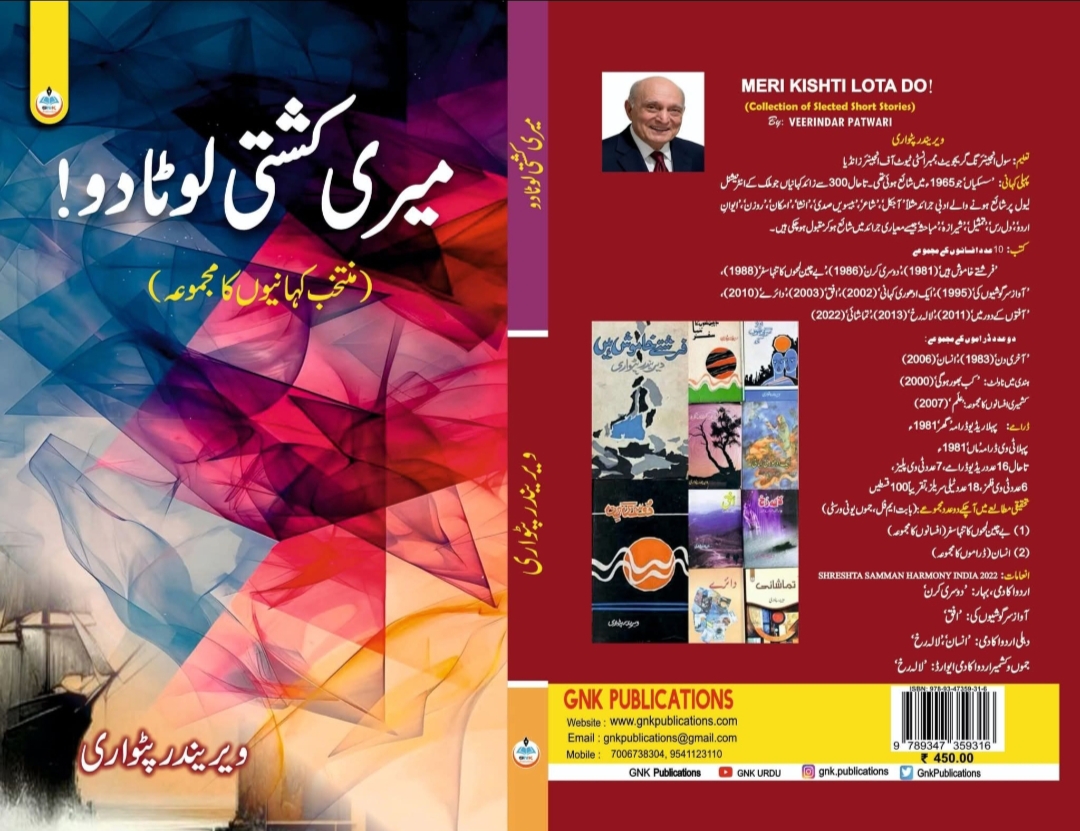
His latest compilation, Meri Kashti Luta Do, is a deep reflection of the pain within, the love for roots and the search for identity. The cry in the title is not just a cry for an individual but a cry of a generation that wants to go back to its past and save its cultural heritage. The stories of Patwari are an embodiment of the intricacies of human relationships, the tragedies of exile, and the never-ending struggle of life with an immense level of empathy and skill. They also remind the reader that no matter how turbulent the circumstances are, a true writer always maintains the spirit of his homeland and its culture through the power of words.
The literary contributions of Veerindar Patwari include afsanche, novels, poetry, and plays in Urdu, Hindi, English, and Kashmiri languages. More than 300 of his afsanche have been published in leading publications such as Aaj Kal, Biswin Sadi, Aiwan e Urdu and Shairazah. His writing style is marked by its unique, effective, and philosophically rich features which have the capability of holding immense meaning and emotion in the short span of a short story.
His literary achievements include publication of ten story compilations: Farishte Khamosh Hain (1981), Doosri Kiran (1986), Bechain Lamhoon Ka Tanha Safar (1988), Awaaz-e-Sargoshiyon Ki (1995), Ek Adhoori Kahani (2002), Ufuq (2003), Dairay (2010), Athon Ke Dor Mein (2011), Lala Rukh (2013), and Tamashai (2022). Moreover, he has published compilations of plays, a Hindi novelette titled Kab Bhoor Hogi, and a Kashmiri stories compilation titled Ilm. His writings have been broadcast on radio and television, and two MPhil research dissertations on his literary contributions have been prepared at Jammu University. Patwari has received many awards, including Shreshtha Samaan from Harmony India, and awards from Urdu academies in Delhi, Bihar, and Jammu & Kashmir.
Renowned writer Deepak Badki says that Patwari’s writing style is unique and fascinating, which is infused with his immense love for the Kashmir soil. His writings are full of humility, compassion and humanism, and the rhythm of his literary expression has continued unabated in all circumstances.
Meri Kashti Luta Do is a breath of fresh air in terms of creativity in Urdu literature. This book is more than a compilation of stories; it is an essence of the observations, artistic insights, and experiences of the author. With 140 pages and publication by G.N.K. Publications, this book is exceptionally well-designed and organized. The title of the book has a philosophical undertone, hinting at the lost memories, struggle for identity, and turmoil of the human soul.
This book is a compilation of forty afsanche and stories, each of which portrays various aspects of human life. The stories revolve around human emotions, social awareness, political predicaments, and personal struggles. Some of the story titles include Fateh Hoon, Hok, Soda, Tota, Anjam, Na Jane Kyun, Jamood, Achanak, Bood Nabood, Dhuen Ki Lakeerein, Ajooba, Sawal, Aur Agar, Jawaaz, Anokha Khel, Ajnabi Dost, Masoom, Yeh Desh Kaun Hai, Ek Hi Rasta, Dushman, Bila Unwan, Magar Kab, Tamashai, Wujood, Saza, Faryaad, Ek Anokhi Adalat, Girdab, Kuch Meri Suno, Kaheen Yeh Woh To Nahin, Khamoshi, Talaash, Hamare Apne Mohsin Ji, Wasiyat, Pukaar, Darpok, Barf, Meena Bazaar, Karwat, and Meri Kashti Luta Do! that transport the reader to a world of human experiences and philosophical ideas.
The strength of Patwari’s craft is his ability to articulate deep truths in simple, precise, and beautiful language. Every story has a philosophy, a question, and an answer to the question of human experience. The final chapter, Meri Kashti Luta Do is a memorable one, distilling the author’s thoughts and observations in a profoundly moving way.
The stories deal with a host of themes ranging from the COVID-19 pandemic to human relationships, the apathy of society, moral dilemmas, historical and political situations, and parent-child relationships. The stories represent the strength of the human spirit, moral awareness, and the never-ending struggle for justice, understanding, and empathy. Patwari’s stories place social issues, politics, and the complexities of human psychology in the open with unflinching honesty and a remarkable artistic sensibility.
Veerindar Patwari’s artistic journey is not just a play of words but the voice of a civilizational elegy that seeks the moisture of its roots in the scorching deserts of migration. Even in the final stages of life and the weakness of old age, when most people are concerned with their own health and comfort, the hallmark of Patwari’s character lies in his concern for the preservation and spread of Urdu literature more than for himself. Veerindar Patwari’s latest offering, Meri Kashti Luta Do, is not just a book but the cry of a soul that is exiled and seeks to reclaim its lost identity and forgotten links of humanity in the crystal-clear waters of the past. His artistic journey shows that when the ground shifts from under one’s feet, the real writer builds an entire universe with words, where the islands of memory and the shelters of hope are never destroyed, and this literary courage and selfless devotion to Urdu is a beacon of hope for the new generation of writers.
In my opinion, Meri Kashti Luta Do is not only a remarkable contribution to the Urdu afsanche literature, but it is also a timeless masterpiece that embodies the spirit of human experience, social awareness, and philosophical insight. Veerindar Patwari has proved his literary acumen in this masterpiece, which has a profound impact on the readers and has raised the bar of modern Urdu literature. I, Wani Arfat take this opportunity to congratulate Veerindar Patwari on this outstanding literary achievement. This book is a precious present and a beacon of intellectual insight for every Urdu literature lover.

Comments are closed.