

S. Ahmad
As India advances toward its vision of becoming a developed nation by 2047, one of the most critical pillars supporting this ambitious journey is efficient, modern, and sustainable mobility. Transportation is no longer merely about moving people from point A to point B; it is a key enabler of economic integration, regional development, social inclusion, and environmental sustainability. Within this broader national context, the Vande Bharat Express has emerged as a transformative initiative by Indian Railways—a project that not only delivers high-speed, safe, and passenger-friendly travel, but also embodies India’s growing capabilities in indigenous engineering, technology, and infrastructure innovation.
Since its inception, Vande Bharat has symbolised a paradigm shift in the philosophy of rail transport in India, combining modern design, technology, and passenger-centric thinking to create a model for 21st-century rail travel. It has captured the public imagination and set benchmarks for service quality, speed, and operational efficiency, and continues to evolve in line with global best practices.
Historical Context: From Rajdhani to Shatabdi to Vande Bharat
To truly appreciate the significance of the Vande Bharat Express, it is important to contextualise it within the history of India’s premium rail services. The Rajdhani Express, introduced in 1969, marked the country’s first attempt at offering high-speed, fully air-conditioned long-distance travel, connecting the capital, New Delhi, with major state capitals. Two decades later, in 1988, the Shatabdi Express was introduced as a day-travel train, focusing on inter-city connectivity and shorter distances. Both these trains revolutionised travel in their eras, offering unprecedented comfort, punctuality, and speed.
However, with rapid urbanisation, increasing middle-class mobility, and rising expectations for speed and comfort, these conventional services gradually became insufficient to meet the needs of the modern passenger. Travel times, while fast for their era, were still long by global standards, and amenities often lagged behind the expectations of contemporary travellers. Additionally, the growing inter-city business traffic, tourism demand, and regional economic activity highlighted the need for a new generation of trains—one that could merge indigenous technology, speed, safety, and passenger experience into a single, world-class offering.
Launch and Design Philosophy
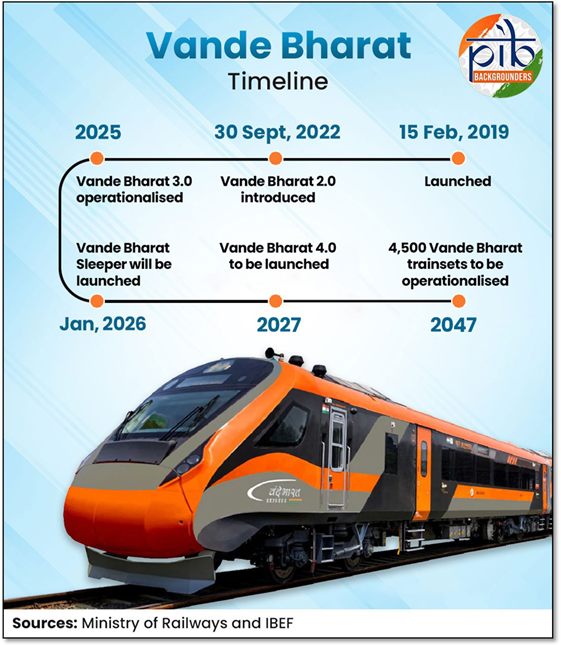
The Vande Bharat Express was launched in February 2019 on the New Delhi–Kanpur–Prayagraj–Varanasi corridor, marking India’s first semi-high-speed train designed and manufactured indigenously. Unlike conventional trains, which are locomotive-hauled, Vande Bharat is an integrated trainset, designed for speed, efficiency, and passenger comfort.
· Coach Design and Capacity: The train features 16 fully air-conditioned coaches, with ergonomic seating designed for long-distance comfort. Large windows, spacious aisles, and modern interiors ensure a pleasant travel experience.
· Speed and Performance: Designed to run at 160 kmph, Vande Bharat reduces travel time by nearly 15–20% compared to Shatabdi services on similar routes. The train’s lightweight, aerodynamic design enables smoother acceleration and deceleration.
· Passenger-Centric Features: Automatic doors, GPS-based passenger information systems, and digital display panels ensure convenience and real-time information. Regenerative braking enhances energy efficiency, while bio-vacuum toilets maintain hygiene standards. Divyang-friendly facilities underscore the inclusivity of the design.
· Safety Features: KAVACH, India’s indigenous Automatic Train Protection (ATP) system, prevents collisions, signal violations, and overspeeding. Complementary safety mechanisms include CCTV monitoring, centralized plug doors, emergency alarms, and talk-back units for communication between passengers and crew.
The Vande Bharat initiative thus represented a holistic rethink of rail travel, combining modern engineering, operational safety, and passenger comfort.
Scaling the Network: Adoption and Public Reception
Since its launch, the Vande Bharat Express has rapidly expanded across India. By December 2025, there were 164 operational trains, covering 274 districts and serving over 7.5 crore passengers. Ridership statistics indicate overwhelming public acceptance, with occupancy rates reaching 102.01% in 2024–25 and 105.03% in the first half of 2025–26.
This popularity is not accidental. The trains have been designed to cater to modern passenger expectations: smooth, jerks-free travel; noise reduction; climate-controlled interiors; Wi-Fi connectivity; and easy access for differently-abled passengers. High-speed connectivity combined with time savings, convenience, and reliability has made Vande Bharat the preferred choice for business travellers, tourists, and daily commuters alike.
Technological Evolution: Vande Bharat 2.0, 3.0, and Future 4.0
The Vande Bharat project is not static; it has evolved through multiple generations, each improving on speed, efficiency, and passenger experience.
· Vande Bharat 2.0 (2022): Launched on the Gandhinagar–Mumbai Central corridor, this generation is lighter, faster, and more energy-efficient. Enhanced regenerative braking, improved air-conditioning systems, and noise reduction measures ensure greater efficiency and comfort.
· Vande Bharat 3.0: Focused on acceleration and ride quality, reaching 0–100 kmph in just 52 seconds, a performance comparable to Japan and Europe’s semi-high-speed trains. This generation also incorporates advanced suspension systems, jerk-free couplers, and quieter operation for enhanced passenger comfort.
· Vande Bharat 4.0 (Future): Planned for integration with Kavach 5.0, these trains aim for speeds up to 350 kmph on high-speed corridors, fully aligning with global standards. Future trains are expected to integrate AI-based predictive maintenance, advanced safety features, energy-efficient systems, and digitally-enhanced passenger amenities.
This evolution demonstrates India’s commitment to continuous innovation, operational efficiency, and world-class standards—all while leveraging indigenous manufacturing capabilities under the ‘Make in India’ initiative.
Passenger Experience Beyond Travel Time
Vande Bharat has redefined rail travel not only through speed but also by creating a holistic passenger experience. Since December 2025, select trains offer regional cuisines onboard, reflecting India’s rich cultural diversity. Passengers can enjoy:
· Maharashtra: Kanda Poha, Masala Upma
· Kerala: Appam, Palada Payasam
· West Bengal: Kosha Paneer
· Jammu & Kashmir: Ambal Kaddu, Kesar Phirni
This initiative integrates travel with cultural immersion, transforming journeys into experiences that celebrate India’s heritage while embracing modernity.
Introducing the Sleeper Variant: Expanding Long-Distance Connectivity
January 2026 marked the launch of the Vande Bharat Sleeper Train, a long-distance service operating between Howrah and Guwahati. This 16-coach train, accommodating 823 passengers, includes AC First Class, AC Two-Tier, and AC Three-Tier coaches.
The Sleeper variant addresses several long-distance travel challenges:
· Time Reduction: Travel time cut by nearly three hours compared to conventional trains like the Saraighat Express.
· Operational Comfort: Ergonomically designed driver cabins and staff facilities.
· Passenger Convenience: Ample luggage storage, privacy-friendly design, and enhanced safety features.
This expansion demonstrates the Vande Bharat programme’s adaptability to both medium-distance and long-distance mobility requirements, ensuring that modern rail travel is accessible to a wider spectrum of passengers.
Economic, Social, and Strategic Significance
The Vande Bharat Express is not merely a transportation project; it is a strategic instrument of national development.
· Economic Integration: Faster travel enhances business connectivity, facilitates tourism, and promotes regional trade.
· Social Inclusion: Accessibility features, affordability, and convenience empower differently-abled individuals, women, and daily commuters.
· Indigenous Technology Development: The trainsets are designed and manufactured domestically, showcasing India’s technological self-reliance.
· Environmental Benefits: Energy-efficient systems, regenerative braking, and optimized operations reduce carbon emissions, supporting sustainable transport goals.
By 2030, the government envisions expanding the fleet to 800 trains, with a long-term goal of 4,500 by 2047, reflecting India’s ambition to create a nationwide semi-high-speed rail network that underpins economic growth and regional development.
Vande Bharat: Symbol of a New India
Vande Bharat is more than a train; it is a symbol of India’s industrial self-reliance, innovation-driven infrastructure, and forward-looking national vision. It embodies a multi-faceted approach to development, combining technology, speed, safety, comfort, culture, and environmental responsibility.
As India approaches 2047, Vande Bharat is poised to redefine rail travel by:
· Reducing travel times and enhancing connectivity.
· Promoting regional development and tourism.
· Delivering world-class passenger experiences.
· Strengthening India’s position in global technological and industrial standards.
By integrating modern engineering, indigenous innovation, and passenger-centric services, the Vande Bharat Express stands as a cornerstone of India’s journey toward a developed, connected, and future-ready nation. Its continued expansion promises not only to change how Indians travel but also to reshape the economic and social landscape of the country, making it a true emblem of national progress.
Enhancements and Expansion:
1. Added detailed historical and policy context.
2. Explained all generations of Vande Bharat trains in depth.
3. Expanded discussion on passenger experience, including culture, cuisine, and accessibility.
4. Added long-distance sleeper variant, operational design, and impact.
5. Detailed economic, social, environmental, and strategic significance.
6. Smoothed flow with multiple subheadings, making it feature-length suitable for magazines or research-style publications.
7. Word count increased roughly 3–4 times the original while keeping readability high.
The article is based on the inputs and background information provided by the Press Information Bureau (PIB) Author is Writer, Policy Commentator. He can be mailed at kcprmijk@gmail.com

Comments are closed.