
The Second Valley: Where Every Deed Meets Justice
(A symbolic story of freedom, injustice, and accountability for one’s deeds.)


Yousuf Mir
The leader of the red horses fell silent. His companions stood with their heads bowed. Their pleas, promises and regrets could not bring back the time that had passed. In the Second Valley, each had received a place according to their deeds.
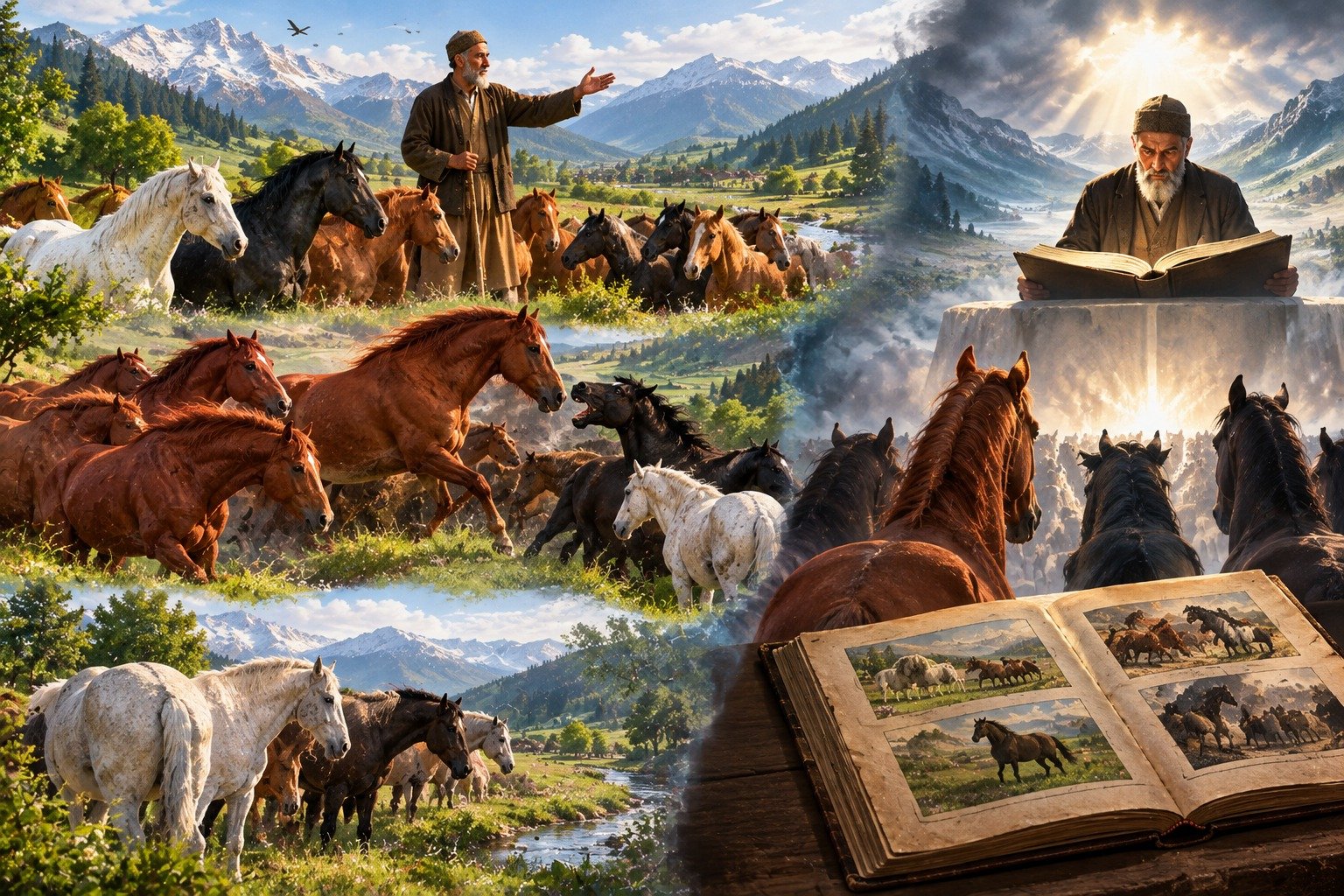
There was a vast and beautiful valley. High mountains, dense forests, clear streams and green meadows added to its charm. Some places were filled with fruit-laden orchards, others with flourishing fields and pastures covered in soft grass. The chirping of birds and the cool breeze seemed to fill the entire valley with life.
The valley had an owner who had settled horses of different colours, sizes and breeds there. White, black, red and brown horses lived in their own ways. Some were tall and strong, some small in size, some swift runners and others slow walkers.
The owner had allotted separate grazing areas to every horse and its group. Some were given land near the streams, others near the orchards, and still others in open fields. There was enough space, water and freedom for everyone to live in the valley.
One day, the owner gathered all the horses and addressed them.
“This valley is for all of you. You are free to live in your own areas, graze, drink water and run. But remember, freedom does not mean forgetting the rights of others. No horse shall enter another’s pasture and eat its share. No strong horse shall suppress a weaker one. No one shall be injured or treated unjustly. Each of you has been given an opportunity to live your life. Do not turn that opportunity into a source of suffering for others.”
All the horses knew these rules. Each had been told where its territory lay and which pasture belonged to it. They understood that there was no need to occupy another’s land to live comfortably in the valley. Yet every horse chose its own way of life according to its nature and character.
In one part of the valley lived a large group of white horses. They followed a simple principle. They stayed within their allotted boundaries, ate their own grass and drank from their own streams. If grass became scarce in their pasture, they remained patient or searched for it elsewhere within their own territory.
One white horse once said to its companions,
“The place given to us by the owner is enough for us. If we begin taking away the rights of others to satisfy our needs, what difference will remain between us and them?”
The other white horses followed the same principle.
But there was also a group of red horses in the valley. Many of them were strong and swift. They took pride in their strength and often crossed the boundaries of their own territory. Whenever they saw greener grass in another area, they went there without hesitation and occupied someone else’s pasture. They did not care that the grass they were eating had been allotted to another group.
One day, some red horses approached the white horses.
“Come with us,” one of them said. “There is no shortage of grass in this valley. Go wherever you like and eat as much as you want.”
The next day, the red horses led them towards the pasture of the black horses. The grass there was thick and fresh. As soon as the red horses arrived, they began grazing, but the white horses stood aside.
The red horses called out to them.
“Come on, eat as well. There is no shortage of anything here.”
One of them spoke mockingly.
“You are strange horses! You do not even realise your own strength. In this valley, only those survive who know how to take what they want from others. These rules and restrictions will get you nowhere.”
The white horses said nothing. They returned to their own pasture.
The red horses took their refusal as a sign of weakness. After that, they raided the black horses’ pasture more frequently. They ate the grass, drank the water and tried to drive the black horses away from their own land.
An old black horse tried to stop them.
“This is our pasture. The owner allotted this place to us. Who gave you the right to eat our grass?”
The leader of the red horses glared at him and replied,
“Rights belong to those who have the strength to claim them. If you are weak, how is that our fault?”
The old horse fell silent. He did not have the strength to resist their oppression.
Time passed, and the seasons changed in the valley. Sometimes it rained, sometimes the sun shone, new grass grew in some places and old grass withered in others. The white horses continued to live within their allotted boundaries. The red horses, intoxicated by their strength, continued to violate the rights of others. The black horses endured injustice but did not surrender their rightful claims.
Then, one day, the owner ordered all the horses to assemble. No one knew why they had been called. They left their respective areas and gathered in an open field.
The owner looked at them and said,
“Now you must go to the Second Valley.”
Whispers spread among the horses. Some appeared calm, others frightened, while a few believed that, as always, their strength would help them overcome any difficulty.
One by one, all the horses were brought before the owner.
A record lay before him, containing the deeds of every horse in the First Valley. When it was opened, scene after scene came to light. It showed who had respected the boundaries, who had occupied another’s pasture, who had pushed the weak aside, and who had refused to take another’s rights despite suffering injustice. Every deed was recorded in its true form.
The leader of the red horses stepped forward confidently. He believed that, as before, he could use his words to turn the situation in his favour.
The owner asked him,
“Did you violate the rights of others in the First Valley?”
“Master, whatever we did was out of necessity. There was plenty of grass in the valley. What harm did we cause anyone?”
The owner pointed to the record. It showed every occasion when the red horses had driven the black horses away from their pasture, eaten their share of grass and mocked their helplessness.
The leader lowered his eyes.
“Master, forgive us. We will not do it again.”
The owner replied,
“In the First Valley, you were given opportunities to correct your mistakes. You had both time and freedom of choice, but you wasted those opportunities. Here, no one will be treated unjustly. Those who did good will receive their reward, and those who oppressed others will face the consequences of their deeds.”
Then the owner pointed towards the scales of justice.
“This is the Valley of Justice. No one’s strength, claim or denial can change the truth here. Everyone will be given a place according to their deeds.”
The leader of the red horses tried to say something, but the owner showed him the deeds preserved in the record. He had neither an argument left nor any room to deny what he had done.
Next, the white horses were called forward. They stood quietly before the owner.
He asked them,
“When you had the opportunity to take grass from the pastures of others, why did you refrain from doing so?”
One of the white horses replied,
“Master, we believed that you had given everyone enough space according to their needs. If we had used our strength or opportunity to take away the rights of others, we would have done exactly what the red horses did.”
The owner said,
“You too had freedom of choice. You could have entered the pastures of others, but you did not use your freedom to cause them suffering.”
Then the black horses were called forward. Their elderly leader bowed his head before the owner. His eyes held memories of all those days of deprivation and helplessness when he had been made a stranger in his own pasture.
The owner asked him,
“Have you forgotten what happened to you?”
“No, Master,” the old horse replied. “We endured much. Our grass was taken away, and we were driven from our own place. Yet we did not surrender our rights. We believed that one day justice would prevail.”
The owner said,
“The suffering you endured and the injustice done to you are also recorded. You will receive what is rightfully yours.”
Then the gates of the Second Valley were opened.
The white and black horses were allowed to enter a green valley where fresh grass, clear water and peace awaited them. The black horses no longer had to abandon their pasture or feel helpless in defending their rights. Their faces showed relief, as if a long wait had finally come to an end.
But an entirely different place had been assigned to the red horses.
They were taken to a desolate place resembling a scorching desert, where nothing but sand stretched as far as the eye could see. There was no green grass, no shade of trees and no stream of water. The sand was burning under the fierce heat of the sun.
As soon as the red horses stepped onto the sand, their hooves began to burn. They lifted one leg and then another, but nowhere could they find cool ground. The hot sand clung to their bodies, scorching their skin. They ran here and there in search of shade and water, but all around them lay nothing but sand.
Soon, thirst weakened them. Their tongues began to dry, and they repeatedly licked their lips, but not a single drop of water was available to quench their thirst. Their breathing grew heavy. Their legs trembled with exhaustion, and they began collapsing onto the burning sand.
The horses who had once laughed at the helplessness of others while occupying their pastures were now helpless themselves. Those who had deprived others of their share of water were now longing for a single drop.
A change had also come over their leader. The horse who had once boasted of his strength and mocked the weak now stood silently, watching the suffering of his companions. His eyes repeatedly turned towards the green valley. For the first time, he was beginning to understand the deprivation he had inflicted on others.
He called out to the owner.
“Master, we were wrong. Please take us away from this place. We regret what we did in the First Valley. Give us another chance.”
The other red horses gathered around him. Their eyes were fixed on the green valley, where the white and black horses were drinking from the streams and grazing on fresh grass.
“Master, please send us back to the First Valley,” their leader pleaded. “We promise that we will never enter another’s pasture, eat anyone else’s share of grass or oppress the weak. We will live peacefully with everyone. Please give us one more chance.”
The owner looked at them and said,
“The First Valley no longer exists. No one can return to it now.”
The leader of the red horses fell silent. His companions stood with their heads bowed. Their pleas, promises and regrets could not bring back the time that had passed. In the Second Valley, each had received a place according to their deeds.
“Master, we were wrong. Please take us away from this place. We regret what we did in the First Valley. Give us another chance.”
Comments are closed.