

Abdul Aziz
“Delay is no longer seen as a failure of governance; it has been normalised as an unavoidable condition of public life.”
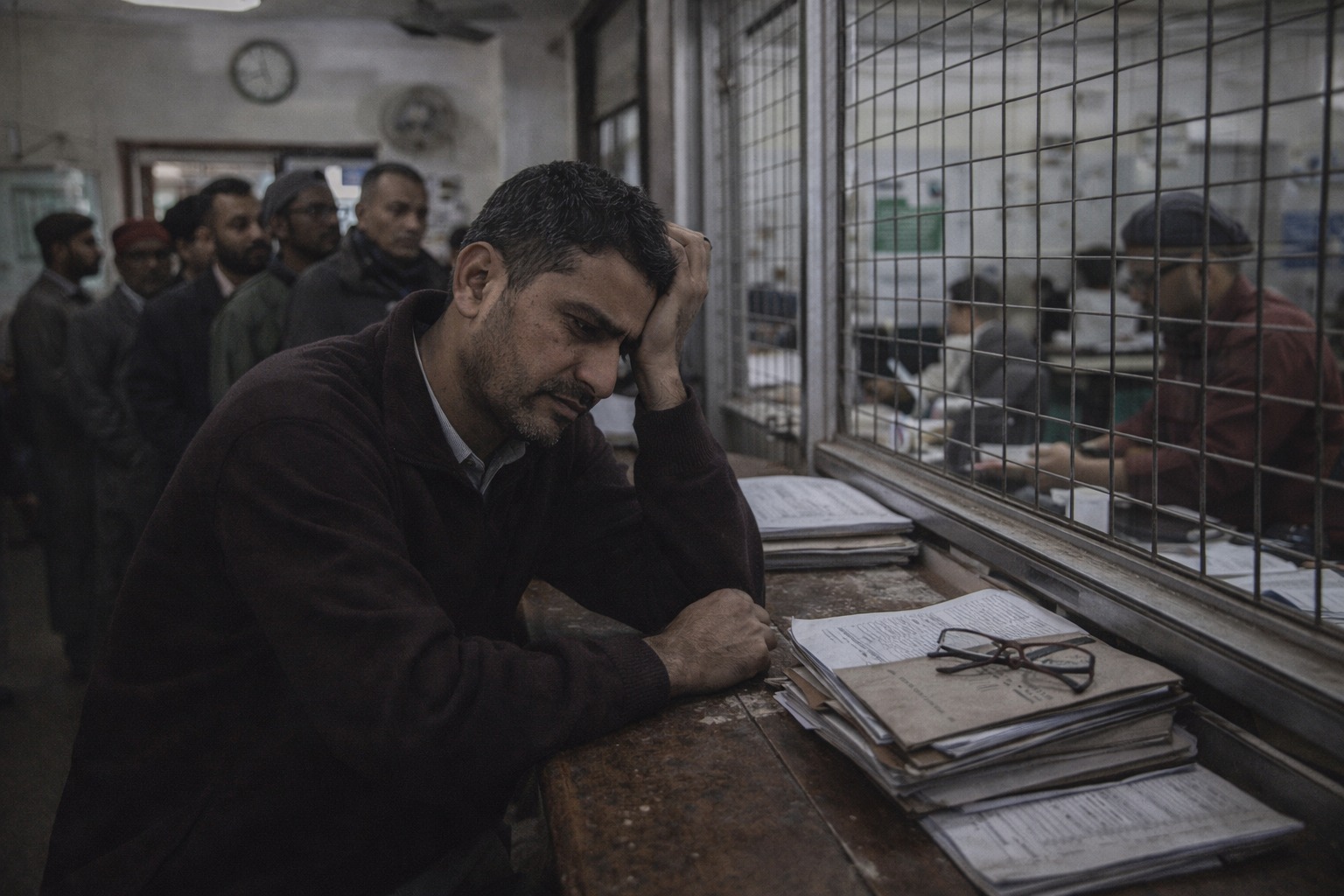
In India, the ordinary citizen most often encounters the state not through lofty constitutional ideals, but through queues, counters, files, and prolonged waiting. The Constitution promises justice, liberty, equality, and dignity to every individual. Yet, in daily life, these promises are frequently undermined by procedural delays, postponed hearings, missed deadlines, and a pervasive lack of punctuality in public offices and institutions. What should be routine administrative processes often turn into exhausting ordeals. This widening gap between constitutional promise and administrative practice has become one of the most persistent and damaging features of Indian officialism.
At its core, this is not merely a problem of inefficiency; it is a cultural and institutional malaise. Delay has become normalised. Punctuality is treated as optional rather than obligatory. Files move slowly, meetings start late, hearings are adjourned casually, and citizens are told—explicitly or implicitly—that waiting is part of governance. Over time, this has created a silent acceptance of delay as an unavoidable reality of public life, even though its consequences are deeply unjust.
The roots of this problem lie partly in history. Many of India’s administrative institutions still carry the imprint of colonial governance. Under colonial rule, administration was designed to exercise control over subjects, not to deliver services to citizens. Authority mattered more than accessibility, and procedure mattered more than outcomes. After Independence, India adopted a democratic Constitution that placed the citizen at the centre of governance. However, while laws changed, institutional habits did not always follow. Rigid procedures, excessive paperwork, hierarchical decision-making, and a tolerance for delay survived the transition. As a result, a democratic state often continues to function with an administrative culture shaped by a non-democratic past.
This culture of delay stands in direct tension with the constitutional framework. The Preamble commits the Republic to justice—social, economic, and political. Justice is not confined to courtrooms or final judgments; it also includes timely access to public services, welfare benefits, licences, permits, and administrative decisions. Justice delayed in administration can be just as harmful as justice delayed in courts.
Article 14 of the Constitution guarantees equality before the law and equal protection of the laws. On paper, procedures apply equally to all. In practice, however, delay creates unequal outcomes. When one citizen receives a licence or certificate within weeks while another waits for months or even years, equality becomes hollow. The law may be uniform, but its operation is not. Unequal access to time becomes a form of inequality, quietly undermining the constitutional promise.
Article 21, which protects the right to life and personal liberty, has been interpreted by the Supreme Court to include the right to live with dignity. Over decades, the Court has expanded this article to encompass rights such as livelihood, health, education, and speedy justice. The famous phrase “justice delayed is justice denied” is most often associated with judicial delays, but its logic extends far beyond courts. A delayed pension deprives an elderly person of security. A delayed scholarship threatens a student’s education. A delayed building permission can ruin a small entrepreneur. In each case, administrative delay interferes with dignity, autonomy, and the ability to plan one’s life.
Judicial pronouncements over the years reflect a growing recognition of this reality. The Supreme Court and various High Courts have repeatedly criticised lax attitudes toward time. They have declared speedy trial to be an essential part of Article 21, quashed proceedings that dragged on endlessly, and condemned routine adjournments granted without compelling reasons. Courts have described inefficient procedures as an abuse of the process of law and have reprimanded authorities for sitting on files and ignoring statutory deadlines. These observations make it clear that punctuality and timeliness are not matters of etiquette alone; they are constitutionally relevant values.
The human cost of delay is most severe for the poor and marginalised. A salaried government employee may treat a postponed hearing or delayed certificate as an inconvenience. A daily wage worker cannot afford such delays. When a labourer has to visit a government office multiple times to correct a ration card, each visit means a day without wages. When a farmer must repeatedly travel to update land records, each trip involves transport costs, lost labour, and physical strain. For people living in remote areas, a visit to a district headquarters may require overnight stays, borrowed money, and missed responsibilities at home.
Beyond these visible costs lies a deeper, hidden burden: uncertainty. Delay creates a permanent state of waiting. Families do not know when a housing allotment will materialise. Young graduates are left unsure about recruitment results. Small business owners wait endlessly for licences, unable to plan investments or employment. Time becomes an invisible weapon, producing anxiety, frustration, and helplessness. Over time, this uncertainty corrodes trust in the state and weakens citizens’ belief that institutions exist to serve them.
Delay and unpunctuality also feed corruption. When procedures move slowly and officials are not held accountable for time, citizens begin to believe that speed is available only at a price. Bribes, favours, and political connections become informal shortcuts. A parallel system emerges alongside the formal one. While the official process remains slow and rigid, an unofficial route promises quick results—for those who can afford it. This system strikes at the heart of Article 14, transforming equality before law into a privilege for the influential.
Recognising these dangers, lawmakers and courts have attempted corrective measures. Several states have enacted Right to Public Services laws that prescribe clear timelines for delivering essential services such as certificates, licences, and permits. Some of these laws even provide for compensation or penalties when deadlines are violated. The Right to Information Act, 2005, marked a major shift by imposing strict time limits and personal penalties on officials who delay or deny information. These laws acknowledge a crucial principle: time is a public resource, and its misuse by the state harms citizens.
Courts have supported this approach. They have urged governments to fill vacancies, simplify procedures, embrace e-governance, and curb unnecessary adjournments. They have emphasised that the state must act as a model employer and a responsible litigant. This means avoiding frivolous appeals, refraining from using delay as a tactic, and respecting the time of courts and citizens alike. When the state drags litigation or administrative processes without justification, it wastes not only public money but public trust.
Technology has brought partial relief. Online portals for passports, taxation, railways, and various state services have improved transparency and reduced some delays. Application tracking systems allow citizens to monitor progress. Virtual hearings and e-courts have eased travel burdens and addressed certain backlogs. Yet technology is not a cure by itself. Without a cultural shift, digital systems can merely digitise delay. A file can remain “under process” on a screen just as indefinitely as it once did on a dusty shelf.
Ultimately, meaningful reform requires a change in mindset. Officialism must give way to a culture of public service. Punctuality should be treated as a professional and ethical obligation, not a personal preference. When offices open on time, meetings begin as scheduled, and decisions are delivered within deadlines, the state signals respect for citizens. Performance evaluations, promotions, and training in the civil services should reward timely delivery, not just procedural compliance. Officers must be trained to see every file as a human story, not an abstract task.
Procedures themselves also need reform. Many delays exist because processes are unnecessarily complex, layered with approvals, and rooted in distrust of citizens. Simplifying rules, removing redundant steps, decentralising decision-making, and clearly publishing timelines can dramatically reduce delay without compromising accountability. Transparency about performance—how often departments meet deadlines—can create public pressure for improvement.
Citizens, too, play a role. Awareness of legal rights, including the right to information and statutory service timelines, empowers people to challenge arbitrary delay. Civil society organisations, bar associations, and the media can spotlight cases where delay causes grave injustice. Courts can continue to insist that timelines in law are meaningful obligations, not decorative provisions. When administrative reform, judicial vigilance, and public awareness converge, the culture of delay can begin to weaken.
In the end, this is not only a legal issue but a moral one. How a state treats the time of its people reflects how it values their lives. An administration that routinely wastes the time of its poorest citizens betrays the spirit of the Constitution, even if it follows every formal rule. Procedural delay and unpunctual officialism slowly hollow out democracy from within. They turn rights into distant promises and reduce citizens to petitioners before an indifferent system.
If India is to honour its constitutional ideals, it must learn to move on time, decide on time, and serve on time. A state that respects the time of its people does more than improve efficiency—it affirms dignity, strengthens trust, and brings the Constitution closer to everyday life.
Author is a Retired Master at the Department of School Education. He can be mailed at azizabdul37122@gmail.com

Comments are closed.