


Usuf Mir
“Broad daylight collapsed into dusk, and the valley learned how to breathe in darkness.”
Dark, dense clouds spread across the sky, and within moments, broad daylight turned into deep darkness. It felt as if the night had swallowed the light of the day. People, in panic, began rushing toward safer places or their homes.
The entire valley—once known as paradise on earth—was gripped by fear. Fields, mountains, waterfalls, markets, and villages—all were trapped in this web of darkness.
As time passed, people learned to live within this darkness. Some carved paths with courage, while others became rulers among the blind, exploiting the weak. Among such names was Asif.
Dressed in a white kurta and black waistcoat, Asif made his presence felt even from a distance. His scent and voice were enough to announce his arrival. He was not openly cruel, but he had become part of a system that thrived under the shadow of oppression.
Then one day, he made a decision that suffocated the entire village—the only source of drinking water, the spring, was shut down.
This spring was not just water; it was life itself. Humans and animals alike depended on it. But in Junaid’s eyes, it was merely a piece of land—one that could be seized to build a road leading directly to his home.
Using Asif’s influence, he succeeded. And thus, nature’s gift was silently buried.
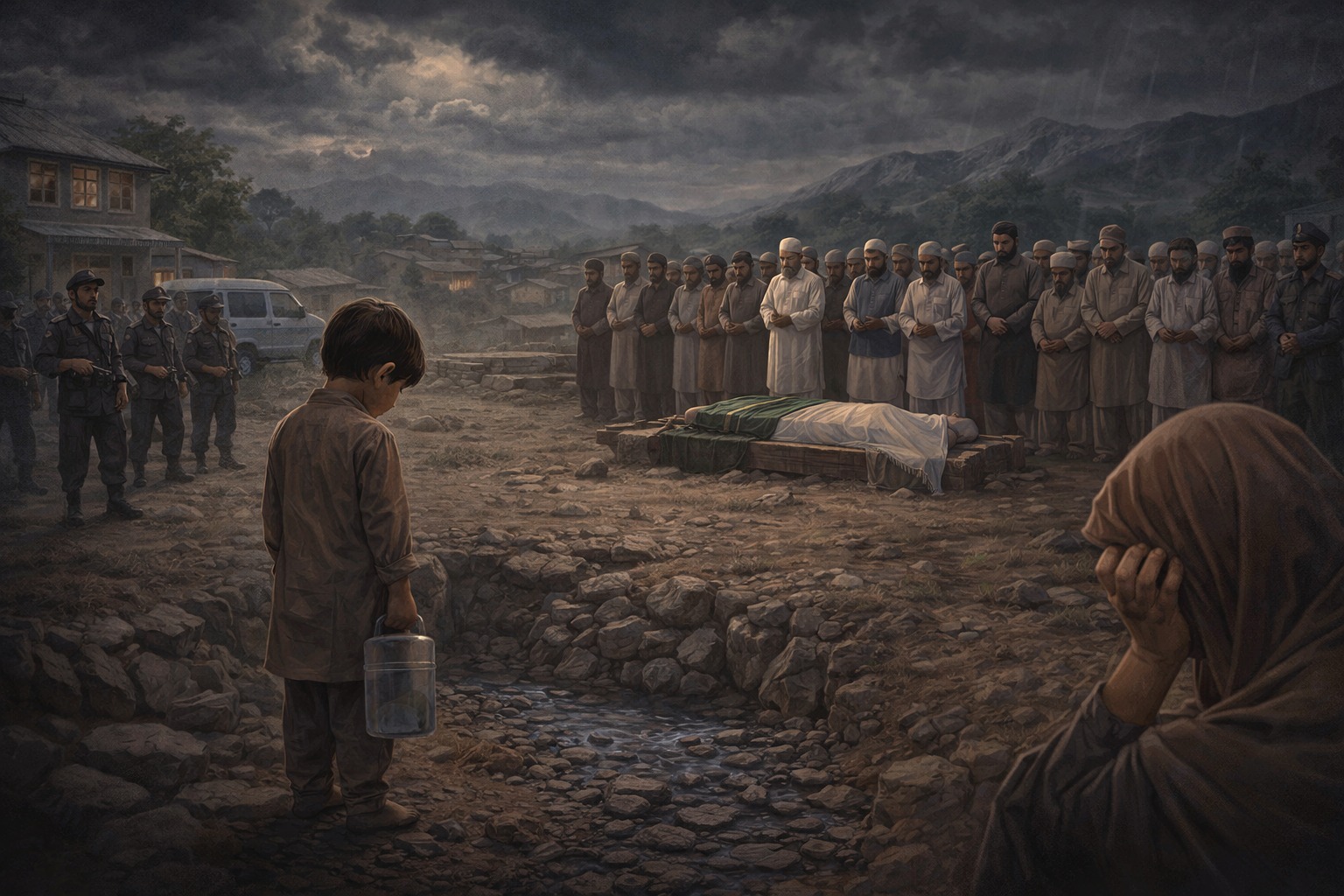
That evening, a small child stood near the now-dry stones where water once flowed. Holding an empty container, he looked toward his mother and asked softly,
“Will the water come back tomorrow?”
His mother had no answer. She simply pulled him closer, hiding her tears in the darkness.
People were filled with anger, yet their tongues remained silent. The darkness had taken away their voice. They knew that speaking against this ظلم could cost them their survival.
But stories do not remain silent forever.
One morning, an unusual silence filled the village. The presence of police outside Asif’s house raised concern. Whispers spread—had he crossed another line?
Then suddenly, an announcement echoed from the nearby mosque: “Asif has passed away. His funeral will be held shortly.”
People stood still. But that day, it was not just Asif’s funeral that was carried out. That day, the silence of a community, its dignity, and its collective conscience were buried as well.
“The silence of the people was heavier than any decree.”
And perhaps the greatest tragedy was this: the spring had already died long ago—today, people were only hearing the announcement. The child still stood there, beside the lifeless stones— waiting for water that would never return.

Comments are closed.