

Dr Aneeda Jan & Rabiya Jan
“The right to life is not confined to biological existence alone. It embraces dignity, autonomy and the humane recognition that, in certain circumstances, letting go may be an act of courage.”
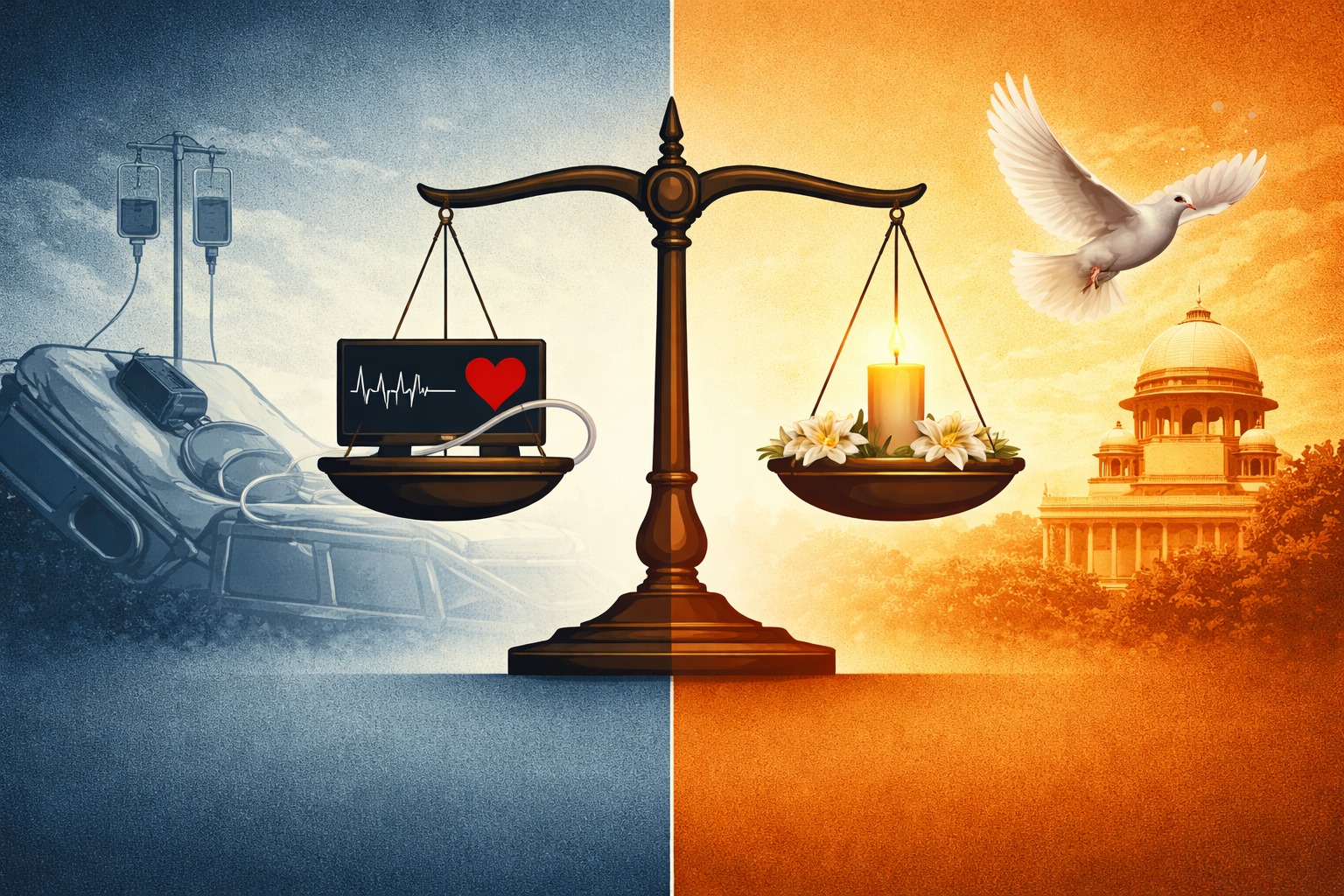
Few legal questions are as emotionally complex as the decision to allow a loved one to die with dignity. The recent Supreme Court judgment in Harish Rana v. Union of India, 2026 SCC OnLine SC 358; illustrates how constitutional principles, medical ethics, and human suffering often intersect in the most difficult circumstances.
Harish Rana was once a bright engineering student in Chandigarh, known for his academic promise and aspirations. In August 2013, his life changed irreversibly when he fell from the fourth floor of his paying guest accommodation near the university. The accident left him with severe traumatic brain injuries and extensive neurological damage. Doctors managed to save his life, but Harish never regained consciousness.
Medical experts eventually diagnosed his condition as a permanent vegetative state (PVS). For more than a decade, Harish remained unable to speak, move, or eat independently. His survival depended entirely on clinically assisted nutrition and hydration administered through feeding tubes.
Despite the grim prognosis, his parents refused to give up. They tried every available form of treatment, including hospital care, physiotherapy, and alternative therapies. The financial burden was immense. Reports suggest that the family sold their house and borrowed extensively to continue treatment, while Harish’s father began selling sandwiches from a scooter to cover medical expenses. All of this was sustained by a single hope: that their son might someday wake up. That day, however, never came.
After more than ten years of caregiving, the family faced an agonising question. Was continuing treatment preserving life, or merely prolonging suffering?
In 2024, Harish’s parents approached the courts seeking permission to withdraw life-sustaining treatment so that their son could die with dignity. The Delhi High Court rejected their request, noting that Harish was not dependent on a ventilator and expressing concern that removing feeding tubes might amount to starvation rather than withdrawal of medical treatment. The family subsequently appealed to the Supreme Court.
On March 11, 2026, a bench comprising J. B. Pardiwala and K. V. Viswanathan delivered a landmark ruling. After examining detailed medical reports and the opinions of two independent medical boards, the Court concluded that Harish was in an irreversible permanent vegetative state with virtually no possibility of recovery.
A key legal question before the Court was whether clinically assisted nutrition and hydration administered through feeding tubes constituted ordinary care or medical treatment. The Court clarified that such artificial nutrition forms part of life-sustaining medical treatment and may legally be withdrawn when recovery is medically impossible.
The Court therefore permitted the withdrawal of treatment and directed that Harish be shifted to the palliative care unit of the All India Institute of Medical Sciences, where doctors would supervise the process while ensuring that his final days were free from suffering.
This form of ending life-sustaining treatment is known as passive euthanasia, which involves withdrawing or withholding medical interventions that artificially prolong life in patients who have no reasonable chance of recovery.
The legal recognition of passive euthanasia in India has evolved gradually through judicial decisions. The issue first came before the Supreme Court in Aruna Ramchandra Shanbaug v. Union of India, (2011) 4 SCC 454; where the Court acknowledged passive euthanasia and laid down guidelines for withdrawing life support in exceptional circumstances. Aruna Shanbaug, a nurse who had remained in a vegetative state for decades after a brutal assault in 1973, eventually died a natural death in 2015.
A significant constitutional development followed in Common Cause v. Union of India, (2018) 5 SCC 1; where the Court held that the right to life under Article 21 of the Constitution of India includes the right to die with dignity. The Court also recognised the concept of a “living will”, allowing individuals to specify in advance whether they wish to continue life-support treatment if they become terminally ill or permanently unconscious.
Within this evolving jurisprudence, the Harish Rana decision represents one of the most significant practical applications of passive euthanasia principles in India.
Yet euthanasia remains one of the most debated ethical questions in modern law and medicine. Supporters argue that personal autonomy is a core value in a constitutional democracy. According to this view, individuals should have the freedom to decide how their lives should end, particularly when suffering from irreversible medical conditions. From this perspective, the right to die with dignity is seen as a natural extension of the constitutional guarantee of life and personal liberty.
Critics, however, warn about the potential dangers of misuse. In a country marked by social and economic inequalities, vulnerable groups such as the elderly, disabled, or economically disadvantaged individuals may face subtle pressure to choose death. There are also concerns about how the true wishes of patients can be determined when they are unable to communicate, as in cases involving permanent vegetative states.
Another ethical dilemma concerns the role of doctors. Medical professionals are traditionally bound by the duty to preserve life. Allowing them to participate in decisions that lead to the end of life inevitably raises complex moral questions.
The Supreme Court attempted to address these concerns by emphasising strict safeguards. In the Harish Rana case, the involvement of two independent medical boards ensured that the decision was based on rigorous medical evaluation rather than emotional or financial pressures. The Court also required that the withdrawal of treatment occur under medical supervision with adequate palliative care.
The judgment thus reflects both compassion and caution. It recognises that the constitutional guarantee of life under Article 21 is not limited to biological survival but also includes the preservation of human dignity.
Ultimately, the story of Harish Rana reminds us that behind every constitutional principle lies a deeply human reality: a patient who cannot speak, a family struggling with grief, and a society attempting to balance the sanctity of life with the dignity of death.
We may stop here by saying:
Between hope and suffering, where silent tears remain,
Dignity may bloom gently in freedom from the pain.

Comments are closed.