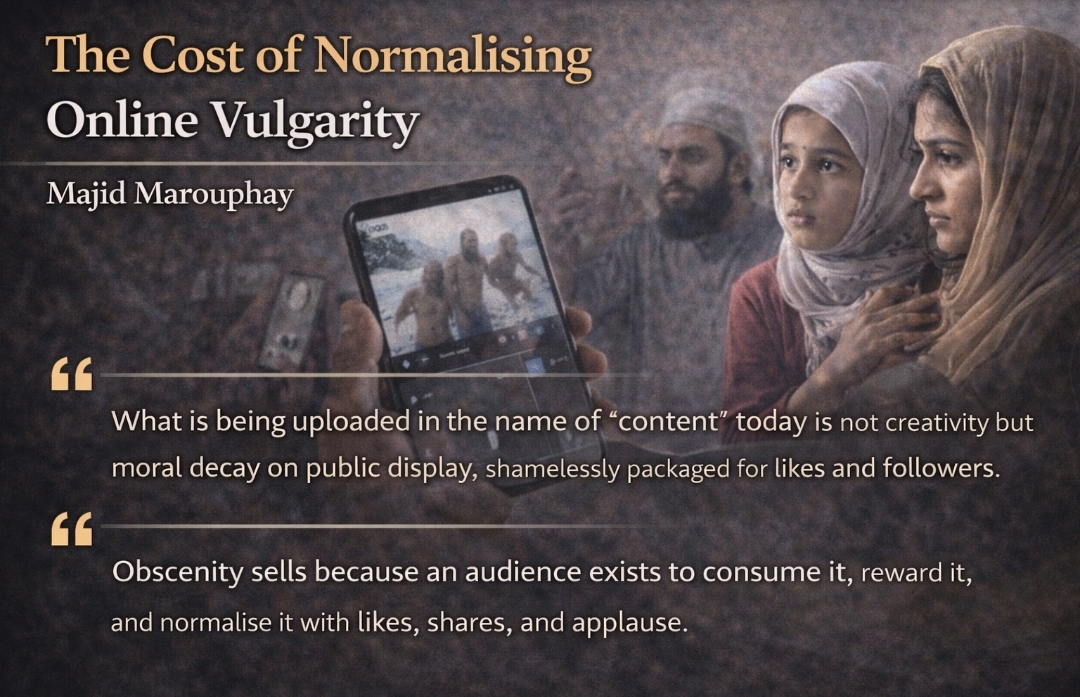
The Cost of Normalising Online Vulgarity

Majid Marouphay

  “What is being uploaded in the name of ‘content’ today is not creativity but moral decay on public display, shamelessly packaged for likes and followers.”

The advent of smartphones coupled with high-speed 4G and 5G internet connectivity has undeniably transformed the way information is created, circulated, and consumed. In its constructive form, this digital revolution empowered teachers, students, journalists, media professionals and even religious scholars. Academic lectures, educational explanations, social awareness messages and reformative sermons reached audiences far beyond classrooms, mosques, and newsrooms. Knowledge travelled faster, voices became louder, and learning became more accessible.

But every powerful tool, when misused, turns into a weapon. Alongside this positive transformation, a deeply disturbing and morally alarming trend has emerged – one that threatens the very ethical fabric of our society. Recent incidents, particularly after the Valley was blessed with snowfall, should shake every conscience. Semi-naked individuals filming obscene and vulgar videos on snow, performing strange and indecent acts and shamelessly uploading them on social media platforms. This is not ‘content’, this is moral decay on display. Another group engaging in similar disgraceful behaviour at Gulmarg, a popular winter destination, had to be publicly confronted, beaten, and handed over to police. These are not isolated incidents; they are symptoms of a growing disease.

What is even more frightening is the audience this filth attracts. A section of morally bankrupt and mentally corrupt individuals has discovered that obscenity sells. They exploit digital freedom to upload immoral, uncivilised, and shameful content only to see their followers multiply by the thousands. Likes, shares, reactions, and filthy comments pour in. Young and old alike consume this garbage without hesitation, without shame, without reflection.

An even more dangerous trend has surfaced: so-called ‘content creators’ who are nothing more than maskharas (clowns) of moral bankruptcy. In the name of humour and creativity, they upload rubbish that insults intelligence and corrodes values. Imitating religious scholars, mocking mosque imams, ridiculing political personalities, caricaturing housewives. nothing is sacred, nothing is spared. Their maskharapan goes viral like wildfire, not because it has substance, but because idleness and moral numbness have found an easy pastime.

These maskharas forget, or perhaps do not care, that social media is not a private playground. Our elders are there. Our parents are there. Religious leaders are there. Most importantly, our mothers, sisters, and daughters are there, forced to scroll past this indecency. Young teenage boys and girls are the most vulnerable in this digital age. This digital pollution risks corrupting an entire generation before it even understands the harm. What message are we sending as a society? What kind of future are we shaping when our youth follow these clowns religiously, believing that vulgarity is a career and obscenity is success?

This is not harmless entertainment; this is slow poisoning. Our Kashmiri society known for moral uprightness, dignity, honesty, and good conduct is being dragged into the gutters of digital shamelessness. Minds are getting polluted. Time is being wasted. Values are being diluted. And we are applauding it with likes, shares and follows. We must ask ourselves; do we really have nothing better to watch? Are we becoming addicted to filth? Have we lost our sense of right and wrong?

What makes this trend even more repugnant is that these maskharas are now indulging openly in mimicry and taunts – mocking our elders, ridiculing family relations and parodying public figures by twisting their public utterances into objects of cheap laughter. They hide behind the convenient labels of humour and satire to justify this filth, forgetting or deliberately ignoring, that satire without ethics is nothing but cruelty in disguise. The impact of such content is not neutral, it is deeply negative. It normalises disrespect, erodes social boundaries, and teaches our youth that humiliation of others is entertainment. While every individual may enjoy freedom of expression, that freedom cannot be absolute or anarchic. The moment it begins to harm the dignity, privacy, or emotional well-being of others, it ceases to be a right and becomes an abuse. No society can afford to applaud mockery masquerading as creativity, especially when it corrodes respect for elders, institutions, and human dignity itself.

The time has come for serious introspection, especially for our youth. Social media can educate, inspire and uplift but only if we choose wisely. Follow meaningful content and promote knowledge. Encourage creativity with purpose and reject vulgarity outright. These maskhara characters must be identified, exposed, unfollowed, and socially rejected. Naming and shaming is not cruelty when silence enables corruption. By withdrawing our attention, we clean our minds and protect our moral ecosystem. If we fail to act today, the consequences will not be digital alone, they will be cultural, social and generational.

This is a call, not just to disconnect from garbage but to reconnect with conscience. The unchecked misuse of social media is no longer a trivial concern; it is a serious moral and social crisis staring us in the face. When obscenity is normalised and vulgarity is celebrated as ‘content’, society begins to lose its moral compass. What we watch, like, and share silently shapes our thinking, behaviors, and values. If we continue to reward indecency with attention, we become complicit in the erosion of our own cultural and ethical foundations. The responsibility now lies with each one of us, especially the youth to choose wisely. Social media should be a tool for learning, reform, and positive expression, not a dumping ground for filth and mockery.

The author is a teacher and can be reached at khanmarouphay@gmail.com


Comments are closed.