

Afreen Manzoor
“I am not a teacher, but an awakener.” — Robert Frost
As winter tightens its grip over the Valley of Mountains—Kashmir—the School Education Department announced winter vacations in a phased manner across government schools. Pre-primary classes were scheduled for a break from November 26, 2025 to February 28, 2026. Classes from 1st to 8th were given holidays from December 1 to February 28, while classes 9th to 12th were allotted winter vacations from December 11, 2025 to February 26, 2026. While this announcement brought relief to students, a pressing and uncomfortable question resurfaced yet again—what happens to teachers and staff working in private schools across Kashmir during this long winter break?
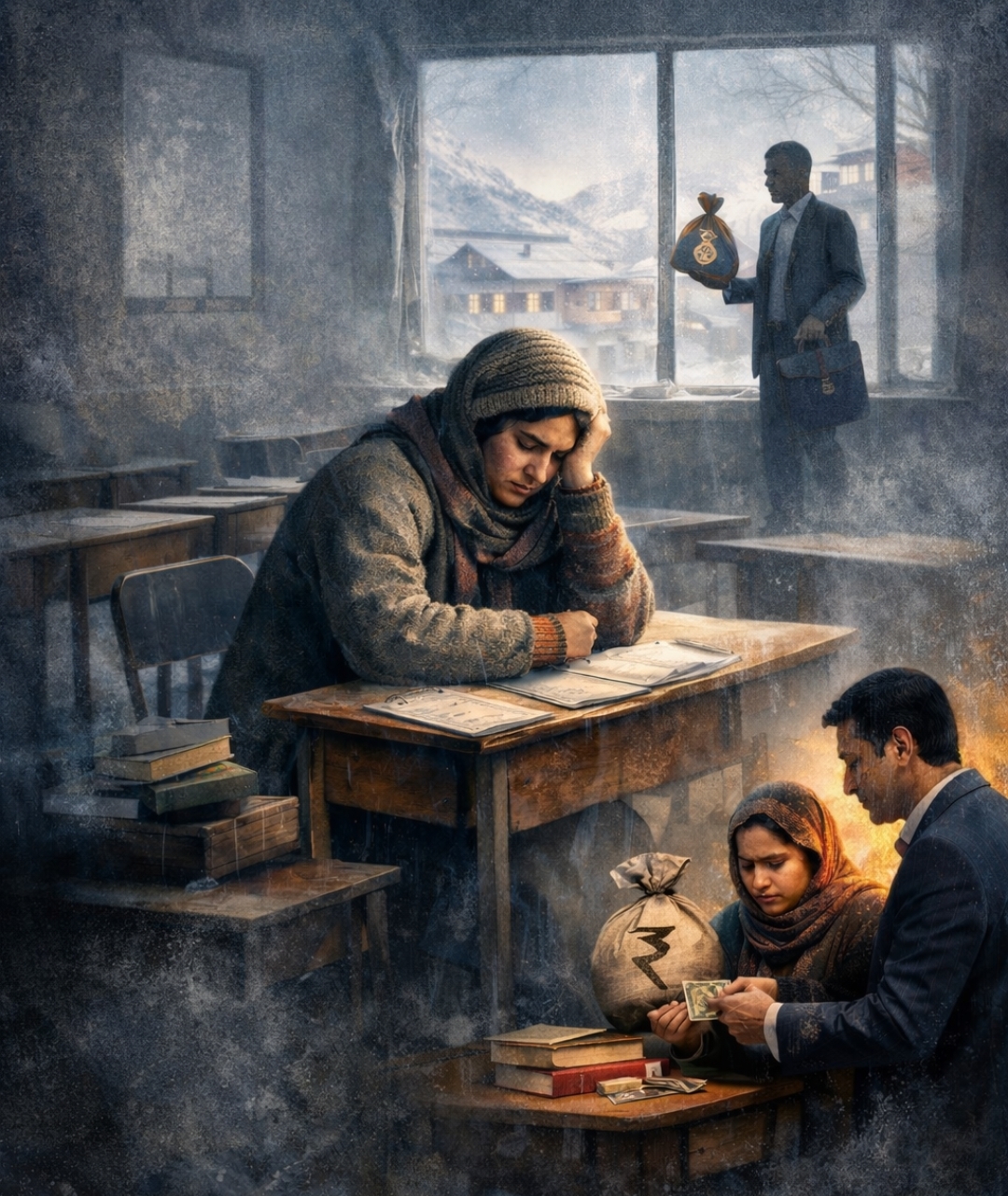
For years, private school teachers in Kashmir have lived under uncertainty. In many institutions, teachers are asked to report to school despite freezing temperatures and suspended academic activity. In others, they are granted leave but without pay, or with drastically reduced salaries. This practice has quietly become normalised. Yet it raises fundamental questions about labour rights, dignity, and fairness. Why are such inhuman and illegitimate practices allowed to continue unchecked? Why does the system repeatedly fail those who are entrusted with shaping young minds?
Jammu and Kashmir has adopted the National Curriculum Framework for Foundational Stage (NCFFS) 2022, follows the Right to Education Act, and claims alignment with Ministry of Education guidelines issued in 2020 and 2021. On paper, the framework exists. In reality, enforcement is weak and standardisation is missing. There is no effective advisory or regulatory body to protect private school educators. The absence of oversight has allowed exploitation to flourish, despite the fact that it takes not just skill but immense emotional labour to shape children’s lives.
Ironically, when it comes to academic outcomes, private schools often outperform their counterparts. They produce consistent results, secure top positions, and maintain high enrolment ratios. Parents are charged substantial fees, sometimes comparable to elite institutions outside the region. Yet this financial success does not translate into fair compensation for teachers. According to a Kashmir Life report, the average salary of a private school teacher in Kashmir ranges between ₹9,000 and ₹22,000 per month. Freshers are often paid as little as ₹7,000 to ₹9,000, despite holding professional degrees and possessing strong pedagogical skills.
This disparity exposes a harsh truth. Teachers, often described as the pillars of the nation, are among the most underpaid professionals. Salary cuts, delayed payments, and arbitrary deductions remain a constant threat. Even more disturbing is the silence that surrounds this exploitation. Rarely is the issue discussed with seriousness, and even more rarely is action taken.
As Christa McAuliffe once said, “I touch the future, I teach.” Teachers play a decisive role in the holistic development of a child. They are trained to understand individual differences, emotional needs, and learning patterns. Every child is born with unique abilities, and recognising that uniqueness requires patience, empathy, and skill. When educators themselves are undervalued and insecure, the ethical foundation of education is weakened. Appreciation, recognition, and fair treatment are not luxuries. They are necessities for nurturing committed educators.
Teaching is both an art and a responsibility. Like any artist, a teacher needs encouragement and respect to perform at their best. Malala Yousafzai’s words remind us of the collective power of education: “One book, one pen, one child, and one teacher can change the world.” A teacher’s influence extends far beyond the classroom. It shapes character, conscience, and courage. A teacher affects eternity and can never truly measure where their influence ends.
The way forward demands urgent intervention. There is a need for a standardised payroll system for private school teachers, devised jointly by private school associations and the School Education Department. Such a framework would ensure minimum wages, timely payments, and clarity in service conditions. Additionally, the government must establish a statutory commission or advisory body to regulate private educational institutions. This body should ensure accountability, transparency, and fairness, while safeguarding the rights of both educators and students.
With a robust regulatory mechanism in place, neither the educator nor the educand would be left vulnerable. Education cannot thrive in an environment built on exploitation. Teachers are nation-builders. They guide, motivate, discipline, and inspire young minds. They nurture future scientists, doctors, artists, administrators, and citizens. When supported, they help create a society that is informed, ethical, and resilient.
Teaching remains a noble profession, even in a rapidly changing, technology-driven world. Educators help students navigate an era of information overload. They guide them in acquiring the right knowledge, selecting credible resources, and developing critical thinking. Teachers read unspoken emotions through body language. They identify stress, anxiety, and emotional needs long before formal systems intervene.
Yet despite this indispensable role, teachers often struggle for respect, dignity, and fair compensation. This contradiction must be confronted. Teachers deserve recognition not just in speeches, but in policy and practice. As Dan Rather aptly observed, “The dream begins with a teacher who believes in you, who tugs and pushes and leads you to the next plateau, sometimes poking you with a sharp stick called the truth.”
If we truly believe in building a better, brighter, and more just society, we must begin by protecting those who educate it. Respecting teachers is not an act of charity. It is an investment in the future.
“On paper, laws and frameworks exist to protect educators. In reality, weak enforcement and the absence of oversight have allowed exploitation to flourish. The system continues to fail those entrusted with shaping young minds.”

Comments are closed.