

Malik Mushtaq
“By embedding healthcare within schools, Jammu & Kashmir has reduced barriers of distance, cost, and awareness—transforming schools into centres of learning as well as preventive healthcare.”
Education and health together form the backbone of any progressive and resilient society. A child who is educated but unhealthy struggles to realise their potential, just as a healthy child without education remains deprived of opportunity. In Jammu & Kashmir (J&K), recognising this deep interconnection, the government—along with health partners—has undertaken a vital and transformative initiative: the systematic health checkup of schoolchildren. This initiative represents not merely a medical exercise, but a comprehensive effort to safeguard the physical, mental, and developmental well-being of children at an early and formative stage of life.
A systematic health checkup means that schoolchildren are not examined casually or only when illness becomes visible. Instead, their health is monitored in a planned, organised, and continuous manner. Through regular screenings, early detection of health problems, timely treatment, and proper documentation, this system aims to ensure that every child receives the care they need to grow into a healthy and productive citizen. This article seeks to explain the meaning, purpose, process, benefits, and challenges of this system in simple language so that students, parents, teachers, and the wider community can fully understand its importance.
At its core, a systematic health checkup in schools refers to a structured and routine medical examination of all students within a school system. Unlike occasional health camps or emergency visits, this process is designed to be predictable, comprehensive, and inclusive. Every child is examined, their health indicators are recorded, and their progress is monitored over time. In Jammu & Kashmir, this initiative forms part of a broader inter-departmental effort involving the School Education Department, the Mid-Day Meal Mission Directorate, and the National Health Mission (NHM). These bodies work in coordination to ensure that health services reach schools regularly and efficiently.
This approach reflects a shift in thinking—healthcare is no longer treated as something separate from education. Instead, health is now recognised as an integral part of the school experience. When healthcare is embedded within schools, children are more likely to receive timely attention, and barriers such as distance, cost, and lack of awareness are significantly reduced. Schools thus become centres not only of learning but also of preventive healthcare.
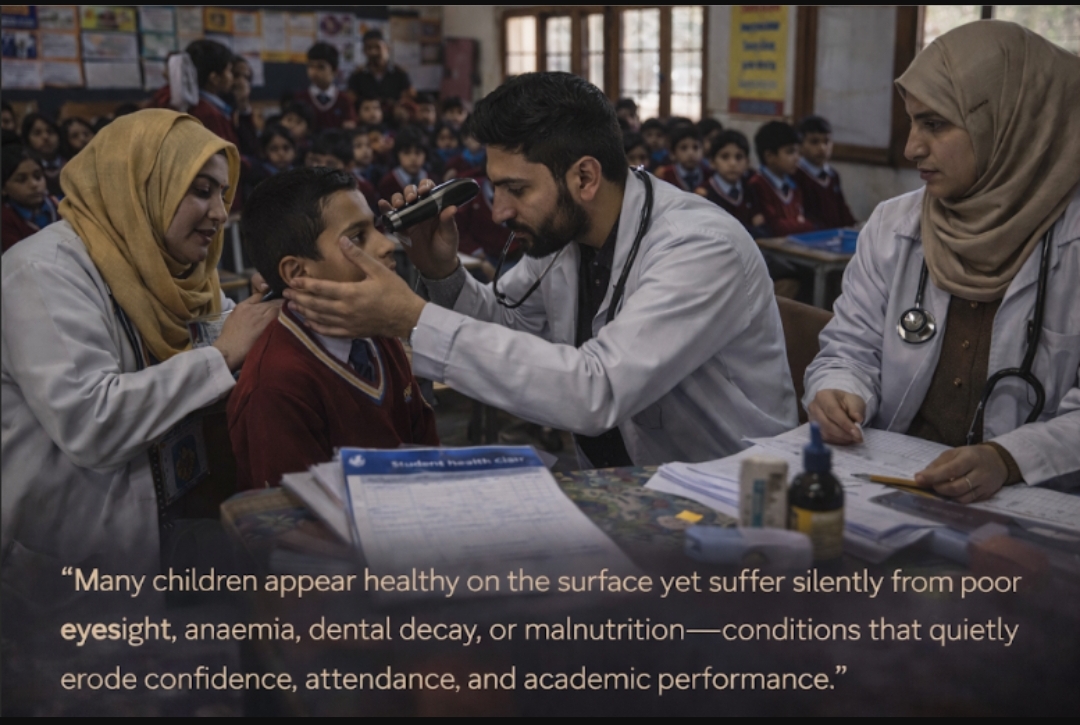
The need for such a system arises from the simple reality that childhood is a critical phase of growth and development. Health issues that emerge during these years—if left undetected—can have lifelong consequences. Many conditions do not show immediate or obvious symptoms. A child may appear healthy yet suffer from poor eyesight, dental decay, anaemia, malnutrition, or developmental delays. These hidden issues can quietly undermine academic performance, attendance, confidence, and overall quality of life.
In Jammu & Kashmir, various surveys and ground-level observations over the years have revealed that a significant number of children face health challenges such as nutritional deficiencies, parasitic infections, dental problems, vision impairment, and general poor hygiene. Geographic challenges, poverty, limited access to healthcare facilities, and lack of awareness have further aggravated these problems. Recognising that waiting for illness to surface is neither humane nor effective, the government adopted a preventive approach—one that focuses on early detection and regular monitoring.
A cornerstone of this initiative is the introduction of the Student Health Card. This card serves as a personalised health record for each child enrolled in government schools across J&K. It is a simple yet powerful tool that captures essential health information in one place. The card records details such as immunisation history, height and weight measurements, findings from physical examinations, nutritional status, vision and dental assessments, and notes on any identified deficiencies or developmental concerns. It also documents follow-up actions and future recommendations.
The official launch of the Student Health Card programme by the Lieutenant Governor of Jammu & Kashmir marked a significant step towards institutionalising child health monitoring. Teachers and health workers are entrusted with maintaining and updating these cards regularly. Over time, these records provide a clear picture of a child’s health journey, enabling doctors, parents, and educators to make informed decisions. In many ways, the Student Health Card becomes a silent guardian—ensuring that no child’s health concern goes unnoticed or forgotten.
To maintain consistency and effectiveness, health checkups are conducted at least twice a year—once during the summer term and once during the winter term. This biannual schedule allows health professionals to track changes, improvements, or emerging issues in a child’s health. Regularity is key; it transforms health screening from a one-time event into an ongoing process of care and observation.
These checkups are carried out by teams comprising doctors, nurses, and trained health workers under the National Health Mission, often supported by local medical professionals and trained school staff. Schools are informed in advance so that students, teachers, and parents can prepare accordingly. This planned approach ensures minimal disruption to academic activities while maximising participation.
During these systematic checkups, a range of basic yet essential examinations are conducted. Physical assessments measure height, weight, and general body development, helping identify undernutrition, obesity, or abnormal growth patterns. Vision screening plays a crucial role, as many children suffer from poor eyesight without realising it—affecting their ability to read, write, and concentrate in class. Early identification allows for timely corrective measures such as spectacles or further medical consultation.
Dental checkups address another commonly neglected area of child health. Tooth decay, gum disease, and poor oral hygiene can cause pain, infections, and long-term dental issues. Immunisation status is carefully reviewed to ensure that all vaccines are administered according to schedule, protecting children from preventable diseases. Nutritional assessments help identify deficiencies such as anaemia, which is particularly prevalent among adolescents and can severely impact energy levels and learning capacity.
Beyond physical checks, attention is also given to growth and developmental milestones. Children who show signs of delay can be referred for specialised evaluation and support. Importantly, these health camps also serve as platforms for awareness and education. Students are taught about personal hygiene, balanced nutrition, physical activity, and healthy habits—knowledge that empowers them to take responsibility for their own well-being.
Such a comprehensive programme cannot succeed without collaboration. Multiple stakeholders are involved at every stage. Government departments provide policy direction, funding, and logistical support. Health teams bring medical expertise and conduct examinations. Teachers play a vital role in organising students, maintaining records, and reinforcing health messages in daily school life. Parents are informed partners, responsible for ensuring attendance, following medical advice, and supporting healthy practices at home. Community health workers often assist with follow-up care and awareness at the local level.
The benefits of systematic school health checkups are wide-ranging and long-lasting. Early detection of health issues leads to timely treatment, preventing complications and reducing healthcare costs in the long run. Healthy children attend school more regularly, concentrate better, and perform well academically. Improved nutrition and hygiene reduce susceptibility to infections and chronic conditions. Health education fosters lifelong habits that contribute to a healthier society. Moreover, the creation of health records ensures continuity of care and informed decision-making in the future.
However, the programme also faces challenges. Jammu & Kashmir’s difficult terrain and remote locations make regular access to some schools challenging. Limited availability of health personnel and medical equipment can constrain the scope of checkups. Awareness gaps among parents and communities may reduce cooperation. Follow-up treatment, especially for families with limited financial resources, remains a concern. Addressing these challenges requires sustained commitment, resource allocation, and community engagement.
Despite these hurdles, the collaboration between schools and health teams continues to strengthen. Schools facilitate logistics and coordination, while health teams deliver services and guidance. Real-world examples—from middle school health camps to Ayush-led screenings and RBSK initiatives—demonstrate how this systematic approach is translating into action across the region.
Parents, too, play a decisive role. By ensuring participation, preserving health cards, following medical advice, and promoting healthy routines at home, they become active contributors to their children’s well-being. Looking ahead, further improvements can be achieved through increased awareness campaigns, teacher training, better medical resources, digital health records, and stronger follow-up mechanisms.
In conclusion, the systematic health checkup of the school system in Jammu & Kashmir represents a landmark step towards integrating education and healthcare. It reflects a commitment to preventive care, early intervention, and holistic child development. When children are healthy, they learn better; when schools and families work together, society grows stronger. These checkups are more than medical examinations—they are an investment in the future of Jammu & Kashmir, nurturing a generation that is healthy, confident, and ready to build a better tomorrow.

Comments are closed.