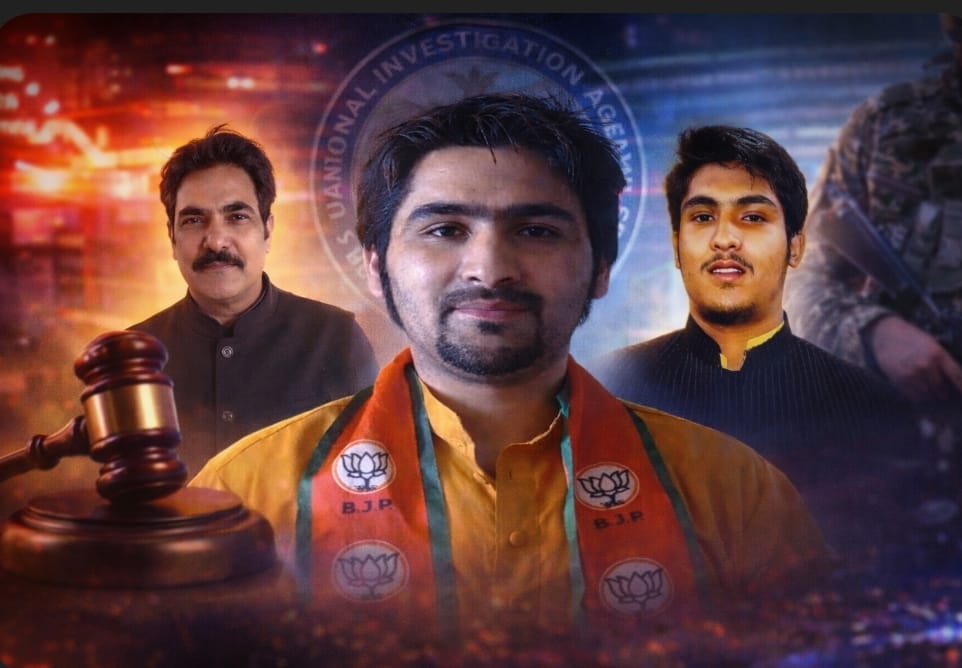
Bandipora, March 13: A Special Court designated under NIA in Bandipora has acquitted three local youth accused of providing support to terrorists involved in the killing of BJP leader Sheikh Waseem Bari and two of his family members in 2020.
Additional Sessions Judge Mir Wajahat, functioning as Special Judge for UAPA cases acquitted three accused — Abrar Gulzar Khan, Muneer Ahmad Sheikh and Mohammad Waqar Lone who were charged with knowingly providing support to terrorists affiliated with Lashkar-e-Taiba and Tehreek-ul-Mujahideen.
The accused were represented by Advocate Shuaib Ahmad Dewani during the trial.
The Court stated that the prosecution failed to prove beyond reasonable doubt that the accused had committed an offence under Section 39 of the Unlawful Activities (Prevention) Act (UAPA).
On July 8, 2020 unidentified terrorist entered the shop of BJP leader’s father at Muslimabad and opened fire killing the BJP leader, his father Bashir Ahmad Sheikh, and his brother Umar Sultan Bari. Subsequently Police registered FIR No. 74/2020 registered at Police Station Bandipora.
Bari was the district president of the Bharatiya Janata Party at the time of the attack.
Four alleged assailants were identified during investigation who were directly involved in executing the attack including Abid Rashid Dar, Azad Ahmad Shah, Abu Usman -a Pakistani terrorist and Sajjad Ahmad Mir alias Haider.
Two among them were later killed in an encounter in Baramulla district, while two others were declared absconders at that time. The absconders-Abid Rashid and Azad ahmad were also later killed during the ongoing trial.
The present trial concerned only the alleged role of the three accused as overground workers (OGWs) who were said to have facilitated the attack by providing information and logistical support.
During the investigation conducted by Bandipora Police, Charges were framed under Section 39 of the UAPA, which criminalizes intentional support to a terrorist organization.
The prosecution examined 17 witnesses between 2021 and 2025, including police officials, local witnesses and the investigating officer-DySP Mohammad Idrees.
The accused were arrested on July 23, 2020, and the prosecution relied primarily on alleged recoveries of posters of Tehreek-ul-Mujahideen from their homes, seizure of mobile phones, and call detail records.
In its 89-page judgment, the Court held that after examining the evidence on record, including the testimony of 17 prosecution witnesses, documentary exhibits and the arguments presented by both sides, the prosecution failed to prove beyond reasonable doubt that the accused — Abrar Gulzar Khan (Accused No. 5), Muneer Ahmad Sheikh (Accused No. 6) and Mohammad Waqar Lone (Accused No. 7) — had committed the offence under Section 39 of the Unlawful Activities (Prevention) Act (UAPA), 1967.
The Court further noted that the prosecution failed to demonstrate any direct, circumstantial, forensic or technical link between the three accused and the militant attack that took place on July 8, 2020, or with the persons responsible for carrying out the attack. It also held that the chain of circumstantial evidence required under the legal principles laid down by the Supreme Court had not been satisfied.
Special NIA court observed that none of the civilian witnesses connected the accused to the crime scene or to any overt act of support. Key witnesses admitted in cross-examination that they did not know the accused or had never seen them prior to their arrest.
Additional Sessions Judge court also noted inconsistencies in the prosecution’s recovery evidence, including contradictions regarding the description of seized mobile phones and the absence of independent civilian witnesses during search and seizure operations. It further recorded that no Test Identification Parade was conducted despite witnesses claiming to have seen unidentified persons at or near the scene.
The Court observed that the case arose from a violent attack on the evening of July 8, 2020 that cased grief to the victims’ families and fear within the society, and that the prosecution had established the occurrence of the killings through evidence on record.
However, the Court stated that the role of a criminal court is not only to acknowledge that a serious offence has taken place, but also to determine whether the persons standing trial have been proved guilty through admissible and reliable evidence. It said that establishing the occurrence of a crime and proving the involvement of the accused are two separate legal questions.
The Court further held that under the rule of law, guilt must be proved beyond doubt and cannot be based on suspicion, association, proximity or the seriousness of the circumstances surrounding the crime.
It added that a conviction without sufficient proof would not serve justice for the victims and could lead to punishment of individuals whose guilt has not been legally established.
After examining the evidence and applying the relevant law, the Court concluded that the material placed on record was insufficient to sustain a conviction against the accused. It stated that the conclusion was reached after a detailed evaluation of the evidence in accordance with the law.
On the issue of electronic evidence, the court framed a specific point for determination regarding the admissibility of call detail records in the absence of a certificate under Section 65-B of the Indian Evidence Act, and examined their evidentiary value accordingly.
“The prosecution cannot found any part of its case against the accused upon inadmissible material, however significant that material might have appeared at the time of its collection. The requirements of Section 65-B of the Indian Evidence Act are mandatory, not directory; they are conditions of admissibility, not mere formalities; and compliance is required as a matter of substantive law,” reads the judgement available with Kashmir Convener
Court further observed that No Section 65-B certificate for CDRs: The Call Detail Records were obtained without citation of the nodal agency official as a witness and without production of the mandatory certificate under Section 65-B(4) of the Indian Evidence Act, rendering the CDRs wholly inadmissible.
“… CCTV examination affirmatively negative: The IO examined CCTV footage from Muslimabad to Nowpora Chowk and confirmed that none of the three accused were captured on any camera on the day of the occurrence objective technical evidence directly negating the prosecution’s theory.,” judgement by NIA court reads.
The Court also noted procedural deficiencies in the conduct of the searches and seizures carried out during the investigation. It observed that no independent civilian witnesses were associated with any of the three search operations despite the requirements under Section 100 of the Code of Criminal Procedure (Cr.P.C.). The Court recorded that although family members were present in the houses searched, no Numberdar, Chowkidar, Sarpanch or other respectable person from the locality was made part of the proceedings.
The Court further pointed out that no Magistrate accompanied the police during any of the recovery operations. It said the absence of a Magistrate assumes significance particularly when the search and seizure proceedings were conducted entirely in the presence of police personnel who were themselves part of the investigating team.
The judgment additionally recorded a discrepancy between the date of filing of the charge sheet — January 9, 2021 — and the date of sanction granted by the Home Department on January 14, 2021. While the court noted the inconsistency, it declined to render a final finding on the validity of sanction, stating that the case was being decided on merits.
“Since sanction was mandatory for invoking the provisions of the UAPA against the accused, it was obtained from the Home Department of the Government of Jammu and Kashmir vide Government Order No. Home/PROS/11/J/2021 dated 14th January 2021. The charge sheet was presented before the NIA Court at Baramulla on 09th January 2021. … the date of filing of the charge sheet (09.01.2021) pre-dates the sanction order (14.01.2021) by five days — a discrepancy that appears on the face of the record,” court cited.
Citing settled principles of criminal jurisprudence, including the presumption of innocence and the requirement that guilt be proved beyond reasonable doubt, the court concluded that the prosecution had failed to establish specific intentional support as required under Section 39 of the UAPA.
The Court directed that the accused be released forthwith if not required in connection with any other case, subject to verification by the jail authorities.



Comments are closed.