


Mohammad Muslim
YUVA’s Mission YUVA initiative, initiated on June 28, 2025, signifies a clear departure from the paradigm of being just another job-seeking mission and towards enterprise formation, targeting 1.37 lakh entrepreneurs and creation of 4.25 lakh employment avenues within the next five years.
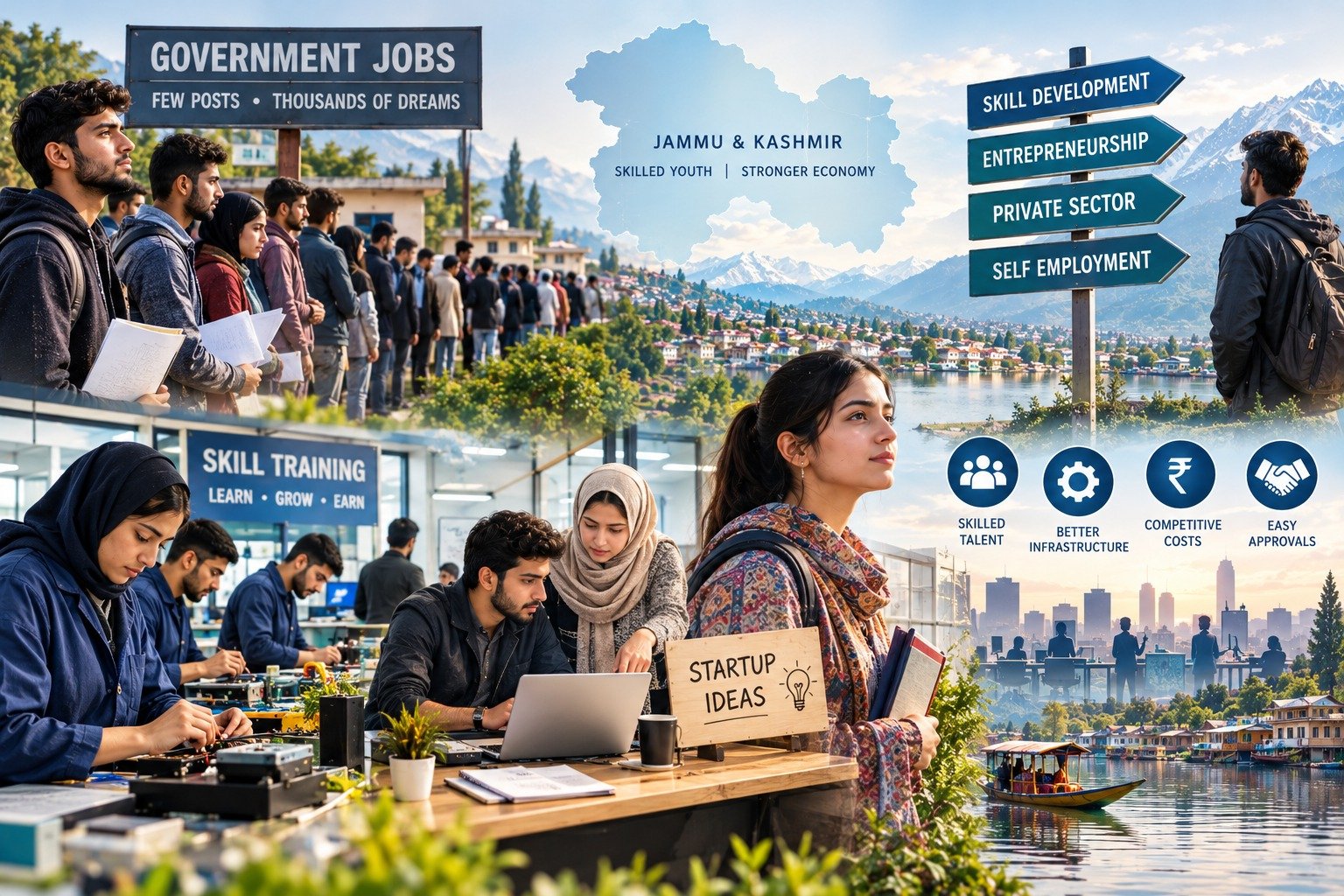
It seems like there is a common theme to each recruiting season in Jammu and Kashmir; thousands of candidates for just a few hundred government posts, all of whom are educated but are unable to find employment commensurate with their education. As per statistics revealed in the Assembly, there are over 3.7 lakh educated youth in Jammu and Kashmir who are officially unemployed, among which include over 66,000 graduates and 47,000 postgraduates. The unemployment ratio for youth in the region is about 17.4 percent, considerably higher than the national average of around 10 percent; the unemployment ratio of women in urban areas rises to 28.6 percent.
Paradoxically, the problem here is not the lack of educated youngsters but the misalignment between their education and the requirements of the labor market. Enterprises from the region complain about their inability to find the right employees while graduates feel that there are no vacancies that match their expectations, which is more likely due to the gap between the education system and the labor market demands rather than to the lack of drive in Kashmiri youngsters.
Government jobs have always been considered the best option when it comes to employment in Kashmir due to years of economic instability and limited employment options in the private sector. However, this preference, although justified by the circumstances of the past, has led to one whole generation being largely dependent on the sphere which cannot absorb such an amount of employees.
A variety of attempts by the government have been made to bridge this gap with varying levels of success and change over time. The J&K Skill Development Mission, constituted in June 2016, was an effort to bring together all the skill development initiatives operating in the state under one roof to provide unskilled and semi-skilled youth with vocational skills and link them with employers.
In its more contemporary incarnation, it brings in four separate streams for training of individuals according to their various life phases – starting from the basic level, going up to the 22 to 35 year old phase which has been identified as the age bracket that is suffering the most from unemployment or underemployment pressures, providing support ranging from preparation for competitive exams to incubating startups and vocational training programs. The fourth stream provides training to those belonging to the 35 to 59 age bracket.
YUVA’s Mission YUVA initiative, initiated on June 28, 2025, signifies a clear departure from the paradigm of being just another job-seeking mission and towards enterprise formation, targeting 1.37 lakh entrepreneurs and creation of 4.25 lakh employment avenues within the next five years.
It is clear that there is an underlying logic to such a strategy. If neither government nor even private employment could absorb the sheer magnitude of Kashmiri youth seeking jobs, then it would become imperative to increase the number of youth who can create their own employment opportunities.
There is also unique experience from Kashmir where the region-specific pathway named Himayat exists in context of the national scheme of Deen Dayal Upadhyaya Grameen Kaushalya Yojana, which was designed to offer training that is linked with employment and placement of candidates.
As per Kaushal Bharat data until August 2026, there were 1,07,653 candidates enrolled in Himayat scheme, out of which 1,03,289 were trained and 59,842 were placed whereas over 76,000 candidates were listed as employed. It is not small figures for a program running in a place where generation of jobs in the formal sector had been significantly slower than the pace of population increase. However, the figures prove one key point that is believed by the proponents of skilling: Training is only useful if it is linked to livelihood path.
Nevertheless, a closer look at the skilling situation in general for the country, and hence for Kashmir in particular, shows an underlying problem that needs to be taken into account seriously. National studies have revealed that less than 15 percent of individuals who have been educated through some of the large-scale skilling programs end up securing jobs.
Such a scenario is a reflection of the misconception that increasing capacity for education through skilling alone can improve the employment situation. The local criticism of the skilling situation in Kashmir is also a reflection of the same problem since thousands undergo skilling programs but very few get meaningful jobs, with the programs appearing better on paper than in reality.
Further complications arise due to structural challenges. Youth entrepreneurs wanting to benefit from the training programs provided to them often face difficulties in raising capital at the early stages, getting mentoring, and linking to the markets, just like Kashmir’s overall entrepreneurial landscape has faced so far.
Job training programs have been designed in such a way that they only teach the skill but do not link the trainees to any market or employer where the acquired skill can be utilized. However, policy efforts by the government have made significant achievements; for example, between 2019 and 2024, the overall unemployment rate has slightly declined, and over eleven thousand youth got employed in the public sector, while the private sector hired thousands in manufacturing and services as well.
What is needed, according to analysts who focus on the employment situation in the region, is for skilling not to be an isolated measure, but to form part of a wider economic plan including investments in infrastructure, growth in the sector in which Kashmir already enjoys a comparative advantage such as horticulture, handicrafts, and tourism, and growth in the IT and service sectors that could employ people with technical skills.
Skill development efforts should extend to every district, especially to rural districts that have traditionally been neglected compared to urban areas, and better access to finance and mentoring might enable more youth to shift from being employed to employers.
Of equal importance, however, say the analysts, is the rebuilding of a basic level of institutional trust by ensuring proper and transparent recruitment procedures, prompt filling of vacancies in the government sector, and information about the schedule of recruitment from the authorities, since the current cynicism with respect to the process of getting a formal job is quite widespread among Kashmiri youth.
Comments are closed.