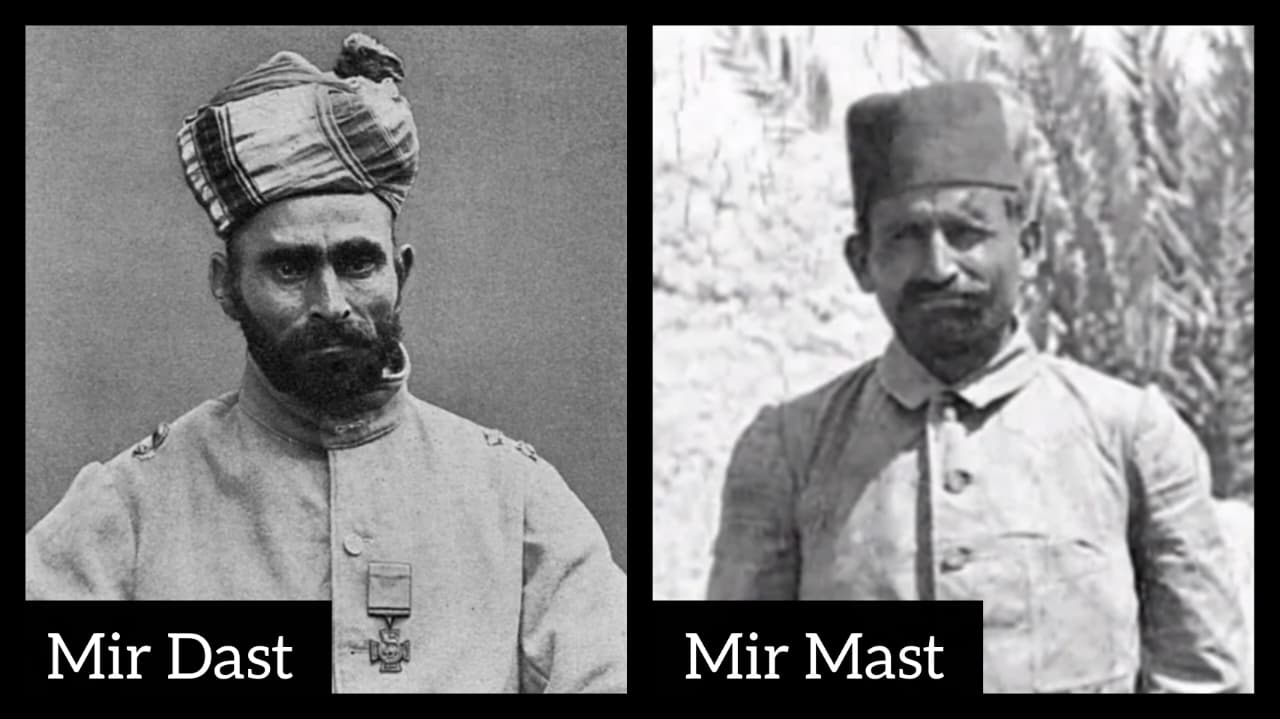
Mir Dast and Mir Mast were two Afridi brothers from British India, who chose two different paths in World War I which made them turn against each other. While Mir Dast achieved global recognition for his service to the British Indian Army, Mir Mast became infamous for defecting to central powers, earning top military honors from the opposing side. Their stories together illustrate the complexities faced by colonial soldiers in a global conflict.
Both Mir Dast and Mir Mast were born in modern day Khyber Pakhtunkhwa. Mir Dast joined the British Indian Army in 1894, demonstrating discipline that marked him out for promotion. By 1909, he held the rank of Jamadar (the most junior officer rank), having built a distinguished career fighting the turbulent North-West Frontier and Waziristan campaigns. Mir Mast, similarly, rose to the rank of Jamadar before the outbreak of World War I. Both brothers, as Afridi Pashtuns, were part of the frontier, often favored for military service by British officers for their loyalty.
Mir Dast : Mir Dast was attached to the 57th Wilde’s Rifles during World War I and played a crucial role during the Second Battle of Ypres in Belgium on April 26, 1915. Despite being wounded and exposed to toxic gas, Mir Dast showed outstanding bravery. He held his position under intense fire, rallied surviving units when most British officers were incapacitated, and carried eight injured British and Indian officers to safety.
After his heroic actions, Mir Dast was taken to England for treatment. In his Hospital bed, he was presented with the Victoria Cross by King George V, becoming only the fourth Indian to receive the British Empire’s highest honor for bravery. Mir Dast was further awarded with the indian Order of Merit (2nd Class), the Order of British India (2nd Class), and Russia’s Cross of St. George (3rd Class), making him one of British India’s most decorated soldiers.
Meanwhile, Mir Mast experienced a crisis of loyalty during the war, exacerbated by the Ottoman Empire’s entry on the side of Germany in late 1914, which unsettled Muslim soldiers fighting under the British flag. On the night of March 2-3, 1915, while serving with the 58th Vaughan’s Rifles in the Bareilly Brigade at Neuve Chapelle, Mir Mast deserted his post with a group of fellow Afridis and defected to the German side, navigating through no-man’s land into enemy trenches.
Mir Mast : Mir Mast subsequently became part of the Ottoman Jihad. He traveled via Istanbul and Constantinople, eventually arriving in Kabul, Afghanistan, attempting to convince Afghan authorities to join the Central Powers, although these efforts were ultimately unsuccessful. While the exact motivations behind Mir Mast’s desertion remain debated whether stemming from religious solidarity with Ottoman Caliphate or opposition to colonial rule. He met major Ottoman religious leaders, and was honoured with the title “Mujahid-i-Millat” in recognition of his commitment to the Ottoman cause. It is widely rumored, that Mir Mast was awarded the Iron Cross (Germany’s highest military honor) by Kaiser Wilhelm II in recognition of his actions. His life after defection remained largely shadowy and steeped in intrigue, with records detailing his efforts to train and rally anti-British forces in South Asia.
Both brothers’ stories illustrate the scenario of World War 1. Mir Dast’s name lives on in plaques, memorial stones, and public commemorations as a symbol of heroism under the British flag. Mir Mast, on the other hand, became a rarely mentioned figure in the colonial record and only mentioned in revisionist histories. The Afridi family story shows how war can fracture the closest bonds. It also illuminates the dilemma faced by Indian soldiers during World War I.
About the Author: Muhammad Talha Amin Baruah is a historian from Assam and the author of The Shamli Uprising. He has contributed several articles to newspapers and online magazines. He can be reached at talhaamin799@gmail.com.


Comments are closed.