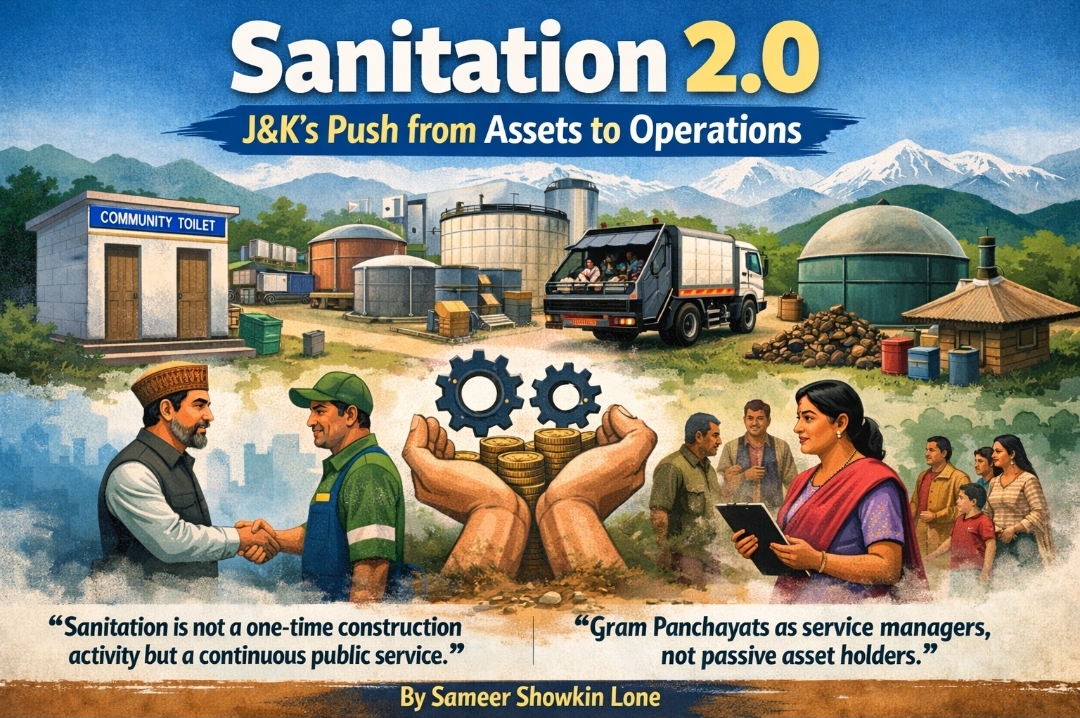
Sanitation 2.0: J&K’s Push from Assets to Operations

Sameer Showkin Lone

 “Sanitation is not a one-time construction activity but a continuous public service critical to public health and environmental safety.”

In a significant and much needed move, Chief Minister Omar Abdullah on Friday announced that Capex funds (District) will be leveraged from 2026–27 onwards for the operation and maintenance (O&M) of rural sanitation assets, marking a decisive transition from asset creation to asset management in Jammu & Kashmir’s sanitation journey.

The announcement, made during the Budget Session of the Legislative Assembly, directly addresses one of the most persistent challenges faced by the Swachh Bharat Mission (Grameen) Phase-II: sustaining sanitation infrastructure after construction.

Why this matters?

Over the years, under Swachh Bharat Mission (Grameen) Phase I and Phase-II, rural J&K has witnessed a major boost when it comes to setting up of sanitation infrastructure in every nook and corner. The major assets include:

– Community Sanitary Complexes (CSCs)

– Door-to-door waste collection systems

– Plastic Waste Management Units (PWMUs)

– Faecal Sludge Treatment Plants (FSTPs)

– DEWATS and GOBARdhan units etc

But across J&K, the Achilles’ heel has remained the same, who maintains these assets, and with what money?

The J&K government has today answered that question by earmarking District Capex funds specifically for professional Operation & Maintenance. With this the government has acknowledged that sanitation is not a one-time construction activity but a continuous public service, critical for public health and environmental safety.

Policy backbone: Directorate of Rural Sanitation’s O&M framework

The announcement follows a draft Operation & Maintenance Policy proposed by the Directorate of Rural Sanitation, Department of Rural Development & Panchayati Raj, J&K which lays down a structured, long-term framework for sustaining sanitation assets.

Under the dynamic leadership of Director General Rural Sanitation, J&K, the Program Management Unit (PMU) while drafting the policy identified a key gap, the absence of dedicated mechanisms for long-term O&M, proposing institutional, financial, and community-led solutions to plug it.

At the heart of the policy is a ring-fenced funding mechanism, with the Finance Department of Govt of J&K earmarking 10% of PRI Capex grants exclusively for O&M of SBM-G and SLWM assets, ensuring predictable and sustained financing.

From government-run to community-owned

A defining feature of the policy is its emphasis on Gram Panchayats as service managers, not passive asset holders. Through Halqa Sanitation Committees, Gram Sabha resolutions, and local monitoring, Panchayats are empowered to:

– Plan and oversee O&M activities

– Engage professional agencies where required

– Levy user charges based on the Polluter Pays Principle

This shift is crucial for sustaining door-to-door waste collection services, regular desludging of septic tanks, upkeep of CSCs, and smooth functioning of FSTPs and DEWATS, areas where neglect often leads to slippage from ODF Plus status.

Public health, environment and circular economy

By ensuring regular operation of waste and sanitation systems, the policy is expected to: Reduce contamination of water bodies and soil; Prevent disease outbreaks linked to unmanaged waste; Improve dignity and usability of community sanitation facilities, Strengthen resource recovery and circular economy models, particularly through GOBARdhan and waste processing units.

A quiet but structural reform

What makes this move noteworthy is its structural nature. Unlike campaign-driven announcements, this reform embeds sustainability into budgets, institutions, and accountability systems. Digital MIS, SOPs, asset audits, and citizen feedback mechanisms proposed in the policy indicate a shift towards service-level monitoring rather than construction targets.

Building toilets was Phase One. Keeping them functional, clean and community-owned is the real test.

Sanitation is not just about building toilets or waste facilities, it is about keeping them clean, functional, and useful every day. Recognising this, the Government of Jammu & Kashmir has taken a major step towards making rural sanitation truly sustainable.

By strengthening waste processing and resource recovery, the initiative also supports the circular economy, especially in rural areas through composting, biogas generation, and recycling.

Swachhata as a Continuous Process

This policy shift sends a clear message: Swachhata is not a one-time achievement but a continuous service. Sustainable sanitation requires people’s participation, regular maintenance, and shared responsibility between government and communities.

With this forward-looking decision, Jammu & Kashmir is moving closer to ensure that every sanitation asset created under SBM-G remains functional, hygienic, and community-owned, securing lasting public health and environmental benefits for rural areas.

(The author is a communications and public policy professional, currently serving as Consultant (IEC) in Rural Sanitation.)

Comments are closed.