

Convener News Desk
New Delhi, July 7: Researchers from Bengaluru have demonstrated for the first time that the way a metal interacts with light can be actively controlled by applying mechanical strain, overturning a long-held assumption in physics and opening new possibilities for programmable nanophotonic devices compatible with conventional semiconductor manufacturing.
According to an official spokesperson of Department of Science and Technology the breakthrough was achieved by scientists at the Jawaharlal Nehru Centre for Advanced Scientific Research (JNCASR), an autonomous institute under the Department of Science and Technology (DST).
Spokesperson said the discovery challenges the traditional understanding that the optical properties of metals remain fixed once the material is produced. Researchers say the finding could pave the way for reconfigurable optical technologies, including advanced sensors, photonic circuits and next-generation optical devices.
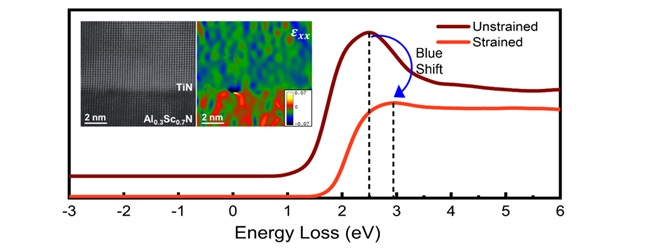
The team focused on titanium nitride (TiN), a highly stable material with plasmonic properties comparable to gold and compatible with CMOS semiconductor fabrication. Two ultrathin TiN films, each 10 nanometres thick, were fabricated—one strain-free and another subjected to controlled mechanical strain.
Using advanced electron energy loss spectroscopy (EELS) in a scanning transmission electron microscope, the researchers observed that the strained TiN film exhibited a significant blue shift of 0.30–0.45 electron volts in its plasmon resonance compared to the unstrained film, indicating that mechanical strain had altered the material’s interaction with light.
Further analysis using density functional theory (DFT) calculations revealed that tensile strain promotes the formation of nitrogen vacancies in TiN. These vacancies increase the concentration of free electrons, thereby raising the material’s plasma frequency and explaining the observed optical changes.
Additional confirmation came from spectroscopic ellipsometry and high-resolution X-ray diffraction studies.
Commenting on the findings, Bivas Saha, the corresponding author of the study, said strain represents a powerful and previously underexplored method for controlling plasmonic properties in metals.
“The ability to mechanically reconfigure the optical response of a CMOS-compatible material like TiN transforms plasmonics from a static platform to an active and programmable one, with exciting implications for on-chip photonics and optical sensing,” he said.
Spokesperson said the research was led by Diksha Dadhich and colleagues in Prof. Saha’s group, with contributions from The University of Sydney researchers Dr. Magnus Garbrecht, Vijay Bhatia and Ashalatha Indiradevi Kamalasanan Pillai.
Comments are closed.