

S. Ahmad
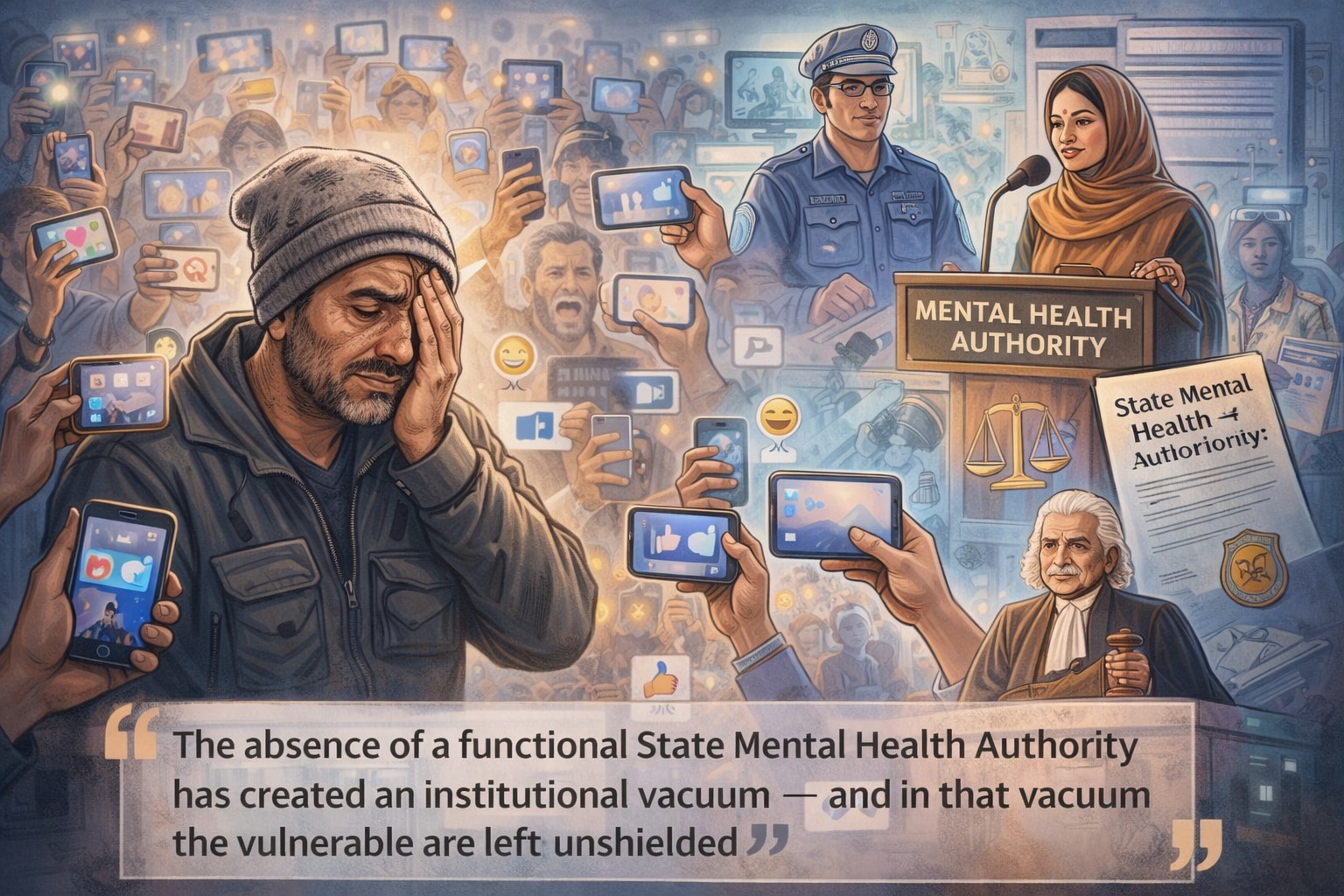
“The absence of a functional State Mental Health Authority has created an institutional vacuum — and in that vacuum, the vulnerable are left unshielded.”
The digital age has brought connectivity, but it has also created spaces where vulnerability can be easily exploited for entertainment. In Jammu and Kashmir the heartbreaking case of Fayaz Ahmad from Rafiabad widely known on social media as “Scorpio” has highlighted a severe gap in our collective empathy. Despite his family’s public statements regarding his mental health challenges, Fayaz has been subjected to relentless viral mockery.
Beyond the urgent need for societal sensitivity, Fayaz’s story serves as a critical case study of institutional paralysis. It highlights the urgent need to implement the Mental Healthcare Act (MHCA), 2017 in Jammu and Kashmir pointing specifically to the negligence of the Health Departments in protecting the region’s most vulnerable citizens.
Dignity and the Duty of Care: The Legal Reality
Fayaz’s situation is not just a matter of public morality; it is a matter of statutory rights. Under Section 20 of the MHCA, 2017, every person with a mental illness has the fundamental right to live with dignity and the right to protection from cruel, inhuman and degrading treatment. The public spectacle made of Fayaz directly contravenes this right.
Furthermore, Section 100 of the Act outlines the clear duties of law enforcement. Police officers are legally obligated to take under protection any person whom they have reason to believe has a mental illness and is either incapable of taking care of themselves or is at risk of harm. The failure of local authorities to shield Fayaz from public harassment reveals a stark disconnect between the law on paper and the realities on the ground.
The Missing Linchpin: The State Mental Health Authority (SMHA)
The MHCA, 2017, is a progressive, rights-based legislation, but its success relies entirely on the structural bodies it mandates. The most glaring administrative failure in J&K is the absence of a fully constituted and functional State Mental Health Authority (SMHA), mandated under Chapter VII, Section 73 of the Act.
The SMHA is not meant to be a passive committee; it is the regulatory backbone of mental healthcare in the region. Without it, the entire framework collapses. Under Section 77, the statutory functions of the SMHA include:
The SMHA is responsible for registering, supervising, and regulating all mental health establishments in the UT. It is also tasked with creating a registry of clinical psychologists, mental health nurses and psychiatric social workers. Without this, there is no quality control over the care provided to patients.
Crucially relevant to Fayaz’s case, the SMHA is mandated to train medical officers and mental health professionals, but also to sensitize police officers and other relevant stakeholders on the provisions of the Act. The fact that local police often do not know how to appropriately intervene in cases of public harassment of mentally ill individuals is a direct result of the SMHA’s absence.
The Authority is supposed to advise the UT Government on all matters relating to mental healthcare, ensuring that facilities at district hospitals are adequately staffed and funded.
It acts as a primary body to address deficiencies in care, working in tandem with Mental Health Review Boards (MHRBs) to protect patient rights.
Because the Health Department has delayed the robust operationalization of the SMHA, an institutional vacuum exists. There is no central body advocating for people like Fayaz, nor is there a system holding local authorities accountable for their inaction.
Fortunately, this administrative inertia is facing judicial scrutiny. In the recent Public Interest Litigation (PIL), Khatib Ali Buch Vs UT of J&K (Home Department), the High Court’s attention has been drawn to these precise structural deficits.
The petition underscores the catastrophic delay in the official constitution of the State Mental Health Authority and the Mental Health Review Boards. It brings sharp accountability to both the Health and Home Departments, demanding that they move beyond mere paper compliance. The PIL is a vital legal mechanism to force the administration to sensitize police forces and build the institutional safety nets required by law.
The harassment of Fayaz Ahmad is a tragic symptom of a system that has not yet prioritized mental healthcare infrastructure. While society must reflect on its digital behavior, the UT administration must fulfill its statutory obligations immediately.
The immediate constitution and empowerment of the State Mental Health Authority is non-negotiable. Only when the structural mandates of the Mental Healthcare Act are enforced will individuals facing mental health challenges be met with clinical support, legal protection and human dignity, rather than public apathy.
Author is Writer, Policy Commentator. He can be mailed at kcprmijk@gmail.com

Comments are closed.