
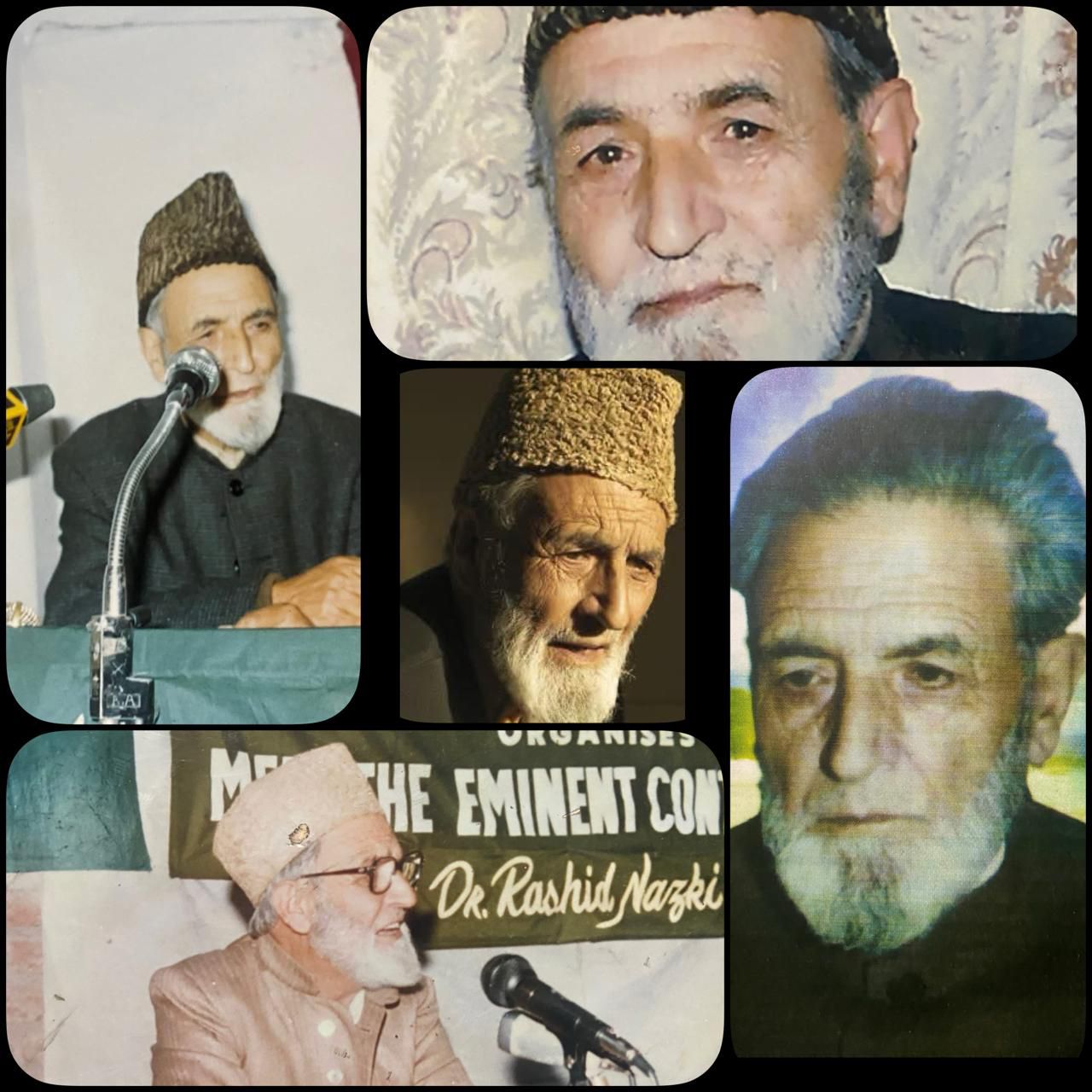

Part-III
Shabeer Ahmad Lone
Zikr-e-Habīb, Rashid Nazki’s biography of the Prophet (pbuh), spans two volumes comprising a total of 758 pages. The first volume (344 pages) was published in 2007, followed by the second volume (414 pages) in 2011. Notably, neither volume contains an index nor formal chapter headings. The narrative begins directly and concludes in the same unbroken manner, preserving a continuous and organic sequence throughout. The work is conceived and executed as a sustained biographical narrative.
As Ahsan al-Qasas has generated diverse scholarly interpretations, this study offers a fresh approach by presenting events strictly as they occurred, grounded in their historical and cultural context. Using a dramatic first-person narrative (ṣīghah-e-mutakallim), akin to classical Sīrah and Ḥadīth traditions, it recreates lived realities rather than isolated anecdotes, guided by the Qur’an, Ṣaḥīḥ al-Bukhārī, early Sīrah sources such as Ibn Hishām, Zād al-Maʿād, and modern Sīrah literature including Martin Lings.[13]
6.Sirriyet (2016)/Kashmiri
Spanning two hundred pages,this work is structured as follows: 1) What is Sirriyat/Mysticism/Esotericism, 2) A Brief Introduction to Major Mystical/Esoteric Movements, 3) Taoism (Chinese Mysticism), 4) Hindu Mysticism, 5) Sufism, 6) Is Sufism an Islamic or Non-Islamic Tradition?, 7) The Origins and Evolution of Sufism: A Historical and Critical Study, and 8) Sufism and the Unity of Being.[14]
In Sirriyat Rashid Nazki presents Sufism as the central intellectual and spiritual axis of Urdu-Kashmiri civilization, without which neither historical consciousness nor contemporary understanding-and certainly no future vision-can be fully grasped. He conceives Sufism not merely as a mystical tradition but as an ordering spiritual system that shapes a nation’s inner moral, cultural, and aesthetic life. Functioning as a reflective mirror, it reveals the deep structures of collective consciousness, binding philosophy, literature, ethics, and civilization into a coherent whole.
Despite their diverse origins and methods, all authentic systems ascend toward a single horizon of truth. Differences arise in interpretation and expression, but at the level of essence, unity prevails .As also held by key thinkers of perennialism/traditionalism as Rene Guenon, Fritjop Schuon, Martin Lingus , Ananda Coomaraswamy, Syed Hossein Nasr etc. Key sufis such as Ibni Arabi, Rumi etc, Vedantism,Islamic theology, Christian mystics such as Meister Echart,Julian of Norwich etc.Kabala mysticism, Neoplatonism, In modern philosophical thoughts of Husseral,Heidegger,Paul Tillich etc Taken together, these traditions show that human differences in perception, culture, and practice reflect our finite understanding, not a fractured reality, and that embracing this underlying unity cultivates humility, dialogue, and reverence for the One Truth expressed in countless forms. Maulana Rumi said in the similar fashion: “There is only one divine light with different candles”
This inquiry offers a concise exploration of the world’s major mystical movements as varied expressions of one perennial quest for meaning.
Muhammad Maroof Shah, in Grounding Religion in Mysticism (Greater Kashmir,dated 22 April 2017), reading Rashid Nazki’s Siriyyat, argues that the modern crisis of religion-manifest in skepticism, disenchantment, and the steady withdrawal of educated minds-cannot be addressed through legalism or apologetic defenses, but only by recovering religion’s inner core: mysticism. He maintains that mysticism and metaphysics illuminate religion from within, offering experiential certainty, ethical depth, and spiritual meaning that exoteric or narrowly rational approaches fail to provide. While institutional religion increasingly loses credibility, its mystical dimension continues to animate philosophy, literature, and serious intellectual life, revealing its enduring human appeal. Countering claims that Sufism is alien, escapist, or un-Islamic, Shah-drawing on Nazki’s Siriyyat-demonstrates that it is deeply rooted in prophetic authority, Islamic orthodoxy, and moral conscience, and has historically resisted tyranny and ethical decay. Acknowledging the dangers of distorted or sentimental mysticism, he nonetheless concludes that only an authentic mystical grounding can restore religion’s intellectual credibility, moral vitality, and relevance in a desacralized modern world.
7.Reshiyet ta Saen Resh (182 page)/Kashmiri
“Reshiyat ta Saen Resh” presents a profound synthesis of Kashmiri Shaivism and Islamic philosophy, emphasizing a balanced, life-affirming spiritual ethos. It highlights Abhinavagupta-disciple of Utpaladeva-as a towering figure comparable to Imam al-Ghazālī, illuminating the monotheistic (tawḥīdī) core of Shaivite thought. Nazki demonstrates that Kashmiri Shaivism evolved through spiritually accomplished Rishis and that Kashmiri rulers historically engaged Islamic scholars through dialogue rather than conflict (Rishiyat ta Saen Rish, p. 17).[15]
In his preface, Prof. Rehman Rahi observes: “The Rishiyat tradition has quietly shaped the character of the Kashmiri nation, providing a layered foundation of local philosophies, thought, literature, and spirituality. Recognizing its subtle yet enduring influence, there has long been a need for a work that introduces the prominent Kashmiri Rishis, situates them within their historical context, and examines their ideas alongside the broader currents of local philosophy. This concise study of the Rishiyat movement, along with an overview of its Rishis, is presented for readers of Kashmiri.” (Rishiyat be Saani Rishi, Kashmiri Department, University of Kashmir, 1979, p. 3)
The book is thoughtfully structured into five sections: 1. Ancient Kashmir and the Rishiyat Tradition, 2. Lal Ded, Islamic Tasawwuf and Trika Philosophy, 3. Islam, Tasawwuf, and Rishiyat 4. On the Rishis
8.Kashmiri Translation of Qasidie Burdesharif (Zum Zum) (pocket size , 1st Ed.1992 and 2nd Ed.2018)
The Arabic Qasida Burda by Hazrat Sheikh Sharafuddin Al-Busiri, also known as Qasidah Halimiyah, stands as one of the most revered devotional poems in Islamic literature. Its profound spiritual and literary value has inspired translations into Persian by Hazrat Abdul Rahman Jami, as well as into various other languages, including Urdu. In Kashmiri, the Qasida was first rendered by Maulana Nooruddin Qari Sahib and subsequently translated a second time by Professor Rashid Nazki.
This translation was published in 1992 through the efforts of Professor Muhammad Amin Andrabi, who writes in the “Presentation by the Publisher”: “One day, Nazki Sahib shared the joyous news that he was undertaking a metrical translation of the Qasida Burda Sharif. He recited several verses in his distinctive style, evoking such profound emotion that tears welled in my eyes, leaving me almost speechless. Though I had read the Qasida in Arabic and was familiar with its Persian rendition, hearing it in Kashmiri through Nazki Sahib’s translation felt as if I were encountering it for the first time. The depth, nuance, and dimensions of meaning he revealed were unprecedented; he illuminated subtle aspects present in the original yet often overshadowed.”(Zam Zam Translation, Rashid Nazki, p. 3, 1992)
Further,Prof. G.R. Malik underscores the profound significance of Rashid Nazki’s translation of Qasidie Burdesharif, asserting that a true translation is not merely faithful but creatively autonomous. Nazki’s rendition preserves the spirit, structure, and devotional depth of the original qasida while emerging as a distinct, luminous literary creation-revealed in its expressive power as even surpassing the original in creative eloquence (Shiraazi Rashid Nazki Number, p. 331).
Hamd yuss zaat-e-haq paran paaney
Wusf gan-zirraaney tehind beh kov zaaney
Naat-go paaney Zul-Jalaal timan
Ye chuh boed izzatag kamaal timan (Or)
Naali gardaney toomar gunneh han hinde
Drass zan HadiyyehinaumTas Wundi Wundi
Chhum nadamat karia Qabool karia
Rehmatuk ro’umie kun Nuzool karia
Lazzatun moot ye yagi ram karoon
Haeng harna ratoon badaam karoon
Soom ratoon yuth ne faqe roozi zanh
Koom karoos yuth neh choori soozi zanh [16]
Nazki’s translations are not mere linguistic exercises; they are acts of cultural synthesis, enabling Kashmiri literature to converse with universal thought.
Dr. Muhammad Maroof Shah identifies Rashid Nazki as one of major intellectual force in modern Sufi poetry, distinguished by the depth and clarity of insight that permeate his significant poems. Beyond his creative work, Nazki has made substantial scholarly contributions through his critical introductions to texts on Sufism and mysticism, and his study of Kashmiri Sufi poetry stands out as one of the most authoritative in the field. His writings are widely engaged across intellectual circles for their articulation of a coherent metaphysical and universal vision. This lived Sufi consciousness finds its most powerful poetic expression in Vahrat, particularly in the poem Isra, where the Miraj of the Prophet Muhammad (PBUH) is rendered not simply as sacred history but as a profound metaphysical and experiential meditation.-Prav Rashid Nazki No. P 118-121, [17].
9.Irfanuk Pai (2023) /Kashmiri )Tasawuf in Urdu Poetry
Irfanuk Pai (305 pages), Compiled insightfuly by Shahbaz Hakbari published by Meezan Publishers in 2023. It stands as a varied scholarly essays collection of Rashid Nazki, which reflect his Intellectual/mystical/Literary Vision. Tasawuf in urdu poetry has been richly expressed through the works of numerous luminaries, including Wali Dakani, Mir Taqi Mir, Hazrat Muhammad Shah Bedari, Shah Ruknuddin Ishq, Syed Amjad Ali Shah Asghar, Hazrat Shah Niaz Ahmad Bareilvi, Syed Ali Ghamgeen Dehlavi, Shah Turab Ali Qalandar, Khwaja Haidar Ali Aatish, Mirza Asadullah Khan Ghalib, Shaikh Muhammad Abdul Aaliam Aasi Rasheedi Ghazipuri, Allama Iqbal, Maulvi Asghar Hussain Asghar Gondvi, and Fani Badayuni, 19,whose collective contributions reflect the profound spiritual, philosophical, and aesthetic dimensions of mystical thought in Urdu literature. Irfanuk Pie is a distinguished intellectual and gnostic work that opens a gateway to the vast ocean of irfan within Urdu poetry. Traversing over fourteen centuries from prophetic (PBUH) period, Nazki integrates religious, literary, cultural, and intellectual histories, engaging poets from Amir Khusro to Iqbal, and demonstrating the enduring relevance of mystical wisdom to contemporary moral and existential crises.Future editions should correct the numerous typographical errors to safeguard the work’s scholarly and literary integrity.
Beyond his substantial published oeuvre, Rashid Nazki’s intellectual legacy extends far deeper, with numerous unpublished, meticulously researched works-notably critical studies of Lall Ded and Sheikh-ul-Alam, alongside profound engagements with Iqbal , Ibn ʿArabi, Tasaawuf, and other colletion of scholary miscellaneous writings presented in journals, seminars etc. forming a vast, latent archive of thought that promises to significantly enrich future scholarship once brought to light.
Wuni bo chhus Ghulam Rasool( saw)
Yoot jurat be chhus gachan haeran
Noozkus Kun te akh nazr lillah
Tas matae bas chu akh nigaahi Nabi(SAW)
Nazukiyen paeath youd tagii praznun
mushke sholakh zi teyuth gulaab demie
10.Baazgasht(Urdu/P.400)Meezan Publication Sgr. 2026[20]
Baazgasht is structured into thoughtfully titled chapters, each examining a key dimension of Kashmir’s history, literature, mysticism, poetry, and spiritual traditions. Together, they form a cohesive and insightful exploration of the Valley’s intellectual, cultural, and devotional heritage, highlighting its thinkers, saints, poets, and enduring philosophical currents.
Compiled by Shahbaz Hakbari, “Bazgasht” is structured into following chapters ; Paish-i-Kalam-Muhammad Yousuf Taing, Professor Rashid Nazki-Ayaz Rasool Nazki, Kashmir kay Batl-i-jaleel Rashid Nazki ko salaam-Dr. M.Maroof Shah, Taqreez-Prof.Rashid Nazki, Pesh-i-Aahang ,Tanha Ansari – Ek Taaruf,Kashmir mein Talou-i-Islaam, Reshi lafz ki mukhtalif taabeerein aur Tavelain,Kashmir mai Reshi Masluk, Kashmir Kay Mazahib wa Aqaid, Sheikh Hamza Makhdoomi, Lal Ded aur Islaam, Reshi Tehreek ke niswani kirdaar, Hazrat Sheikh Noor-ud-din Noorani, Sheikh-ul-Alam aur Bhakti tehreek,Silsila-e-Reshia ke mujaddid, Fouq ki shayari, Kashmiri Shairi Mai Tasawuff, Lalla Aarifa, Encyclopedia Kashmiriyana Kyon?,Tamaduni zindagi mein saadat ka hissah, Mughal daur ki Farsi shayari mein Kashmir ka tazkirah, Tasawwer-i- Ishq, Mourikh-Hassan ka Shairaneh Maqam, Mehjoor aur Habba Khatoon, Hazrat Sheikh Noor-ud-din Noorani ke tableeghi mission ke chand Haqaiq, Professor Rasheed Nazki ka maktoob.
Muhammad Yousuf Taing’s preface presents Rashid Nazki as a polymathic luminary, whose letters and essays transform the ordinary into the sublime, blending wit, elegance, and spiritual insight. Nazki’s scholarship illuminates Kashmir’s literary, mystical, and cultural heritage, tracing the Rishi order, Lal Ded, Shaivism, and the advent of Islam with rigor, originality, and fearless intellectual honesty. His mastery of multiple languages allows him to synthesize diverse traditions-Urdu, Persian, Kashmiri, Sanskrit, Arabic-into a coherent vision that bridges history, philosophy, and spirituality. Taing emphasizes Nazki’s ability to challenge entrenched myths, provoke thought, and reveal the harmonious interplay between indigenous and Islamic traditions, portraying him not merely as a critic or historian, but as a transformative custodian of Kashmir’s cultural memory. The preface itself exemplifies scholarly elegance, guiding the reader to grasp both Nazki’s profound erudition and the enduring resonance of his work.
While as Ayaz Rasool Nazki’s tribute presents Professor Rashid Nazki as a towering custodian of Kashmir’s literary, cultural, and spiritual heritage, whose essays collectively form an intellectual encyclopedia of Kashmiriyat. Through meticulous scholarship, Nazki illuminates Kashmir’s history, mysticism, Reshiyat, Sufism, poetry, and literature, bringing alive personalities such as Lalleshwari, Sheikh-ul-Alam, and Hazrat Hamza Makhdoom. The work demonstrates the interconnectedness of Kashmir’s religious, cultural, and literary traditions, tracing the impact of pre-Islamic beliefs, the advent of Islam, and the evolution of poetry and philosophy. The son’s labor in compiling these essays preserves and amplifies the Professor’s legacy, offering readers a comprehensive, transformative vision of Kashmir that is both erudite and profoundly evocative.
And finaly under the title, Kashmir kay Batl-i-jaleel Rashid Nazki ko Salaam, Dr. Maroof Shah’s engagement with Rashid Jaleel Nazki is a vital act of intellectual recovery. It restores to visibility a thinker whose scholarship embodies depth, discipline, and moral seriousness-qualities increasingly rare in contemporary criticism. Nazki stands as a classical Kashmiri intellect: rooted in tradition, multilingual in mastery, and uncompromising in historical rigor.
Nazki’s foremost contribution lies in his redefinition of Rishiyat as a way of life rather than a sectarian creed. By locating “Rishi” within the cultural archetype of Kashmir, he dissolves false oppositions between Islam and indigeneity, Sharia and Tariqa, continuity and change. His analysis demonstrates that Kashmiri Sufism neither abandoned Islamic orthodoxy nor ignored local philosophies, but transformed both into a coherent spiritual ethos.
His reading of Lal Ded is equally decisive. Refusing reductive religious labeling, Nazki situates her within a metaphysics of realization where Shaivism, Buddhism, and Wahdat-ul-Wujood converge. Lal Ded emerges not as a contested symbol, but as a civilizational synthesis-an answer to historical transition rather than a problem within it.
Nazki’s comparative treatment of Sufism and Shaivism reveals a shared metaphysical vocabulary, making Kashmiri Sufi poetry a living testament to inter-civilizational dialogue. His defense of Islamic scholarly traditions, particularly the Syeds, is marked by evidentiary rigor and ethical clarity, exposing modernist distortions without polemic.
In style and substance, Nazki belongs to the lineage of master Urdu prose stylists-precise, luminous, and intellectually exacting. His work is not merely contributive but corrective, offering a durable framework for understanding Kashmir’s literary, mystical, and cultural history. This volume secures his place as an indispensable authority for generations to come.

Comments are closed.