
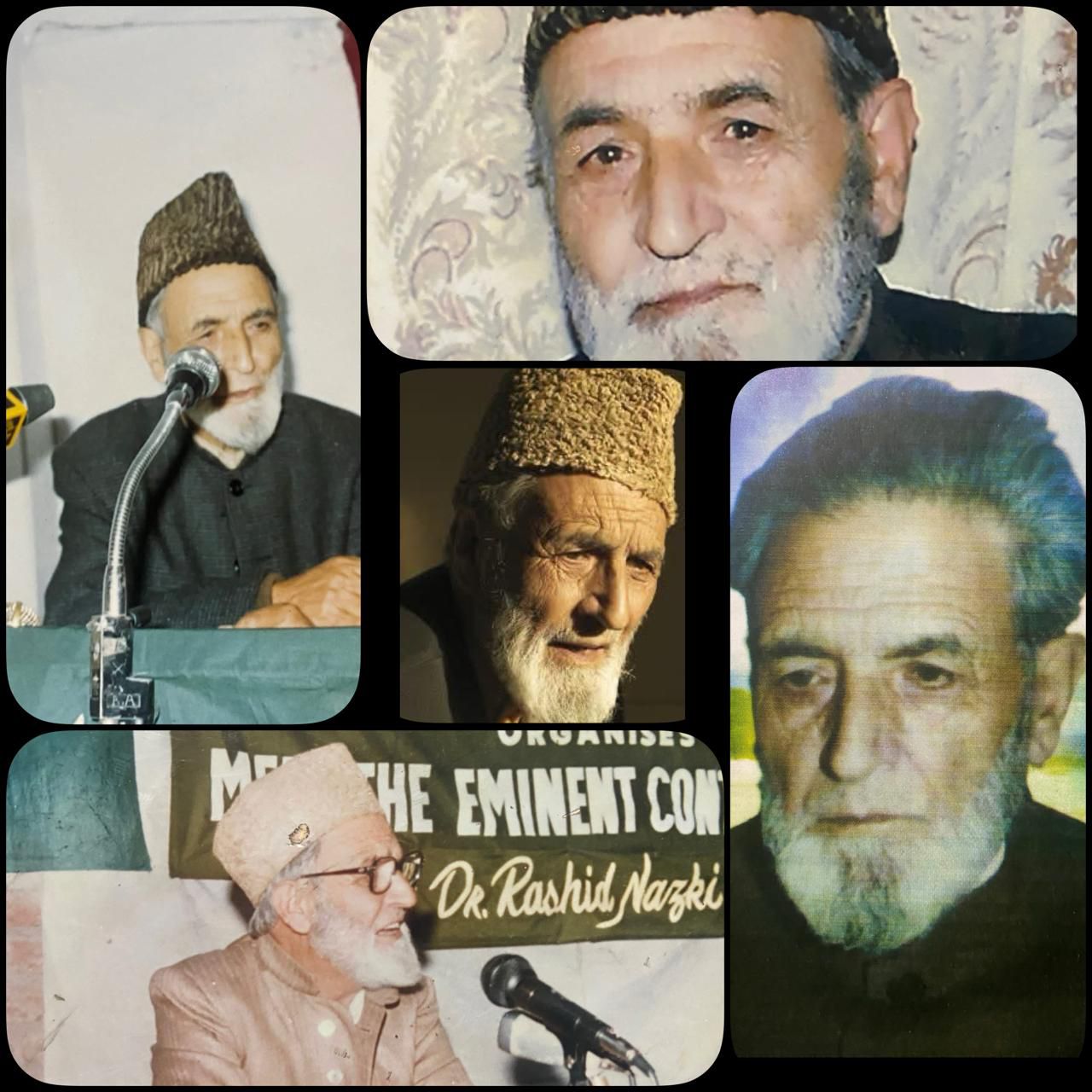
Prof. Rashid Nazki: Luminary Doyen of Kashmiri Literature, Mysticism, and Cultural‑Intellectual Legacy

This write-up serves as a modest monographic tribute to Professor Abdul Rashid Nazki, outlining some key aspects of his literary and intellectual legacy while indicating areas that invite further scholarly exploration and critical study
By: Shabeer Ahmad Lone
نه من بر آن گل عارض غزلسرایم و بس
که عندلیب تو از هر طرف هزارانند
— [Hafiz]
Meri nawai pareshan ko shairee na samj
Ke mai hoon muhrum raazi darooni maikhanah
— [Iqbal]
Some representative verses ( from Vahrath-Poetic collection)
Acher Awazi Garan Kaech Shabeeh
Preth shabihas zabaan bayan tanha
Tath shaharas Az te Narus gul folan
Khabri cha vead nazri hind yaven golab
Naz parverdeh chukhneh kham khanuk
Hoshi roostoi be Kos sharab dimie
Bael vana chokh hato be chos tanha
Saeth chee saseh baed sehra
Keate haftkhaneh cheteth chai banith yoet vaches
Shiv zan vareh rotom parvatee seenas saeth
Gindon aabus te aatish peyou jahanas
Sarooruk noor peyou Ayean khanus
Khuda zanaan zi kati full yousfistaan
Zulikha vare voshlon Aasmanas
Chi Gulro sade lovhan vade thavaan
Em saeth rung khoot preth dastaanus
Wuchh tha chashman hanz vahrath
Tarakh nab heth bon vetch raath.
Jani Isa , salaib, karb o bala
Preth Akha chee saraan saraan tanha,
Mean pathin agr wajood labakh
Zoon kyah Kath chie aaftab dimie
Daeeg gov nooraneh sahruk shaam peo aasmaneh waes
Royeh nazus peth gindaan yelle kookli pehchaan voth
Vate peth pruchnum beyeh tem maet
Yeteh petheh dunyaah kotaah door
Chaane khamooshi kathun pun heove tulaan
Bay zabani meaani hath izhaar raech
Sahra Sahra koos mangi treash
Pannoie dil chum zum zum
Chamun ta Chamun zaal vahrith thook
Qafs ta qafs aes chi Maazoor haz
Jawaan khoon, asmat te biye kya neh diyut
Khuda sabeh bas yee chu maqdoor haz
Wanov kyah aes chi majboor haz
Zameen taeng gy aasman door haz
Temis rukhsat karith oosh qatreh kinh pei
Shameh sholeo muqadus Aastanus
Faresh Lalwaan chu miyaani khoonech dug
Arsh gulnaar , Aetibar Kariv
Achen Manz vouch vothun hinz lash shoolan
Nazr mahrum te chandaan naav bavath
Vojooduk Un wates mehshr Vonull Ghaen
Hayaatuk yup te Adum Khav Bavath
Saseh baed vih vochith nazreh voolaan
Dil chu shoolan nagaar khanek paeth
Mushke saran gye thaanah wa theth zan rotoul rotoul gow bedaar
Kehnh te gatchtun toti chhanh izhaaras zyuv denus tayaar baasaan.
Lach qayamtch te karb o bala
Noozkan parde thoov izharun
Naeun karamath sarem sahr waqten
Paez haqqiqat wochim khabeak paeth
Es che badres andr faqt kehn zen
Bus Khuda yaar etibar kaeriv
Chavnie roodim kathun hind poshi vun
Havnie roodim athan hind aaftab
Asr sharuk dilech masti chona aasaan kudadadie
Vanin kum kyah vanun , cho Nuzkus narok sanear baqi
Ye Gardish Aaftabuk tarkan hund yun Ghachun piehum
Me Basaan doori chayen choori kustaamath sahr baaqi
—[Nazki]
Dr. Muhammad Hasan once observed that every act of creation unfolds on three interrelated levels. It is at once a reflection of the creator’s own inner self, a resonant voice of the consciousness of its age, and an echo of the universal values emerging from that era. For this reason, the study of serious literature necessarily becomes a study of the author-through their works, biography, and psychology; a study of the epoch-through sociology, economics, and the social sciences; and a study of enduring values-through aesthetics and history. Literature, therefore, is not merely a record of words or events; it is a living mirror, revealing the interplay between individual insight, societal consciousness, and timeless human ideals.
The renowned literary figure and critic Majnoon Gorakhpuri observes: “The environment shapes the literary figure, just as his intellect helps to reinterpret and reconstruct the environment. Literature speaks both as the voice of the present and the herald of the future. The greatest literary figure is one who harmoniously unites the present with the promise of what is yet to come.”(Literature and Life)
Rashid Nazki: Roots, Times and Becomming
Born in 1931 in Bandipora on the serene shores of Wullar, where the waters mirror the skies and, as Iqbal whispers, the contemplative spirit of Khazir still wanders, and the surrounding mountains with quiet sacred wonders-Rashid Nazki’s formative environment was sweeped amid this quiet mysticism.
He was the son of Mir Syed Asadullah Mir Nazki, a deeply virtuous man initiated into the Qadri silsila. Long without a male heir, the family sought a wandering mystic from Mader, Bandipora, who sensed the fragrance of Ghaus-ul-Azam in their home, then entrusted with sacred relics from a nearby mosque. Following his symbolic blessing, Rashid Nazki was born, the mystic foretelling a future as a great alim and abid.
Orphaned at seven, he was raised with care and moral discipline by his elder sister Ateeqa Aapa. After completing his tenth standard, he entered public service as a teacher in the School Education Department, reflecting an early devotion to learning. He later married into a distinguished scholarly lineage, being wed to the niece of Maulvi Yousuf Shah Vaterhali of Budgam, a Deoband-trained alim and fazil of the Bukhari family. Alongside his professional life, he pursued higher learning with distinction, earning a Ph.D. in Kashmiri from the University of Kashmir-a life shaped by mystic grace, resilience, and enduring scholarship.
Rooted in the rich literary soil of Bandipora, Rashid Nazki flourished amid a circle of luminaries-his own Nazki family, Hajinis, Ameen Shakeeb, Nishat Ansari, Mashal Sultanpuri, and others, while drawing early inspiration from the region’s earlier stalwarts like Pir Ghulam Hassan Shah, Abdul Ahad Nadim of Gamroo Bandipore. On his maternal side Rashid Nazki was shaped by a rich literary and scholarly environment, home to respected naat poets such as Abdul Ahad Nadim and Movi Hassan Sahib Aerij, and from his inlaw’s householded in Budgam , guided in Arabic studies by Molvi Syed Yousuf Sahib . This heritage cultivated in him a strong foundation of poetic sensibility, linguistic skill, and intellectual depth, which became central to his contributions to Kashmiri literature. Through these companions and his lineage, he inherited, reflected, and elevated Bandipora’s intellectual and spiritual legacy, bridging past and present, and shaping the destiny of modern Kashmiri literature.
Prof.Dr.Abdul Rashid Nazki (1931-2016)emerges as one of the most seminal figures in modern Kashmiri intellectual and cultural history, a sage-polymath whose life and oeuvre occupy a signifant place at the intersection of literature, mysticism, philosophy, and cultural stewardship. Nazki’s formative years were steeped in the rich syncretic traditions of the Valley-a space where mystical thought, poetic expression, and scholarly rigor coalesced into a unique epistemic environment. This milieu shaped Nazki’s lifelong endeavor to articulate an intellectual and aesthetic vision that was both rooted in the Kashmiri ethos and conversant with universal philosophical currents.
As the eminent Kashmiri poet and literary figure, Prof. Rehman Rahi, underscores that the mid-20th century-especially the forty-five years following 1945-marked a pivotal era in Kashmir’s history, characterized by profound political, social, and cultural awakening. It was in this transformative period that Kashmiri poetry emerged into the realm of collective consciousness.-M.Yousf Taing , Hamara Adeb, p.10-13
The poetry of Rashid Nazki Saab reveals its full depth only when contemplated against the backdrop of his historical/cultural fermrnt and the enduring continuum of Kashmiri poetic traditions. A poet does not exist in isolation; his voice is woven from the spirit of his time and the threads of ancestral literary heritage, resonating with both the echoes of the past and the consciousness of his present, giving rise to a vision at once personal and universal.
Nazki’s academic journey reflects a remarkable fusion of erudition and vision. At the University of Kashmir, he became the first individual to earn a doctoral degree in Kashmiri literature, with his dissertation focusing on the mystical trends in Kashmiri and Urdu poetry. This work exemplifies his ability to navigate the delicate terrain between traditional mysticism and modern critical scholarship, situating the Rishi and Sufi traditions of Kashmir not as relics of the past, but as living, interpretive frameworks for contemporary literary and philosophical inquiry.
Recalling his time as a student in the Kashmiri Department in 1986, Ravinder Ravi reflects on studying Sufi poetry under Professor Rashid Nazki. The classroom itself was a realm of spiritual elevation and immersive experience. Prof. Nazki never assumed the mantle of a preacher or moral instructor; his lectures were instead pure, contemplative sermons. With remarkable mastery, he could illuminate any distinguished topic with clarity, coherence, and depth, adhering to the allotted time without exhaustion. His impartiality in both speech and conduct embodied a profound blessing/giraan qadr tabarruk which, Ravi notes, conferred enduring stature and significance upon his comparative studies.
He further writes,this wise, trusted, and devout scholar had a remarkable command of Urdu as well. His language did not imitate Deccani, Awadhi, or Lucknowi styles, but flowed naturally and effortlessly. The depth of his experiences, careful observations, and extensive learning gave rise to a style that is both engaging and beautifully expressive.-Sheeraza Rashid Nazki No.2019.
Ayaz Rasool Nazki recalls , among all the qualities of Rasheed Nazki Sahab’s charming personality, the most powerful and impactful aspect is his pleasant conversation, the selection of words, and his manner of expression. The vast vocabulary of the Kashmiri language that he commands is perhaps unmatched by anyone present today. His unique and charismatic way of engaging in everyday conversation and discourse captivates the listener and makes them completely absorbed.Beyond our familial bond, we shared the rare coincidence of name: both Dr. A.R. Nazki. When he received the Sahitya Akademi Award, I was in Jammu as Registrar of the Agricultural University, receiving call after call as the news spread. The formal welcome afirmed ,having an uncle is also indeed a blessing(Prav. p. 40).
I could recall my introduction to Professor Rashid Nazki in 2004 by Dr. M.Maroof Shah, I witnessed his profound thought and mystical engagement firsthand. Despite being often absorbed in himself, he welcomed deep intellectual and spiritual discourse, and his home remained a warm, vibrant hub for scholars and literary minds. With insight and quiet grace, the poet-sage welcomed all with warm, gracious hospitality, truly embodying the spirit of “chum nov mai mashanee.” His keen mind, reserved demeanor, and thoughtful hospitality toward visitors reflected a life shaped by mystical writings and practices
His scholarly, critical, and analytical writings-spanning subjects such as Lalleshwari (Lal Ded), Shaikh-ul-Alam, Ibn Arabi, Iqbal, Reshiyat, Tasawwuf, poetry ,scores of articles distinguished luminaries etc. have been published in both Kashmiri and Urdu, appearing in esteemed journals including Sheeraza, Anhar, Tameer, Bazyaft,Gaash, Prav and in other collected works reflecting the depth, rigor, and enduring significance of his intellectual contributions.
For instance his scholary article “Shaikh-ul-Alam and the Bhakti Movement,” it is noted, “The processes of analysis and synthesis within the civilization and culture of India have been ongoing for centuries, and it is through their grace and blessing that Indian civilization remains both flourishing and magnanimous.”The article further observes:”The arrival of Muslim Sufis in India did not merely spread the message of Islam; it also inaugurated a renewed process of analysis and synthesis. Through this dynamic interplay, Muslim Sufis and Hindu saints alike contributed to a shared spiritual and cultural discourse, enriching the intellectual and mystical fabric of the subcontinent.”
Rather than mere formalities, Hindus embraced the spirit of religion with heartfelt passion and deep longing. This great Bhakti movement gave rise to noble souls among both Hindus and Muslims, who, like beacons of light, illuminated the path of self-realization and divine awareness amidst the shadows of hypocrisy, greed, and outward show.(Ta’meer: Intikhab Number, page 79)
Regarding the Bhakti Movement, Nazki Sahib further observes: It is through the generosity and spirit of this movement that Kashmir has largely remained free from conflict based on religion, color, or race. This is the true essence of Bhakti-a path of love that has inscribed an enduring legacy of peace and harmony upon the heart of Kashmir.(Ta’meer: Intikhab Number, page 80)
In an article on Allam Iqbal, Rashid Nazki writes: Iqbal, the falcon of philosophy and the nightingale of Islamic thought, is affectionately called “Badal Iqbal”, “Yaroon Ka Yar”, and “Qadr-danoon Ka Qadrdaan” by his friends in candid and unrestrained letters-a friend to friends, an appreciator of appreciators . As a philosophical poet, his seriousness is profound, at times approaching the intensity of self-absorption, reflecting the remarkable depth of his intellectual and spiritual engagement.
Nazki Sahib observes that towering artists often exist apart from their creations. For instance, Ghalib the epistolary writer differs from Ghalib the poet and man; similarly, the politician Abul Kalam Azad is distinct from Abul Kalam of Ghubar-e-Khatir (Sallies of Mind).
On Iqbal’s Correspondence: From these reflections, Rashid Sahib notes that Iqbal frequently ignited brilliant sparks of insight through his correspondence and close circle, offering guidance marked by candor, generosity, and intellectual illumination,while elaborating on Iqbal’s correspondence with Muhammad udin Fouq.
In the Cultural Academy’s special issue 2010 on Kamil Sahib , Kamil Sahib is covered with essential brevity.Rashid Nazki writes, Kamil Sahib was not confined to a single field; his intellectual and creative range encompassed literary criticism, research, history, poetry, fiction, folk literature, and philosophy.Kamil Sahib’s temperament radiated a timeless spirit, sharp wit, and subtle satire.
Rashid Nazki further writes”In their own distinctive ways, Nadim, Rahi, and Kamil emerged as new triad on the literary horizon, bearing the honor of elevating the fortune and stature of Kashmiri poetry and literature. Among the three, Kamil stood apart for the sharpness of his intellect, resolute temperament, and the dynamism of his creative action” P-28,29
“…Such pioneering research awakened Kamil Sahib’s mind to the multifaceted hues of Kashmiri culture. In prose and poetry alike, he charted a distinctive path through the ancient avenues of Kashmir’s luminous civilization.” Nazki adds: “One may at times differ with Kamil Sahib, yet none can deny the enduring blessings of his pen, his monumental contributions to the Kashmiri language and literature.
After retirement, Rashid Nazki’s life, though distinguished by literary achievement, was struck by a profound personal tragedy: on March 15, 1992, his wife and two sons fell victim to a grenade blast amid the unrust in Kashmir. Yet, his patience and quiet resilience shaped his sensibility, imbuing his poetry with reflective depth, grace and enduring human insight. This capacity to transform personal sorrow into creative and spiritual insight became a defining feature of his later work.
Rashid Nazki’s literary excellence was recognized through several prestigious honors. In 1999, he received the Sahitya Akademi Award for his acclaimed poetic collection Vahrath. In 2005, he was presented with the Certificate of Honour in Literature by the then President of India, A.P.J. Abdul Kalam, acknowledging his enduring contribution to poetry. Later, in 2008, Award for Literature was conferred upon him by the Government of Jammu and Kashmir on Republic Day, celebrating his lifetime achievements and lasting impact on Kashmiri literature.
Rashid Nazki, a luminary doyen of Kashmiri literature, blends literary mastery, mystical insight, and cultural-intellectual vision, resonating with figures from Jami, Rumi, Ibn Arabi, and Ferdowsi to Allama Iqbal, Hugo, Goethe, Rilke, and T.S. Eliot, Derrida, Focault etc. while, if studied deeply, his works reveal profound intellectual, literary, and mystical affinities, cementing his legacy as a thinker and poet whose vision transcends time, language, and culture.
(To be Concluded…)

Comments are closed.