

S. Ahmad
“Since its launch in December 2000, PMGSY has achieved an extraordinary scale of execution. Over 8,25,114 kilometres of rural roads have been sanctioned, and nearly 95 per cent—7,87,520 kilometres—have already been completed. Very few public infrastructure programmes in India have demonstrated such continuity, reach, and delivery over two and a half decades.”
When a road reaches a village, it does much more than reduce physical distance. It reshapes daily life. It alters how people work, learn, heal, and dream. A road connects farmers to markets, children to schools, patients to hospitals, and families to opportunities that once felt impossibly far away. As India marks twenty-five years of the Pradhan Mantri Gram Sadak Yojana in 2025, this is not merely an anniversary of an infrastructure programme. It is a moment to reflect on how rural connectivity has quietly redrawn the economic and social map of the country.
Launched on 25 December 2000, PMGSY emerged from a simple yet transformative idea. No rural habitation should remain isolated because of the absence of an all-weather road. At the time, millions of villages across India were connected only by dirt tracks that vanished during monsoons and winters. For large parts of the year, access to markets, schools, and health facilities depended on weather, terrain, and physical endurance. PMGSY sought to change this reality permanently.
Two and a half decades later, the scale of achievement is extraordinary. Since its inception, over 8,25,114 kilometres of rural roads have been sanctioned under PMGSY. Of these, 7,87,520 kilometres—nearly 95 per cent—have already been completed as of December 2025. Very few public infrastructure programmes in India have demonstrated such continuity, execution capacity, and national reach over such a long period.
At its core, PMGSY has never been just about roads made of stone, bitumen, and concrete. It has always been about dignity. It has been about ensuring that a person’s birthplace does not determine their access to opportunity. In a country as geographically diverse as India, this principle carries deep moral and economic significance.
Rural roads have long been recognised as a foundation of development. Connectivity reduces transport costs. It improves access to agricultural inputs and markets. It allows farmers to sell produce before it perishes and at prices that reflect real demand. It enables rural workers to access non-farm employment and services. It shortens the distance between villages and institutions such as schools, colleges, banks, and hospitals. PMGSY’s lasting contribution lies in turning this understanding into reality, village by village and district by district.
Over time, the programme evolved in response to changing rural needs. PMGSY Phase I focused on first-time access. It aimed to provide all-weather road connectivity to eligible, previously unconnected habitations. Under this phase, connectivity projects for 1,63,339 rural habitations were sanctioned. For millions of households, this marked the first dependable link to the outside world. It meant that emergencies no longer had to wait for clear skies. It meant that mobility became a right, not a privilege.
As basic connectivity expanded, new challenges emerged. By 2013, it became clear that access alone was not enough. Roads needed to support economic activity. PMGSY Phase II responded to this need by focusing on the upgradation of economically important routes. These roads connected villages to rural markets, growth centres, and service hubs. The emphasis shifted from reaching habitations to strengthening networks that could sustain livelihoods and local economies.
A crucial intervention followed in 2016 with the Road Connectivity Project for Left Wing Extremism Affected Areas. This initiative covered 44 of the most affected districts across nine states, including Chhattisgarh, Jharkhand, Odisha, Telangana, and parts of Uttar Pradesh. These regions had long suffered from isolation, underdevelopment, and weak state presence. Roads here served a dual purpose. They improved the mobility of security forces, but more importantly, they opened remote regions to development, governance, and public services. As roads entered some of the country’s most inaccessible landscapes, they carried not only infrastructure, but also inclusion and visibility.
PMGSY Phase III, launched in 2019, marked another strategic shift. This phase focused on upgrading major rural links and through routes that connect villages to agricultural markets, higher secondary schools, and healthcare institutions. These roads are lifelines. They are essential for sustaining rural economies beyond subsistence. By December 2025, 1,22,393 kilometres had been sanctioned under Phase III, and 1,01,623 kilometres—around 83 per cent—had already been constructed. The results have been visible in reduced travel times, improved access to services, stronger agricultural value chains, and employment generation during and after construction.
The government’s continued commitment to rural connectivity is reflected in consistent budgetary support. For the financial year 2025–26 alone, PMGSY received an allocation of Rs. 19,000 crore. This sustained investment underscores the recognition that rural roads are not a completed task, but an evolving development necessity.
PMGSY Phase IV represents the programme’s most ambitious and equity-focused phase yet. Approved for implementation from 2024–25 to 2028–29, it proposes the construction of 62,500 kilometres of roads at an estimated cost of Rs. 70,125 crore. These roads aim to connect 25,000 unconnected habitations, with special focus on tribal regions, aspirational districts, desert areas, Himalayan and North-Eastern states. Population thresholds have been designed to ensure fairness and inclusivity. This phase is about completing the unfinished promise of universal connectivity. It is about reaching the last village, regardless of terrain or remoteness.
Technology has played a central role in strengthening PMGSY’s credibility. The Online Management, Monitoring, and Accounting System enables real-time tracking of both physical progress and financial flows. This system ensures that delays and deviations are visible as they occur, not discovered long after completion. Quality monitoring has been institutionalised through independent inspections by State and National Quality Monitors. Their reports, uploaded through mobile applications with geo-tagged photographs, create a transparent and verifiable record of construction quality.
Maintenance, often the weakest link in public infrastructure, has received special attention. Through the e-MARG platform, contractor payments during the five-year defect liability period are linked directly to road performance. Since 2022, GPS-enabled vehicle tracking systems have been made mandatory to monitor equipment usage and operational time. Together, these measures reflect a shift toward technology-enabled trust and accountability.
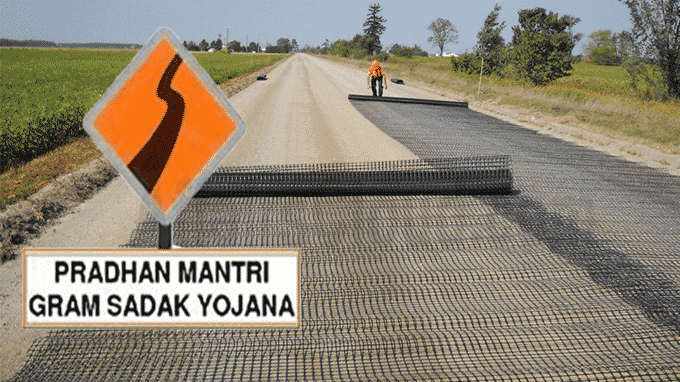
PMGSY has also adapted to the realities of climate change. Rural roads today must endure not only traffic, but also extreme weather events. The programme has increasingly adopted eco-friendly materials such as waste plastic, fly ash, slag, bio-bitumen, and recycled construction waste. Innovative construction methods like cold mix technology and full-depth reclamation have been used in over 1.24 lakh kilometres of roads as of July 2025. Updated standards from the Indian Roads Congress reinforce this transition toward durable and climate-resilient infrastructure.
As PMGSY completes twenty-five years, its true legacy lies beyond numbers and milestones. It lives in everyday experiences. It is present in the farmer who reaches the market before prices fall. It is visible in the student who no longer misses school during monsoons. It is felt in the expectant mother who reaches a health centre in time.
Development often arrives quietly. It does not always come with slogans or ceremonies. Sometimes, it arrives as a road.
Aligned with the Sustainable Development Goals and grounded in principles of inclusion, transparency, and resilience, PMGSY stands today as one of India’s most enduring nation-building initiatives. As the programme moves into its next phase, its challenge will be to not only connect habitations, but to continue strengthening the economic and social pathways that those roads enable.
In doing so, PMGSY reminds us that the journey toward a more equitable India is long, demanding, and ongoing—and that it is, quite literally, paved one road at a time.
Author is Writer, Policy Commentator. He can be mailed at kcprmijk@gmail.com

Comments are closed.