

S Ahmad
In rural India, the meaning of a home extends far beyond brick and mortar. It represents safety during monsoons, warmth during winter nights, dignity in social life, and a foundation upon which families can build aspirations for education, health, and economic progress. Over the past decade, the Pradhan Mantri Awaas Yojana–Gramin (PMAY-G) has quietly but steadily transformed this aspiration into reality for millions of households. What began in April 2016 as an ambitious pledge to ensure “Housing for All” has evolved into one of the largest and most technology-enabled rural housing initiatives in the world.
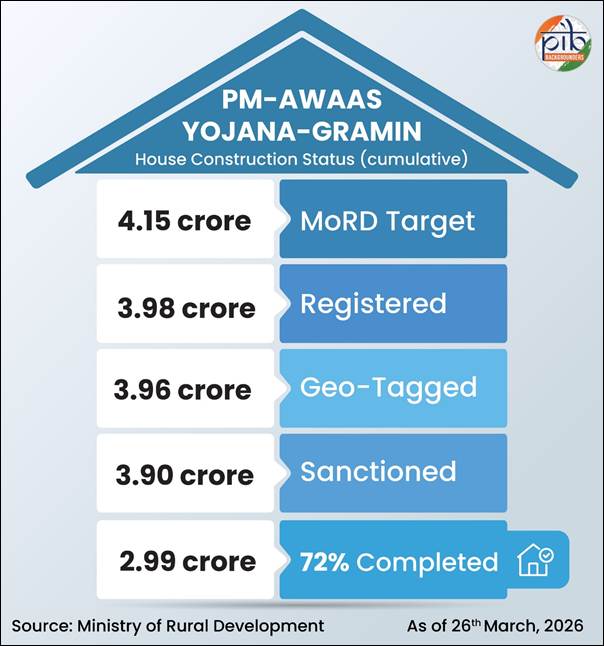
As of late March 2026, the programme’s numbers tell a story of scale and persistence. Across Phase I and Phase II, states have been allocated 4.15 crore houses. Of these, 3.90 crore have been formally sanctioned and 2.99 crore have already been completed. Behind these figures lies a massive financial commitment: over ₹4,03,886 crore has been directly transferred to beneficiaries to support construction. With a cumulative target of 4.95 crore rural houses to be achieved by 2029, PMAY-G stands at a decisive moment—poised between substantial accomplishment and the promise of full saturation.
A Permanent Home as the First Step Toward Dignity
For decades, rural housing deficits were a silent but severe challenge. Kutcha homes—constructed from mud, thatch, or temporary materials—offered little protection against floods, storms, or extreme heat. Families often lived in cramped, unsafe spaces, with no dedicated cooking area and limited sanitation facilities. Housing insecurity fed into broader cycles of poverty, limiting social mobility and undermining well-being.
PMAY-G addressed this structural vulnerability head-on. The scheme mandates a minimum house size of 25 square metres, including space for hygienic cooking. More than a structural specification, this requirement reflects a philosophy: housing must ensure dignity, safety, and functionality. By targeting houseless families and those living in dilapidated structures, the programme systematically reduces the rural housing deficit while creating an enabling environment for socio-economic upliftment.
Yet the scheme’s real strength lies in its recognition that a house is not merely a roof—it is an ecosystem. Convergence with sanitation, water supply, electricity, clean cooking fuel, and livelihood programmes ensures that beneficiaries do not receive isolated support, but a comprehensive transformation of living conditions.
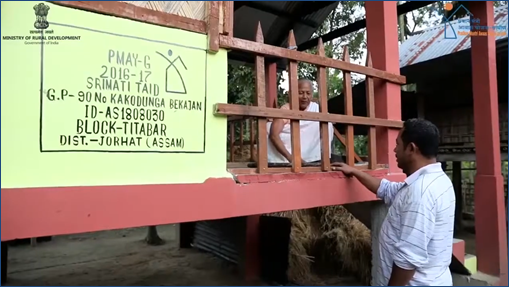
Statistics capture scale, but stories reveal impact. Taid, a widow from Titabor in Assam’s Jorhat district, spent years in a flood-prone area where her fragile dwelling offered little protection. Each monsoon season brought anxiety. The walls trembled, the roof leaked, and uncertainty shadowed daily life.
In 2016–17, her circumstances changed when she received support under PMAY-G. With financial assistance transferred directly into her bank account, she built a permanent home—solid, elevated, and resilient against floods. The transformation was not simply architectural. It restored her sense of stability and security. Her home now stands not as a symbol of charity, but of resilience and rightful entitlement.
Taid’s journey illustrates the deeper objective of PMAY-G: to ensure that even the most vulnerable citizens can anchor their futures in safety. Across states and regions, similar stories unfold—of elderly couples protected from seasonal storms, of children studying under secure roofs, of women gaining recognition as co-owners of property.
The past ten years have demonstrated the scheme’s capacity to deliver at scale without losing administrative coherence. Year after year, PMAY-G has maintained steady completion rates, reflecting institutional continuity across political and bureaucratic cycles.
Crucially, the programme is designed as beneficiary-led. Instead of contractors dominating construction, families themselves take ownership of building their homes. Financial assistance is released in instalments directly into beneficiaries’ bank accounts through Direct Benefit Transfer (DBT). This model reduces leakage, strengthens accountability, and enhances financial inclusion by encouraging bank linkage in rural areas.
Geo-tagging technology further strengthens oversight. At each stage of construction, time- and date-stamped photographs are uploaded, creating a digital audit trail. Local functionaries are assigned to each sanctioned house to provide follow-up support, ensuring that construction adheres to guidelines and timelines. Block-level officers inspect approximately 10 percent of houses at each stage, while district officials examine an additional 2 percent, adding multiple layers of verification.
Annual social audits conducted at the Gram Panchayat level embed community participation into the process. Beneficiaries and villagers collectively review implementation details, fostering transparency and public trust. At the national level, monitors from the Ministry of Rural Development conduct field visits to verify progress and ensure adherence to norms.
All these processes converge on AwaasSoft, a bilingual web-based Management Information System that integrates beneficiary identification, sanction orders, fund release, and monitoring into a single digital platform. The result is a framework that blends decentralised execution with centralised data integrity.
Convergence: From Shelter to Comprehensive Well-Being
One of PMAY-G’s defining features is its seamless integration with other flagship programmes. Beneficiaries receive financial support of ₹12,000 for toilet construction under Swachh Bharat Mission–Gramin, MGNREGA (now rebranded under the Viksit Bharat Guarantee framework), or other dedicated sources. This convergence not only improves sanitation but also reduces health risks and enhances village hygiene standards.
Employment generation is embedded within the housing process itself. Beneficiaries are entitled to 90–95 person-days of unskilled labour wages under MGNREGA, ensuring that construction generates livelihoods while building assets.
Clean cooking energy access through the Pradhan Mantri Ujjwala Yojana reduces reliance on firewood and biomass, improving respiratory health and decreasing drudgery for women. Linkages with Jal Jeevan Mission facilitate piped drinking water connections, while electricity access schemes illuminate homes that once relied on kerosene lamps.
Renewable energy options, including solar lanterns and rooftop systems, introduce sustainability into rural infrastructure. Housing thus becomes a node within a larger web of rural transformation.
A transformative aspect of PMAY-G is its emphasis on registering houses in the name of women or jointly with spouses. This seemingly procedural requirement carries profound implications. Ownership strengthens women’s social standing, enhances security against abandonment or dispossession, and contributes to economic empowerment.
A 2019 study by the National Institute of Public Finance and Policy observed that such measures align with India’s commitments under Sustainable Development Goal 5a, which calls for equal rights to economic resources and property ownership for women. In villages where land titles have historically been male-dominated, PMAY-G subtly but decisively shifts norms.
The expansion of rural housing created a demand for skilled masons capable of ensuring structural integrity and disaster resilience. Recognising this, the programme introduced Rural Mason Training in partnership with the National Skill Development Corporation. As of November 2025, over 3.75 lakh candidates had enrolled, and more than 3.02 lakh masons had been certified.
This intervention accomplishes two goals simultaneously: it enhances the quality of rural housing and generates skilled employment opportunities. The ripple effect extends beyond PMAY-G, strengthening the broader rural construction ecosystem.
Perhaps the most innovative evolution within PMAY-G lies in its adoption of Artificial Intelligence and Machine Learning for monitoring and fraud prevention. AI-based recommendation systems analyse uploaded photographs to identify structural elements—walls, roofs, doors, and windows—before suggesting approval. This reduces subjective bias and ensures that only completed, guideline-compliant houses are marked as finished.
Machine learning models detect anomalies by comparing images within local clusters, flagging potential duplication or fraudulent claims. Aadhaar-based face authentication and e-KYC verify beneficiary identity, while liveliness detection features such as eye-blink recognition prevent impersonation.
The Awaas+ 2024 mobile application further integrates face authentication with innovative 3D house design features developed in collaboration with the Central Building Research Institute. Such digital interventions elevate transparency while minimising administrative friction.
In a country where welfare delivery has historically faced challenges of leakage and ghost beneficiaries, these AI-driven safeguards enhance credibility and public confidence.
Toward 2029: The Promise of Saturation
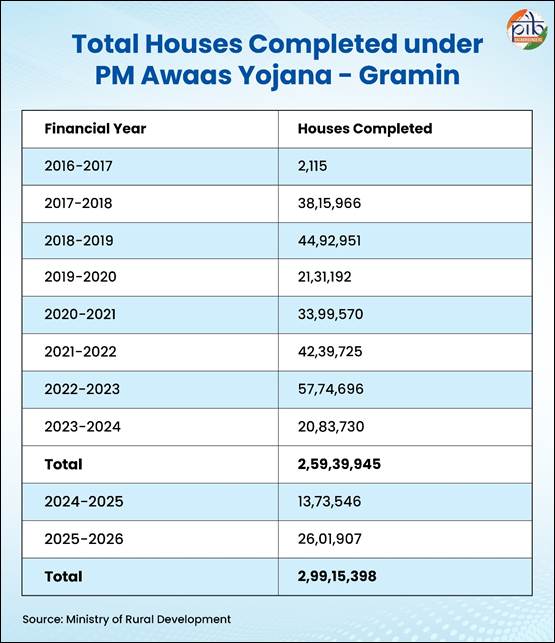
With nearly three crore houses completed and more under construction, PMAY-G has already reshaped India’s rural housing landscape. Yet the journey is unfinished. The cumulative target of 4.95 crore houses by 2029 reflects a commitment to saturation coverage—ensuring that no eligible rural household remains without a permanent home.
The road ahead will demand sustained funding, administrative diligence, and technological innovation. Climate resilience must remain central, especially in flood- and cyclone-prone regions. Continued skill development will be vital to maintain construction quality. Social audits and community engagement must deepen to preserve trust.
However, the momentum achieved thus far suggests that the foundation is strong. The integration of digital governance, direct financial transfer, and local accountability creates a template that other welfare initiatives can emulate.
At its core, PMAY-G redefines housing as a catalyst rather than a commodity. A permanent home stabilises family life, encourages school attendance, supports entrepreneurship, and reduces vulnerability to natural disasters. It fosters dignity—a concept often overlooked in policy discourse but central to human development.
By converging housing with sanitation, water, energy, and livelihood programmes, the scheme acknowledges that development is multidimensional. It does not isolate shelter from its socio-economic context; it embeds it within a broader architecture of empowerment.
The story of PMAY-G is therefore not only about construction targets and fund transfers. It is about reshaping rural India’s social contract. It signals that development must reach the last mile, that transparency must accompany scale, and that dignity must underpin delivery.
As India advances toward its 2029 goal, the transformation unfolding in villages—from Assam’s floodplains to Rajasthan’s deserts—underscores a simple yet powerful truth: when policy aligns with purpose and technology reinforces trust, change becomes tangible.
In countless rural landscapes, new walls now stand where vulnerability once prevailed. Doors close against storms. Lights glow after sunset. Toilets ensure privacy. Kitchens burn clean fuel. And women sign property documents bearing their names.
PMAY-G is building more than houses. It is building confidence—brick by brick, village by village—laying the groundwork for an India where rural aspiration is matched by rural opportunity.

Comments are closed.